
From which stage should the policy‑making process be opened?
The meaning of public comments and inclusion‑ and transparency‑from‑early‑stages
Imagine a situation where a local government listens to citizens’ opinions. Most people will first think of an opinion‑recruitment procedure, that is, a public comment. In fact, the former practice of “listening to opinions” has been built largely on the assumption of public comments. And I think many people, both inside and outside the administration, already feel that this public‑comment process has become a formality. In this article, after organizing the structure of that formality, I would like to consider the significance of opening the policy‑making process from an earlier stage, using two practices in Toyooka City as material.
1. Why are public comments “hard to submit”?
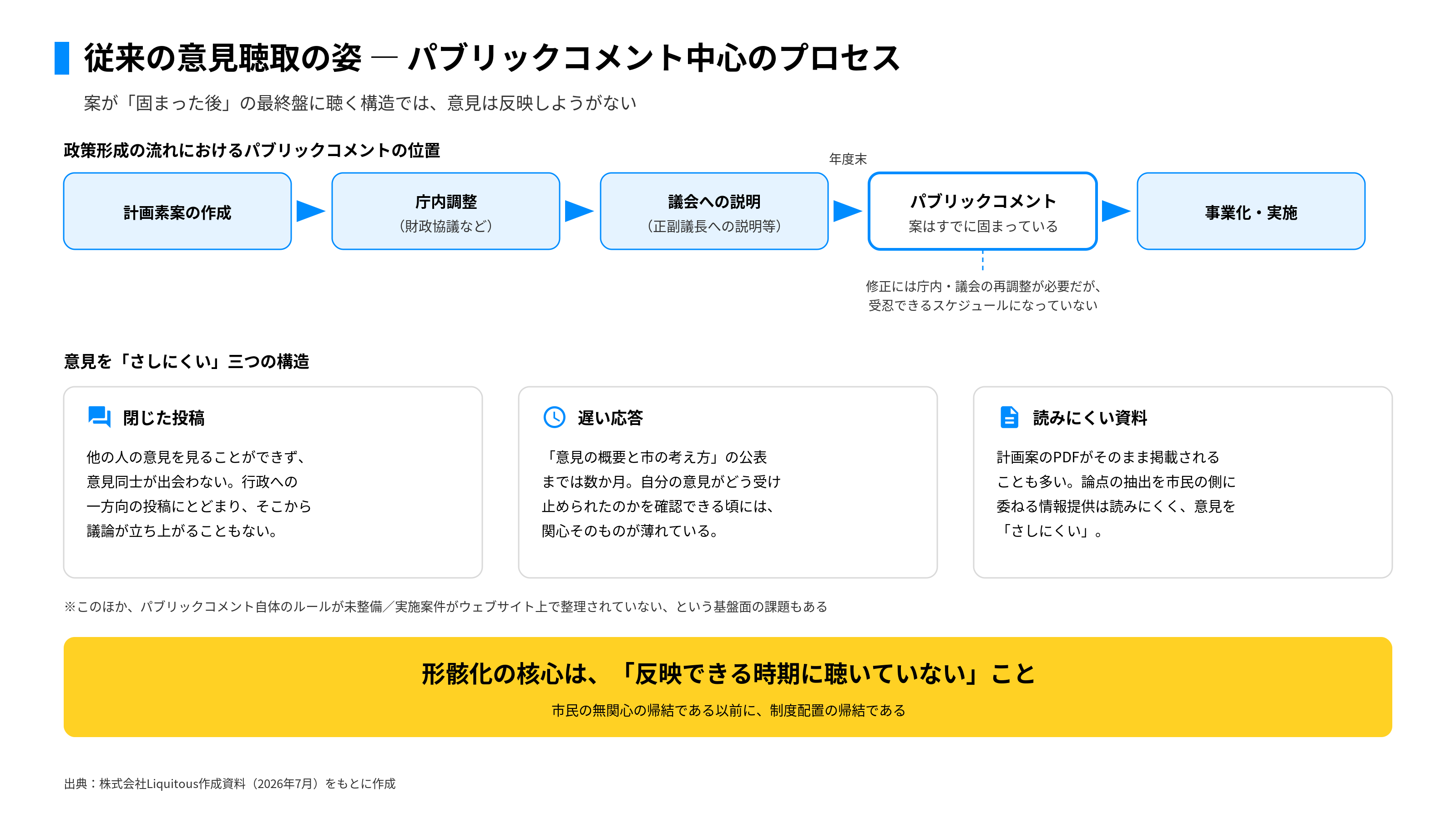
The issue of “formalized public comments” that is often pointed out in public discourse is frequently described from the perspective of phenomena such as “few opinions are gathered” or “the same kinds of opinions keep appearing.” However, I recognize that the “difficulty of submitting” that stems from the very design of the system itself has not been discussed directly enough.
First of all, in a public comment you cannot see other people’s opinions. You have no clue how your view overlaps with or differs from someone else’s, and you simply throw your opinion in one direction toward the administration. Because opinions never meet, no discussion can arise from them.
Responses are also slow. It usually takes several months from submission until the “summary of opinions and the city’s stance” is published. By the time you learn how your opinion was received, your interest has usually already faded.
There are also problems with the way the materials are presented. It is not uncommon for the PDF of the draft plan to be pasted directly as the target of the opinion solicitation. This implicitly asks citizens to read dozens of pages of the draft, extract the issues on their own, and then construct their comments. It is hard to read, therefore it is “hard to submit” comments.
In addition, there are actually many municipalities whose rules for public comments are not sufficiently developed, or whose ongoing projects cannot be listed on a website. Reaching the entry point of the system itself is not easy.
2. The more serious problem is the “timing”
Even if the ease of posting were improved, that alone would not be enough. A deeper issue is the timing of when public comments are carried out.
Most public comments are conducted toward the end of the fiscal year. By that point, typically, the draft plan has already completed internal adjustments, has been discussed with the finance department, and the procedures for explaining it to the council chair and vice‑chair have already been completed. The draft is already solidified within the organization.
What happens if citizens submit opinions that require revisions at this stage? It would require internal readjustments, re‑consultations with related departments, and possibly a re‑explanation to the council. In the schedule leading up to the end of the fiscal year, there is virtually no slack left to absorb those adjustment costs. It is not that the administration lacks the will to listen; the structure makes it listen at a timing when there is no possibility of reflecting the input.
Therefore, public comment becoming an empty formality is, before it is a consequence of citizen apathy, a consequence of an institutional arrangement that does not listen while there is still time to incorporate the input. Without addressing this, attempts to increase participation through stronger publicity or improved forms will fail to reach the core issue.
[Figure 1 Structural issues inherent in the traditional public‑comment‑centric opinion‑gathering approach]
3. Opening the process from an earlier stage
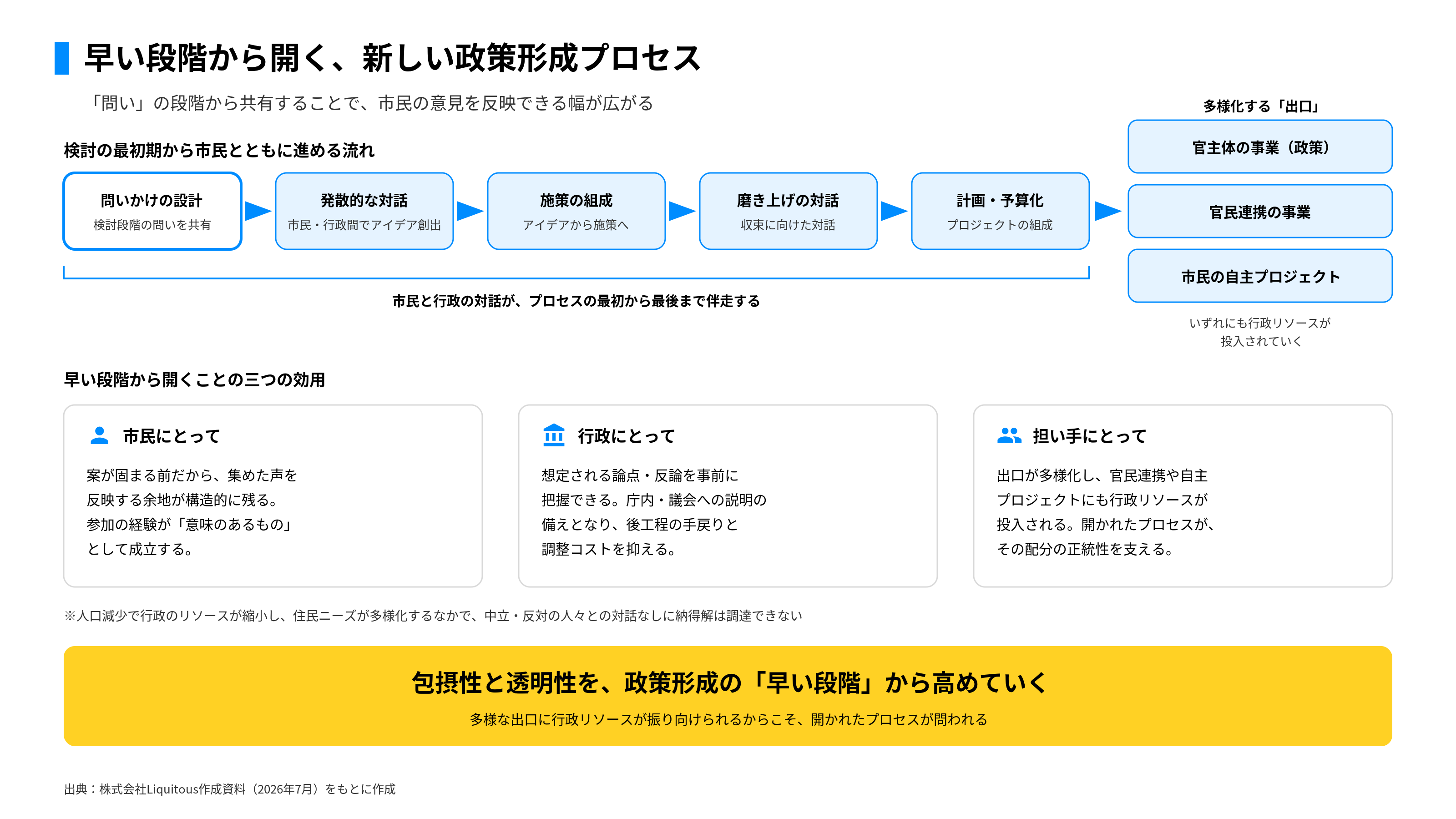
So, what should be done? What we have consistently considered important is to open the policy‑making process from an earlier stage. Instead of asking for opinions after a draft has been fixed, share with citizens the very “questions” that are being considered. Publish the information that will become the material for deliberation. Raise the inclusiveness and transparency of the policy‑creation process from an early stage.
If you open it early, there remains room to incorporate the collected voices. The lack of a substantive response—“we listened, but could not incorporate it”— quietly builds distrust in participation. Listening while there is still room for reflection can be called the minimum condition for making the participation experience meaningful.
There are also benefits for the administration. If officials encounter citizens’ voices at an early stage of deliberation, they can grasp what issues and counter‑arguments may arise before they have to explain the policy to internal units or the council. Early‑stage opinion gathering should be repositioned not as a “burden‑adding” activity but as an investment that reduces rework and coordination costs in later stages.
Behind this premise lies a larger structural change. As I noted in my earlier essay “When Will Local Governments Stop Being ‘Answer‑Holders’?”, administrative resources do not expand amid population decline; rather, they must shrink. At the same time, residents’ administrative needs are becoming more diverse, and it is no longer realistic to expect every initiative to be accepted from the start.
It is not only the entry point of policies that is changing; the exits are diversifying as well. The way the outcomes of deliberations reach society is no longer limited to projects directly carried out by the administration. There are public‑private partnership projects, and there are also projects initiated by citizens or the private sector that the administration supports. In every exit, administrative resources such as budgets and staff are invested. The more actors and forms of collaboration increase, the more the process leading to the decision is questioned: who was it opened to and how? Because exits are diversifying, transparency and inclusiveness of the process become the foundation that supports the legitimacy of resource allocation.
If that is the case, we must actively reach out to neutral parties on a theme, as well as to those who oppose it, engage in dialogue, articulate what they are seeking, share that understanding, and encourage mutual shifts in perception. Without this ongoing activity, a consensual solution cannot be cultivated. And that cannot be achieved by a one‑off procedure such as a single public comment. That is why opening the policy‑making process early and enhancing its inclusiveness and transparency is essential.
[Figure 2 The shape of a policy‑making process opened from an early stage]
4. Two practices in Toyooka City
As an example of putting this idea into practice, I would like to introduce two initiatives that Toyooka City carried out on “Civic Toyooka” (the citizen‑participation consensus‑building platform for Toyooka City that we provide based on Liqlid).
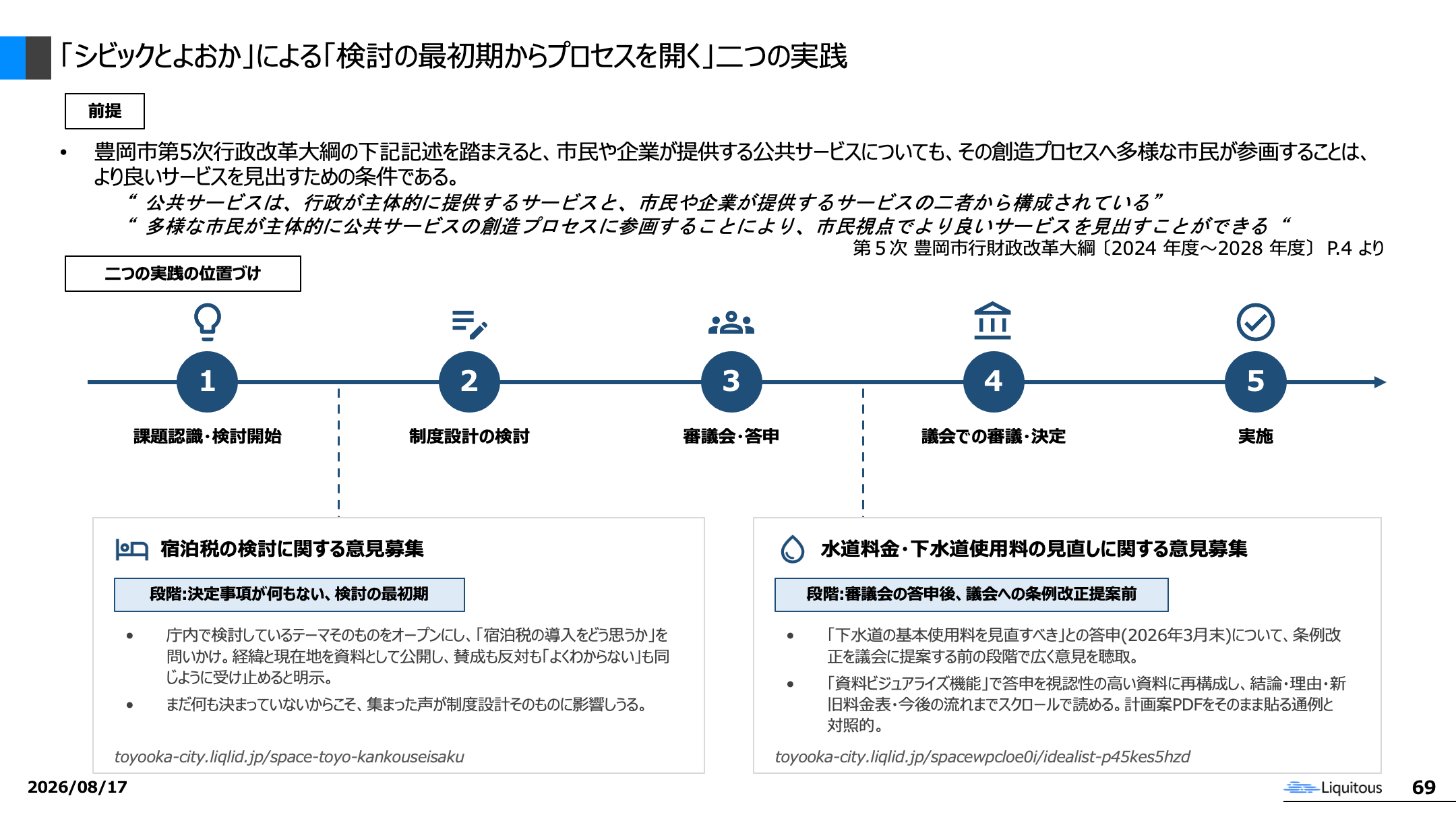
The first is an opinion solicitation on the consideration of a lodging tax. Toyooka City is at the stage of examining the introduction of a lodging tax as a self‑financing source for tourism promotion, that is, before the details of the system are fixed and before any decisions have been made. The city opened the very theme under internal discussion, asking citizens “what do you think about introducing a lodging tax in Toyooka?” After publishing the background and current status as material, the city explicitly accepted both support, opposition, and “I don’t know” as valid responses and solicited opinions. Because nothing has been decided yet, the collected voices can actually influence the design of the system. This is a practice that opened the process from the very early stage of deliberation.
The second is the Call for Opinions on Revising Water Rates and Sewerage Fees. In Toyooka City, at the end of March this year, the Public Enterprise Council issued a recommendation that the basic sewerage fee should be revised. Regarding this recommendation, before proposing an ordinance amendment to the council, the city used Liqlid’s “document visualisation function” to restructure the recommendation’s content into highly readable materials, and solicited wide public opinion through Civic Toyooka.
Providing information that allows readers to scroll through the recommendation’s conclusions, reasons for revision, old and new fee tables, and the future process contrasts with the usual practice of simply attaching a PDF of the plan.
[Figure 3: Left side shows information provision within Civic Toyooka, right side shows posts actually submitted to Civic Toyooka]
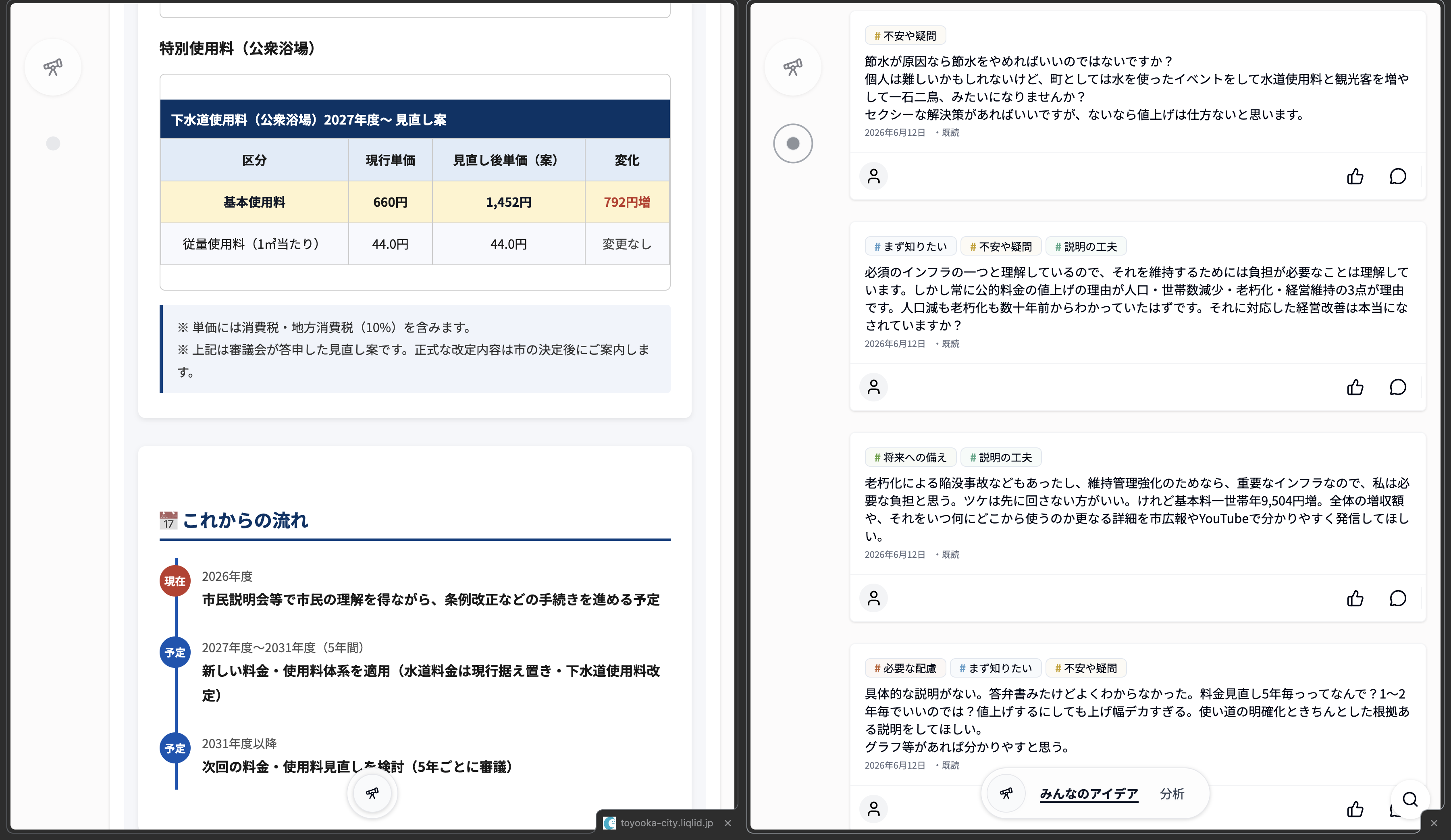
I would like to delve a bit deeper into this second example. Since the subject is a fee increase, if it had been carried out as a conventional public comment, the majority of opinions would probably have expressed strong opposition. For the record, the emergence of opposing opinions is not inherently bad. The problem is that only the strong opinions become visible, while other diverse points—such as questions about the burden, requests for managerial efficiency, or demands for better information dissemination—remain absent from the discussion.
In the practice of “Civic Toyooka,” making the information easier to view and lowering the barrier to posting has resulted in submissions that include a wider range of issues. It likely also reaches the silent majority who normally do not speak up. Receiving diverse viewpoints not at the final stage but in the middle of the policy‑making process not only adds depth to the policy but also increases the chance of incorporating voices of people whose views differ from the direction the city is pursuing. This process is what enhances the inclusiveness and transparency of policy formation.
5. Future Outlook
It goes without saying that opening the process early means, for the administration, “showing something that is not yet finalized,” which brings psychological resistance within the agency. There is a certain rationality to the cautious view of publishing information under consideration, and the boundaries of what and how much to disclose need to be carefully designed for each theme. Moreover, unless a mechanism is put in place to trace how the early‑heard voices are reflected in subsequent deliberations, it could lead to a new form of tokenism—“listen early” without impact.
Nevertheless, isn’t it fair to say that the direction we should aim for is clear? Of course, this is not a call to abolish public comments.
Place a stage before the final‑stage public comment in which questions are shared, information is opened, and dialogue is repeated. Designing the placement of participation depth at each stage of the policy cycle is the key to moving beyond the tokenism of opinion gathering.
As a communication agent between citizens and government, we would like to advance the design of this placement together with municipalities that share our vision.
Main reference information
Civic Toyooka “Please share your opinions on introducing a ‘lodging tax’ in Toyooka City!”
https://toyooka-city.liqlid.jp/space-toyo-kankouseisakuCivic Toyooka “What will happen to Toyooka City’s water rates and sewerage fees?”
https://toyooka-city.liqlid.jp/spacewpcloe0iLisearch “How quickly should the results of citizen participation be returned?”
https://liquitous.com/lisearch/article/26072002
(Author: Liquitous Inc., CEO Hiroyuki Kurimoto)
Note: This article reflects the author’s impressions based on publicly available information and does not represent the views of the municipalities mentioned.