
How quickly should the results of citizen participation be returned?
Delegation of Authority and the Speed of Feedback: A Case Study of Nagaokakyo City's 'Machi-Katsu Contest'
When measuring the quality of citizen participation, we often use the number of participants or the depth of deliberation as metrics. In this article, we examine a different metric that has rarely been discussed: how quickly the results of participation are returned to the participants themselves, that is, the speed of feedback.
The material for this discussion is the citizen voting component of the 'Machi-Katsu Contest,' a program launched by Nagaokakyo City, Kyoto Prefecture, in fiscal year 2026, with which our company is collaborating. This mechanism involves the additional disbursement of subsidies for citizen activities. When read as an institutional design for citizen participation, it contains several points worthy of consideration.
1. Overview of the Case - Deciding the 'Add-on' Subsidy via Citizen Vote
Nagaokakyo City has the 'Machi-Katsu Subsidy for Building a Future for Everyone,' which supports public-interest projects by citizen activity groups. It consists of the 'Tane Maku Course' (for projects within three years of launch, capped at 100,000 yen) and the 'Hana Saku Course' (for ongoing projects, capped at 300,000 yen). Approval is determined by a review committee of experts well-versed in citizen activities, based on written reviews and presentations. In fiscal year 2026, following a review committee meeting on June 20, a total of 13 projects were approved across both courses.
What was added starting in fiscal year 2026 is the mechanism that follows. For approved projects that wish to participate, the project overview is published on the city's citizen participation and consensus-building platform, 'Voice NAGAOKAKYO' (Nagaokakyo City's platform, based on Liqlid provided by our company), and a citizen vote is conducted.
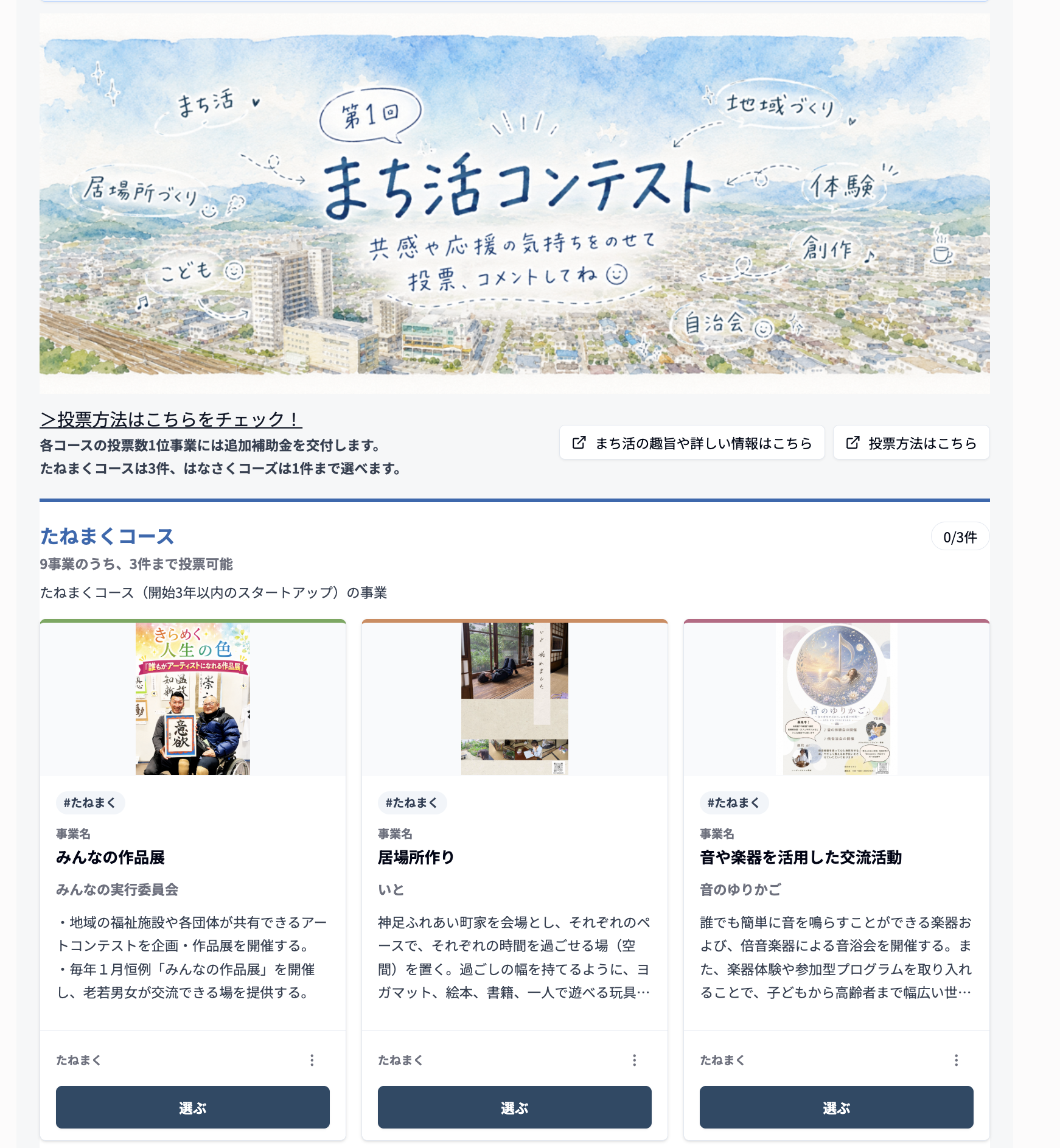
The project that receives the most votes in each course is granted an additional 50,000 yen, not exceeding the eligible expenses at the time of approval. Along with voting, citizens can also send messages of support to each group.
What deserves attention is the distribution of authority in this system. The decision on which projects to approve is still made by the expert review committee, as before; the citizen vote only determines the destination of the additional disbursement after approval. This system can be understood as one that maintains existing controls—namely, expert review and accountability for public expenditure—while establishing a new domain outside of them where citizen votes directly determine the allocation of public funds.
2. Comparing with the IAP2 Spectrum
As a framework for measuring the depth of citizen participation, the 'Spectrum of Participation' by the International Association for Public Participation (IAP2) is frequently referenced. It follows the lineage of the 'Ladder of Participation' presented by American sociologist Sherry Arnstein in 1969, organizing the relationship between the administration and citizens into five stages: inform, consult, involve, collaborate, and empower. As the stages rise, the influence of citizens' opinions on decision-making increases; at the highest stage of empowerment, the decision itself is entrusted to the citizens.
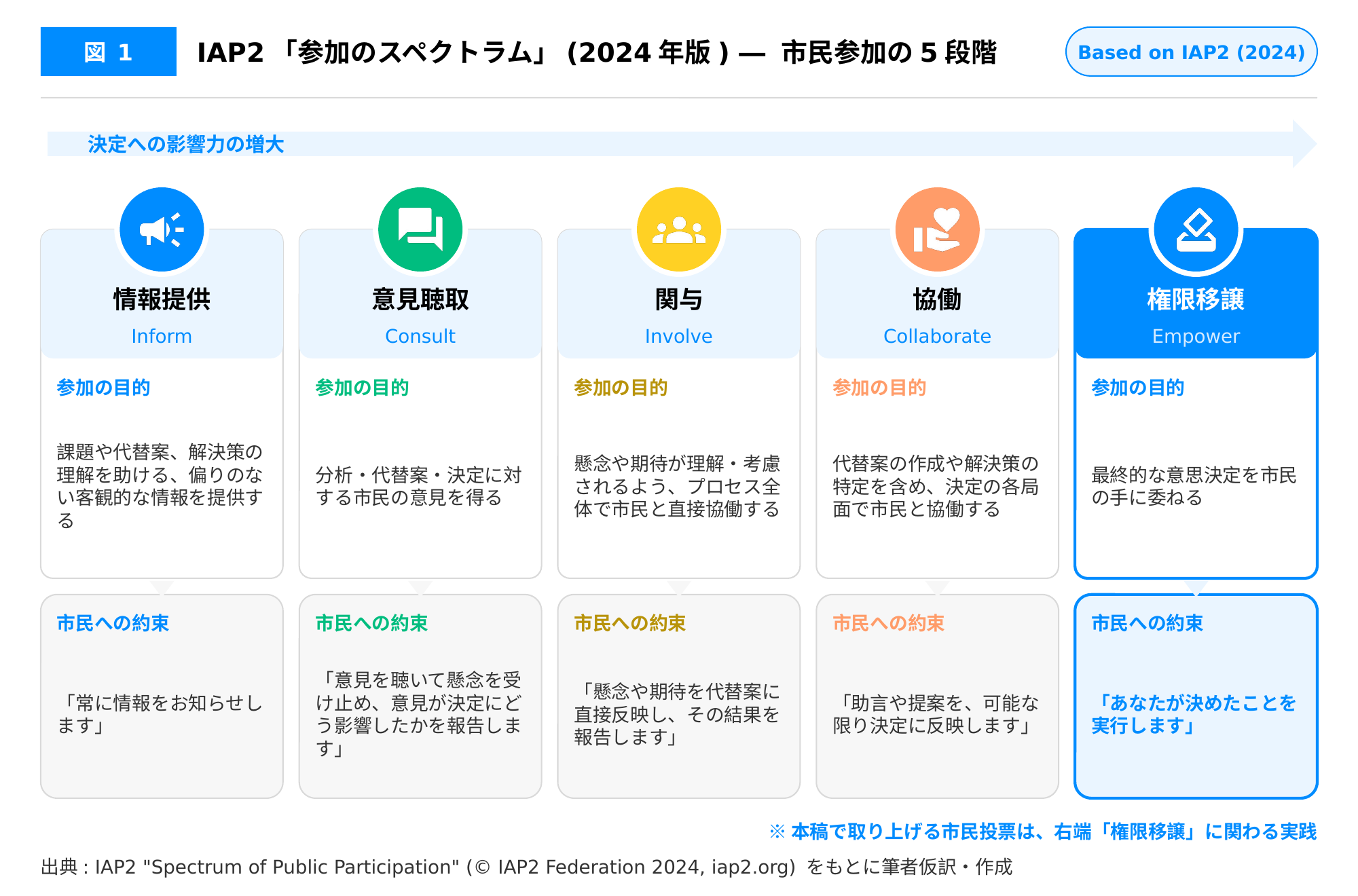
In light of this framework, it can be said that citizen participation practices in Japanese local governments have heavily concentrated at the consultation stage. Methods such as public comment procedures, advisory committees, questionnaires, and workshops all share the structure of 'listen first, then the administration decides.' While practices of involvement and collaboration are increasing, there are few cases of empowerment that entrust decisions to citizens. There is significant institutional and psychological resistance to entrusting decisions, and the question of who bears responsibility in case of failure tends to arise at the early stages of consideration.
It is worth noting here that this spectrum is not irrelevant to our company either. Liqlid explicitly references these five stages as the core of its product design, mapping features such as blogs and notifications to informing, idea submissions and reactions to consulting, and projects and voting to reflecting opinions. On the other hand, for the top two stages of co-decision and empowerment, it states that it 'depends on the method of operation' rather than listing corresponding features. What platform features can guarantee is only up to the middle stages; whether one can reach the higher stages depends not on the features themselves, but on the operational design of how those features are connected to institutions. We have stated this clearly on the product side as well.
The Machi-Katsu Contest can also be read as an example of this 'operational design.' The voting function on Voice NAGAOKAKYO is often used at the opinion-reflection stage in other contexts, but here it is connected to the institution of deciding the additional disbursement. What is entrusted to the citizen vote is not the approval or rejection of projects, but the destination of the additional disbursement, and the amount is 50,000 yen. It is natural to view this as a small step for empowerment, and it is not within the author's knowledge whether the city designed this system with a framework like the spectrum in mind. However, it is certain that this is a mechanism where citizen votes directly connect to the allocation of public funds. The scale is set so that both the administration and citizens can accumulate the experience of entrusting and being entrusted with decisions under small risks. The author finds significance in this point.
3. Considering the Utility of Empowerment from the 'Speed of Feedback'
The significance of empowerment is usually discussed from normative perspectives such as democratic legitimacy and the cultivation of citizen agency. While acknowledging this significance, this article focuses on a more practical utility: empowerment structurally speeds up feedback for participation.
It is useful to trace consultation-type participation chronologically from the perspective of the participating citizen. If you submit an opinion via public comment, a 'Summary of Opinions and the City's View' is published months later. Even if the opinion is reflected in the plan, it takes years for the plan to become a project and for the project's effects to appear in the community. The period before citizens can confirm whether their participation changed anything often spans years, and in many cases, it ends without it being clear whether anything changed at all.
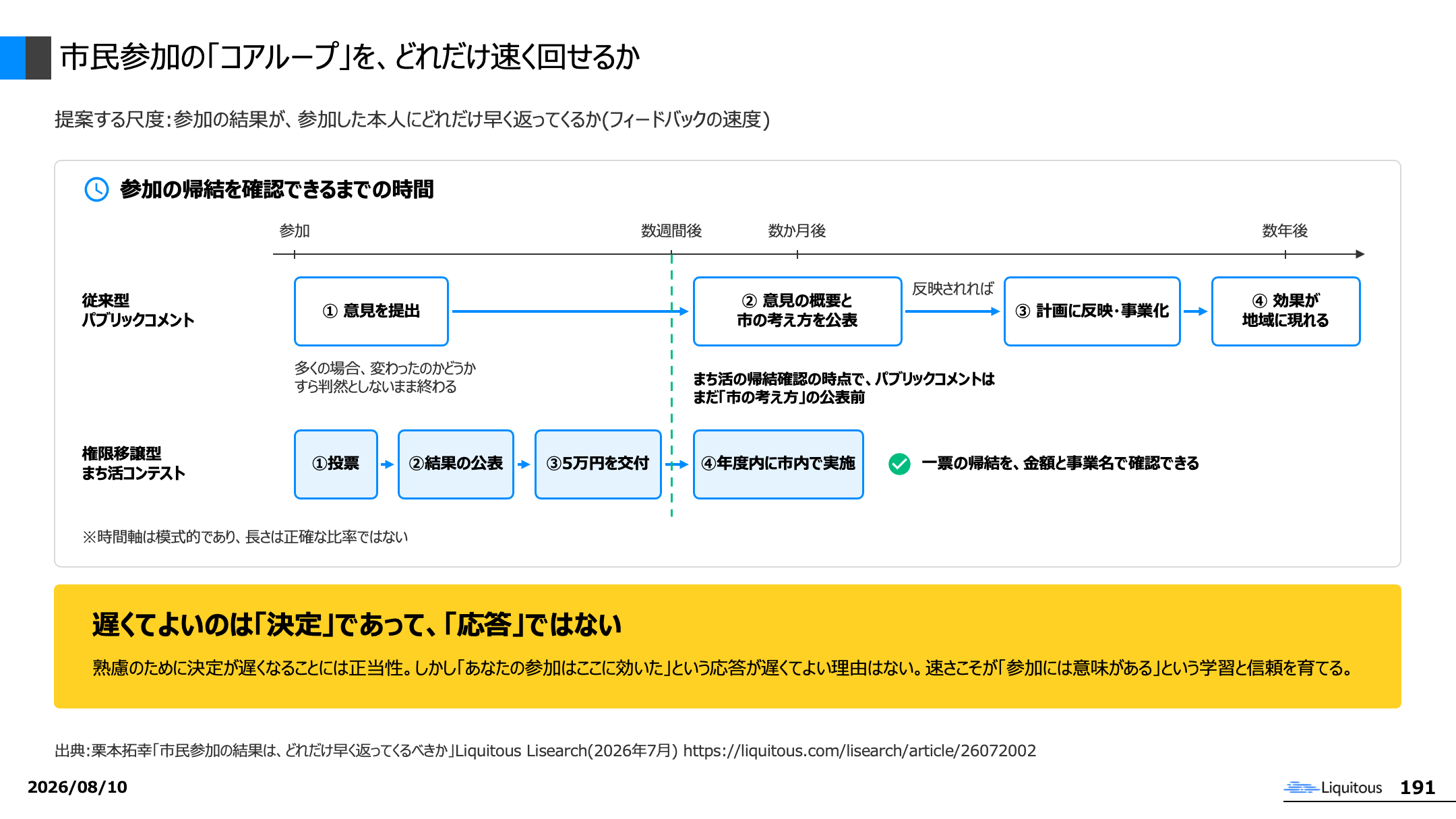
In the Machi-Katsu Contest, this period is completed in a few weeks. Citizens vote, the results are published, 50,000 yen is disbursed to the selected project, and the project is implemented within the city within the fiscal year. Citizens can confirm what their single vote changed through specific amounts and project names.
The significance of this difference becomes even greater when considered alongside the modern information environment. We live in an environment where videos of a few dozen seconds are standard content and a reply to a message is considered slow if it takes a few hours. We should sound an alarm about this sense of speed itself. Policy requires time for deliberation, and if speed is used as the measure of democracy, deliberation will wither. However, at the same time, we must face the fact that a generation raised within this sense of speed already occupies a considerable part of society. The administrative sense of time—months from opinion submission to response, years to confirm effects—is perceived by this generation not as a manifestation of care, but simply as an absence of response.
What needs to be distinguished here are the time required for a decision and the time required for a response. There is legitimacy in a decision being delayed for the sake of deliberation. However, there is no justification at all for a delay in responding to participating citizens—that is, in presenting a verifiable outcome that “your participation had an effect.” A slow feedback is not evidence of deliberation; in most cases it is merely the consequence of a system that was not designed that way. Experiences of participation without response build distrust in participation, whereas experiences of rapid response create the learning that “participation matters.” This learning becomes the trust foundation that supports deeper future participation. Even if this cycle does not start immediately at the scale of the Machikatsu Contest, the design direction can be read as aiming for such a cycle.
4. Participation is not limited to the planning stage
The Machikatsu Contest also brings out another issue: the problem of the “stage” at which participation is placed.
In Japan, citizen participation is institutionalised overwhelmingly at the planning stage. The public comment procedures and deliberative councils carried out when drafting comprehensive plans, individual plans, or reviewing draft ordinances are basically designed as participation in “things that will be decided in the future.” Yet the policy process includes formulation, decision, implementation, and evaluation. The citizen vote in the Machikatsu Contest is positioned at a stage that has traditionally received almost no participation touchpoints: after the adoption decision and before project implementation. Citizens are not judging “what the town should do,” but rather which of the already‑approved concrete projects to give additional support to.
Participation at this stage differs in nature from participation at the planning stage. The subject matter is concrete, and the consequences of the judgment appear quickly. The burden on participants is far smaller than taking on a seat on a deliberative council. From the perspective of organisations, votes and supportive messages serve both as encouragement for their activities and as material to gauge how their projects are perceived locally. For the administration, it provides information about which fields attract citizen interest. The roles differ, so one does not replace the other. The question is at which point in the policy cycle, and with what depth and speed, participation should be placed. Examining this placement is the core of participation system design.
5. Reservations and Outlook
A few reservations should also be noted. Because this is a vote, well‑known organisations may have an advantage, and if the size or attributes of the voting participants are skewed, the legitimacy of the result could be affected. Moreover, the additional‑grant framework, when viewed from the opposite side, means that the ultimate decision‑making authority still resides with the administration and experts. Whether this system will function as an entry point for power‑devolution or remain merely an entry point will depend on future operation and evaluation.
Nevertheless, the design that keeps the existing review mechanism while creating a small area outside it where citizens make direct decisions, and that shortens the period from participation to outcome to a few weeks, demonstrates a model for advancing power‑devolution not as a single decisive act but as a step‑by‑step institutional adjustment. It is a case worth referencing for local governments that are considering deepening citizen participation.
(Authorship: Liquitous Inc., CEO Hiroyuki Kurimoto)
Note: This article expresses the author’s impressions based on publicly available information and does not represent the views of the municipalities mentioned herein.
Main reference information
Nagaokakyo City “Machikatsu Grant for Building Everyone’s Future” (including the system overview of the citizen vote) https://www.city.nagaokakyo.lg.jp/0000000107.html
Nagaokakyo City “Results of the 2026 Machikatsu Grant Selection & Review Committee Minutes” https://www.city.nagaokakyo.lg.jp/0000015961.html
Voice NAGAOKAKYO “Machikatsu Contest Citizen Vote” https://nagaokakyo-city.liqlid.jp/spacemachikatsu/structured-vote-contest
Nagaokakyo City “Citizen‑participation Online Consensus‑building Platform ‘Voice NAGAOKAKYO’ Launches!” (Nov 2024) https://www.city.nagaokakyo.lg.jp/0000014599.html
IAP2 "Spectrum of Public Participation"
https://cdn.ymaws.com/www.iap2.org/resource/resmgr/pillars/iap2_spectrum_2024.pdfLiqlid product page (mapping of citizen‑participation spectrum to functions) https://liquitous.com/liqlid
Arnstein, S. R. (1969) "A Ladder of Citizen Participation", Journal of the American Institute of Planners, 35(4)