
Municipal Management and Effectuation
"Designing" Unplannedness
In the previous column "Beyond the Buzzword: ‘Co‑creation’", the author positioned co‑creation between citizens and administration not as an ideal, but as a technique of economic rationality to suppress rework and lower the total cost of decision‑making. This article, as a sequel, introduces one theoretical support line that underpins this practical sense: effectuation in the field of management studies. The author feels that this way of thinking is becoming essential for municipal management.
1. What is Effectuation? — Starting from "what you have" rather than from "prediction"
The practice of municipal management has long been built on the premise of "prediction". Future population is projected, an ideal state ten years ahead is envisioned, and policies and resources are allocated by working backwards from that vision. This approach, exemplified by comprehensive plans, can be described as grounded in causation (the reverse‑engineering of means from a predetermined purpose) in management theory.
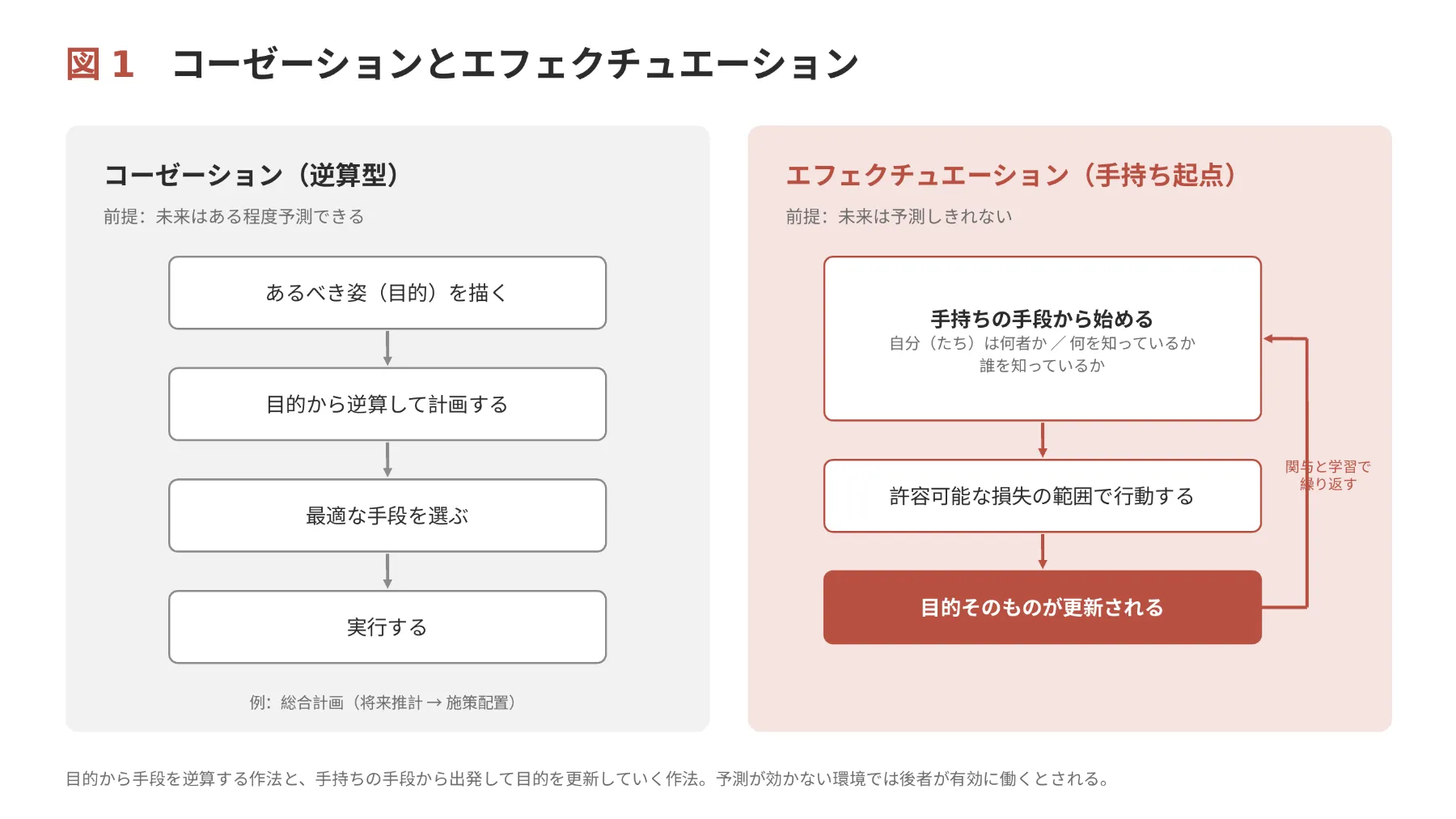
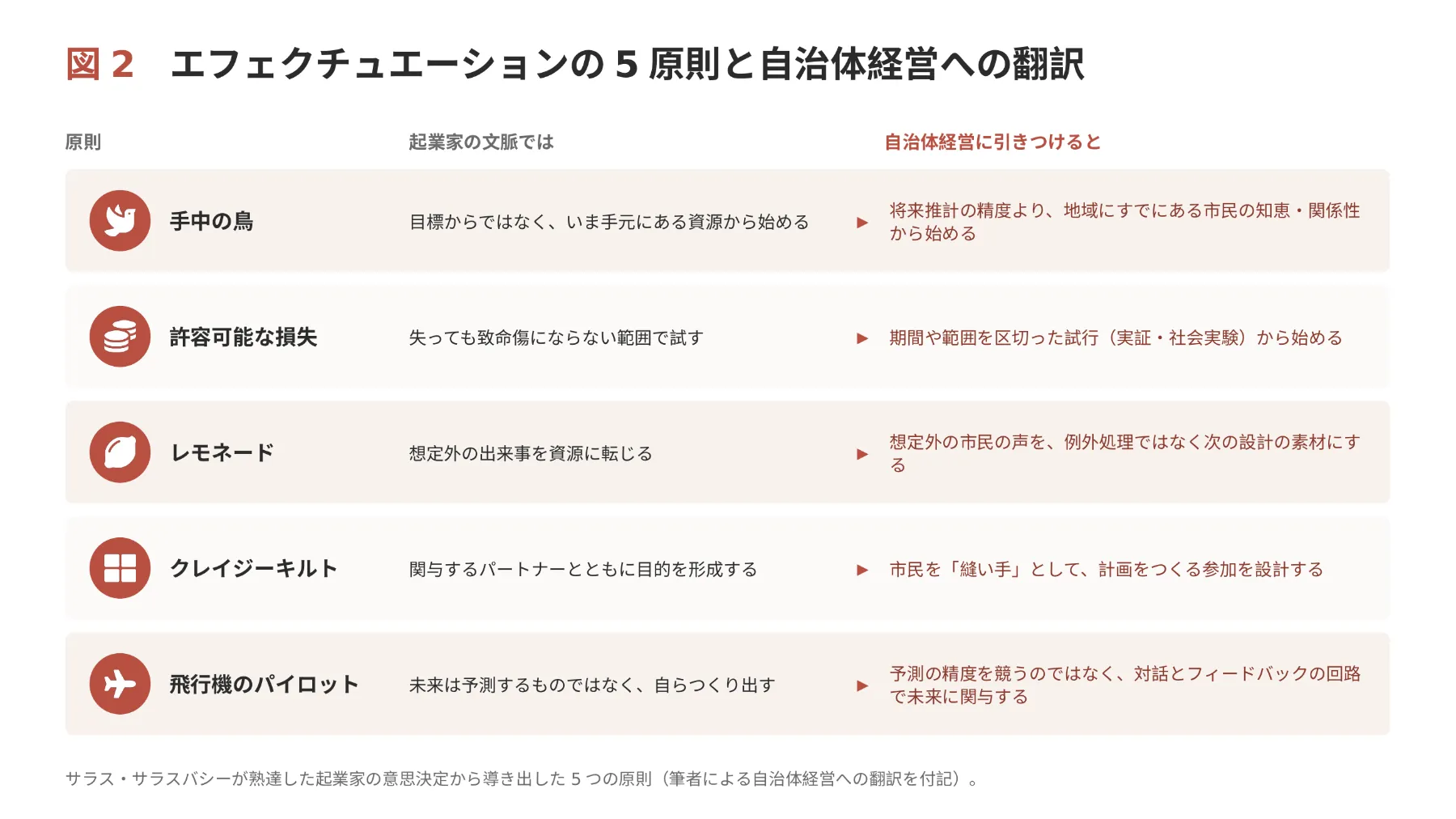
In contrast, effectuation is a decision‑making mindset derived by management scholar Saras Sarasvathy from analyses of skilled entrepreneurs. Instead of working backwards from a goal, it starts from the means at hand—"who you are", "what you know", "who you know"—and updates the goal itself through action. Sarasvathy organizes this into five principles: the "bird in hand" (starting from available resources), "affordable loss" (testing within a range that won’t cause fatal damage), "lemonade" (turning unexpected events into resources), "crazy‑quilt" (co‑creating the purpose with partners), and the "pilot in the plane" (viewing the future as something you create rather than predict).
It is natural to wonder why a theory of entrepreneurs would apply to municipalities. Effectuation is said to work best in environments where the future cannot be predicted and markets or customers do not yet exist. As demographic shifts exceed forecast ranges and disasters or pandemics arrive without waiting for plan‑revision cycles, is the environment facing municipalities today not approaching precisely those conditions?
2. Municipal Management as a Crazy‑Quilt — Citizens are "sewers" rather than "spectators"
Among the five principles, the one to highlight is the "crazy‑quilt". A crazy‑quilt is not assembled by first deciding on a finished pattern and then gathering fabrics; instead, it is created by stitching together assorted scraps, allowing the pattern itself to emerge. In effectuation, the purpose of a venture is not solely drawn by the entrepreneur; it evolves as more partners, who are committed, become involved.
Applying this metaphor to municipalities changes how citizen participation is viewed. Traditionally, most citizen participation has been designed as "participation in a plan"—the administration asks for opinions on a blueprint it has already drawn. In the previous article, the author wrote that co‑creation becomes hollow when the administration prepares the stage and asks stakeholders to "join in". The problem with this configuration is, more than a problem of attitude, a problem of structure. As long as a finished picture exists beforehand, citizen involvement is structurally unlikely to shift the skeleton of the plan, and that is precisely why a sense of futility and distrust remain.
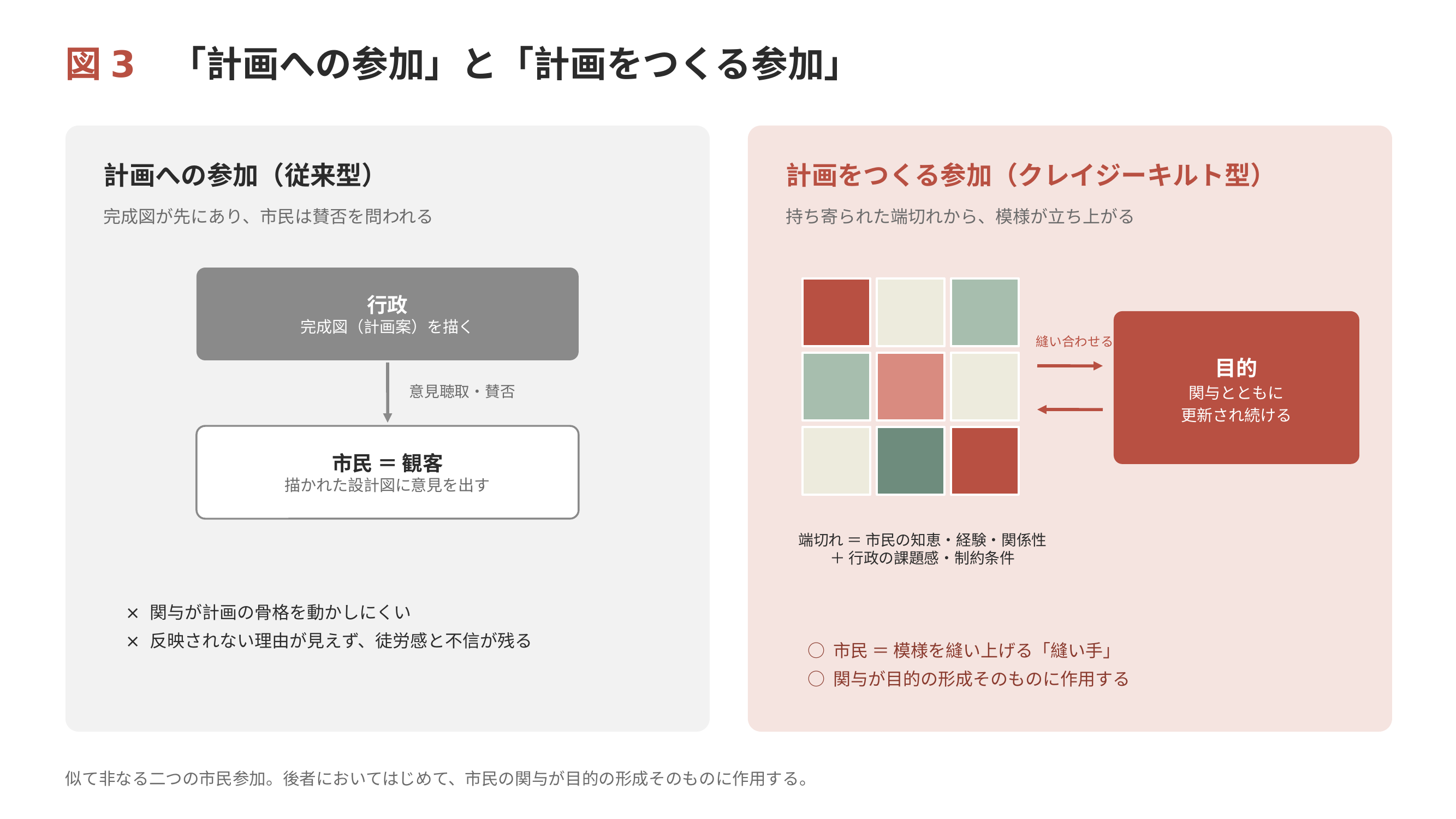
From the crazy‑quilt perspective, citizens are not spectators asked to approve or reject a finished design; they become "sewers" who bring scraps—local knowledge, experience, and relationships—into the stitching. "Participation in a plan" and "participation in making the plan" are similar yet distinct, and only the latter allows citizen involvement to shape the very formation of the purpose. In an unpredictable environment, a municipality's greatest managerial asset is not the precision of future forecasts but the existing wisdom and relationships of its citizens—the "bird in hand". If so, citizen participation is not a decorative element of management nor merely a cost of consensus‑building; it is a core managerial technique for navigating uncertainty.
3. "Designing" Unplannedness
Here I would like to introduce a phrase that has stayed with me: "designing unplannedness".
This phrase was highlighted during multiple meetings of a "Future Co‑creation Team" composed of young people with ties to Kyoto, when I was supporting the formulation of Kyoto’s "Kyoto Basic Concept".
Effectuation can be mistakenly taken as an endorsement of no planning at all. In reality, it is the opposite: it acknowledges the fact that "the future cannot be fully planned" and, rather than leaving the un‑planable parts unattended, it deliberately designs a circuit that allows the purpose to be continuously updated. Set time frames, test within ranges that won’t cause fatal loss, treat unexpected voices gathered during trials not as exceptions but as material for the next design, and embed dialogue and feedback loops into the process from the outset. Having no plan and having a plan that anticipates what cannot be planned are entirely different things.
For example, the trial to shorten office hours in Toyooka City and the accompanying online platform "Civic Toyooka" for gathering citizen opinions, which I introduced in the previous article, can also be read through this lens. Instead of deciding solely on desk‑based forecasts or endlessly postponing decisions through debate, the city set a limited period for trial, captured user experiences on the platform, and used those insights as material for the next operational design. The practice of "decide after trying" is precisely a designed unplannedness—effectuation in action, probing the future within the bounds of affordable loss.
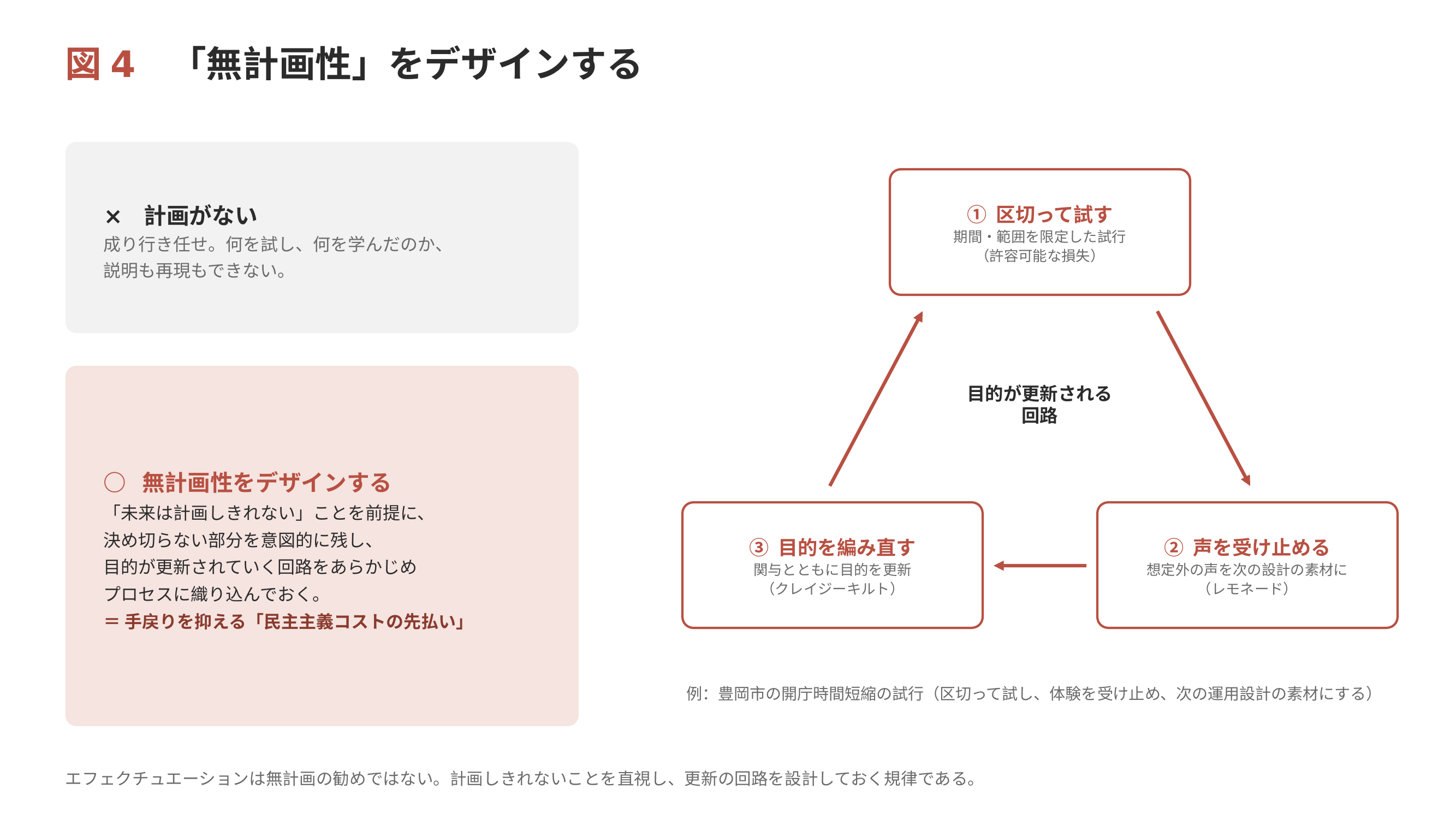
To avoid misunderstanding, this does not mean discarding reverse‑engineered activities like comprehensive plans. Where prediction works, reverse engineering remains effective. The question is how to use the two approaches appropriately, and whether it is rational to keep applying the "decide then listen" practice even in domains where prediction fails. Reversing decisions after they have been set is costly. Therefore, intentionally leaving some aspects undecided and weaving citizen dialogue into those gaps can be seen as highly rational.
4. Conclusion — Citizen Participation as a Management Technique for an Age of Uncertainty
Borrowing the term effectuation is useful because it gives a name and a blueprint to what savvy municipalities have already been doing: deciding while testing, and nurturing the purpose together with those involved.
With a name, explanations can be given within the administration, shared with the council, and reproduced elsewhere. In an era where predictability is waning, relying solely on reverse‑engineering from an ideal vision becomes risky. Starting from the resources at hand—especially citizens’ wisdom and relationships—and stitching the purpose together with them, the author sees great significance in the "design of unplannedness".