De‑buzzwording “co‑creation”: Why we promote citizen‑government co‑creation from an economic rationality perspective
Citizen‑government co‑creation is a technique for lowering “decision‑making costs”
When I think about local autonomy, I sometimes return to Article 1 of the Local Autonomy Law. Article 1 states that local public administration should be “democratic and efficient.” From this ordering I have drawn a major insight. Needless to say, efficiency is important. However, if we pursue efficiency alone, the question of why administration exists remains, and guaranteeing democracy is not a mere add‑on but a condition that touches the very legitimacy of administration.
In recent years, discussions around DX and administrative reform have strongly emphasized efficiency. Processing time, waiting time, cost, standardisation, online‑isation/DX – improvements that can be described with these metrics are easy to advance and to explain. On the other hand, whether administration (policies) is democratic – that is, “upon whose consent, through what procedures, what is prioritised and what is sacrificed” – cannot be answered by efficiency arguments alone. In fact, if efficiency is pursued while leaving this question vague, backlash later erupts, eating up time for explanation and coordination, and ultimately even efficiency is damaged.
From the end of 2025 to the beginning of 2026, various reports were released on infrastructure maintenance and decentralisation. In addition, the next Local System Study Committee is being asked to examine the division of administrative service roles between wide‑area and basic‑level governments. In such a context, not only the efficiency‑driven administrative reforms that have dominated so far but also a new wave of reform that re‑examines “democracy” is becoming increasingly necessary. The “democracy” I refer to here is not a lofty celebration of democratic ideals. It is a very practical effort to secure decision‑making stability and curb rework costs – in other words, to prevent rework and lower the total cost of administration. Therefore, I see citizen‑government co‑creation not as an idealistic notion but as a “technology” that should be repositioned as a means of pursuing economic rationality.
Different “necessities” for co‑creation in cities and regions
The need for co‑creation varies in intensity between urban and rural areas. In regional areas, local governments – one of the main providers of public services – face personnel and fiscal constraints, and surplus capacity tends to disappear before existing projects can be fully scrapped. At the same time, private providers of public services such as transport and infrastructure often have to reconsider their service models because of market failures or a shortage of operators. Consequently, a “gap” emerges that neither the public nor the private sector can fully fill.
At this point co‑creation is not merely desirable; it is a “must‑have” to fill the gap and ensure the sustainability of the whole public‑service system. In other words, under these circumstances co‑creation is the means by which Japan’s various regions can continue to provide public services sustainably over the long term.
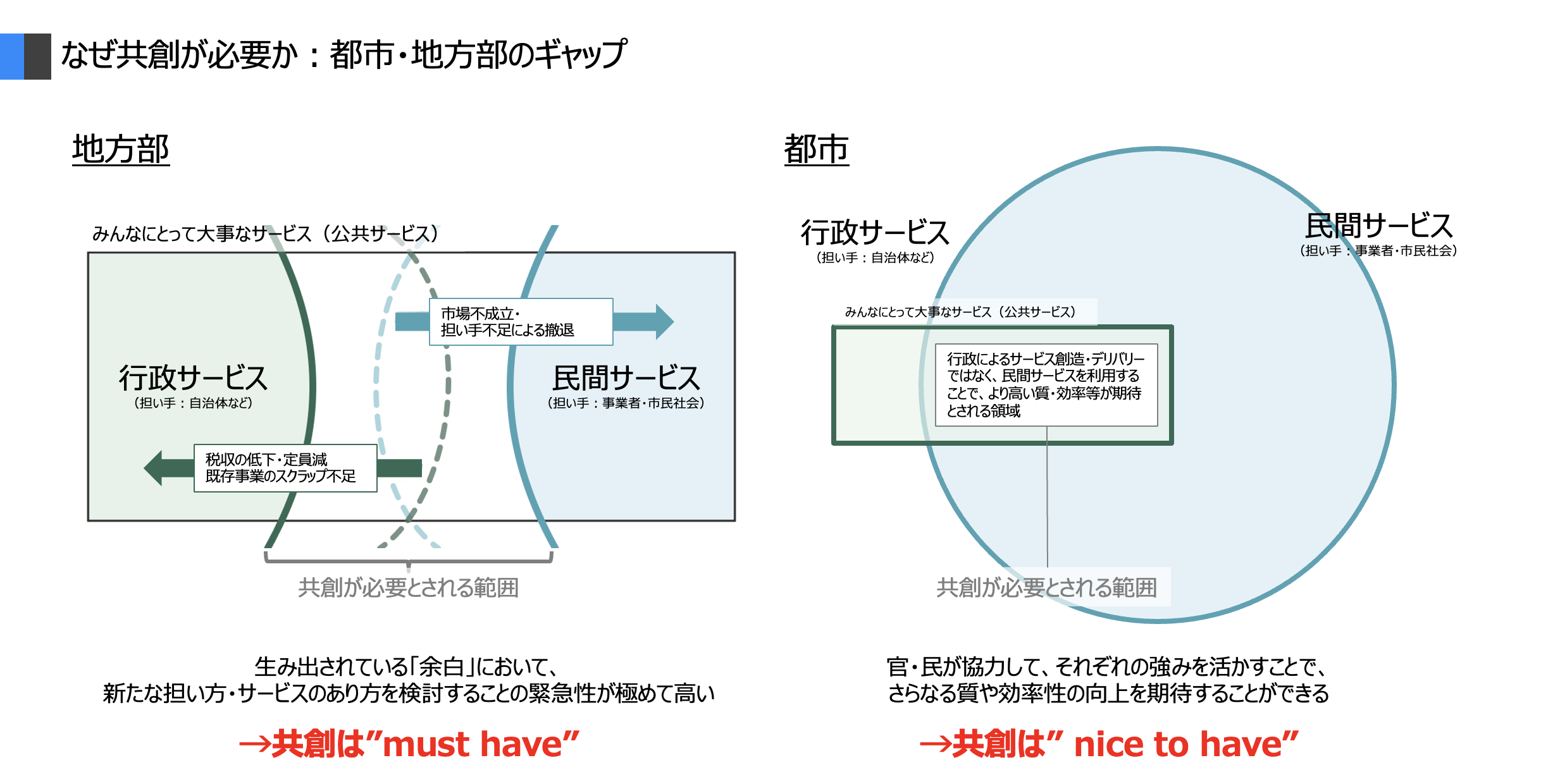
In urban areas the situation is somewhat different. Both administrative and private services are relatively abundant, leaving little gap within public services. Hence, the value of co‑creation appears less as “filling a gap” and more as a way for government and the private sector to cooperate, leveraging each other’s strengths to further improve the quality and efficiency of public services.
In cities co‑creation may look like a “nice‑to‑have”. Yet even if it is currently perceived as such, I expect that as municipal resource constraints intensify over the next decade or so, co‑creation will move closer to a “must‑have” in many locales. This is because growing resource constraints will make decisions about how to sustain existing services and solve problems more complex, increasing the costs of explanation, coordination and rework – and co‑creation becomes essential as a means to lower those procedural costs.
We don’t need “co‑creation” as a buzzword
In recent years the term “co‑creation” has become something of a buzzword even among local governments. Yet in many municipalities the concept has become hollow – even if a mayor loudly promotes it – because the underlying premise that “public services must inevitably change” is not shared. In effect, the administration prepares a stage from a top‑down perspective, assuming stakeholders will simply “participate” or “do it”, which often results in self‑satisfaction for the organisers and little real impact. For example, a “co‑creation” initiative may gather opinions but never show how they are used, fail to explain why they are not reflected, and only present results from the administration side. Such experiences generate frustration and distrust among stakeholders who took part in the co‑creation stage. Distrust makes it harder to expand the co‑creation platform or keep participants motivated, and while the effort to explain and publicise the process increases, concrete outcomes remain absent and the word “co‑creation” floats in empty air.
A functional co‑creation process only emerges when the premise that “public services must inevitably change” is shared, and the administration engages with stakeholders as flat, equal partners rather than from a superior stance, providing appropriate feedback and ensuring process transparency. Only then can concrete results be achieved and the necessity of the effort spread organically, creating a truly “functional co‑creation process”.
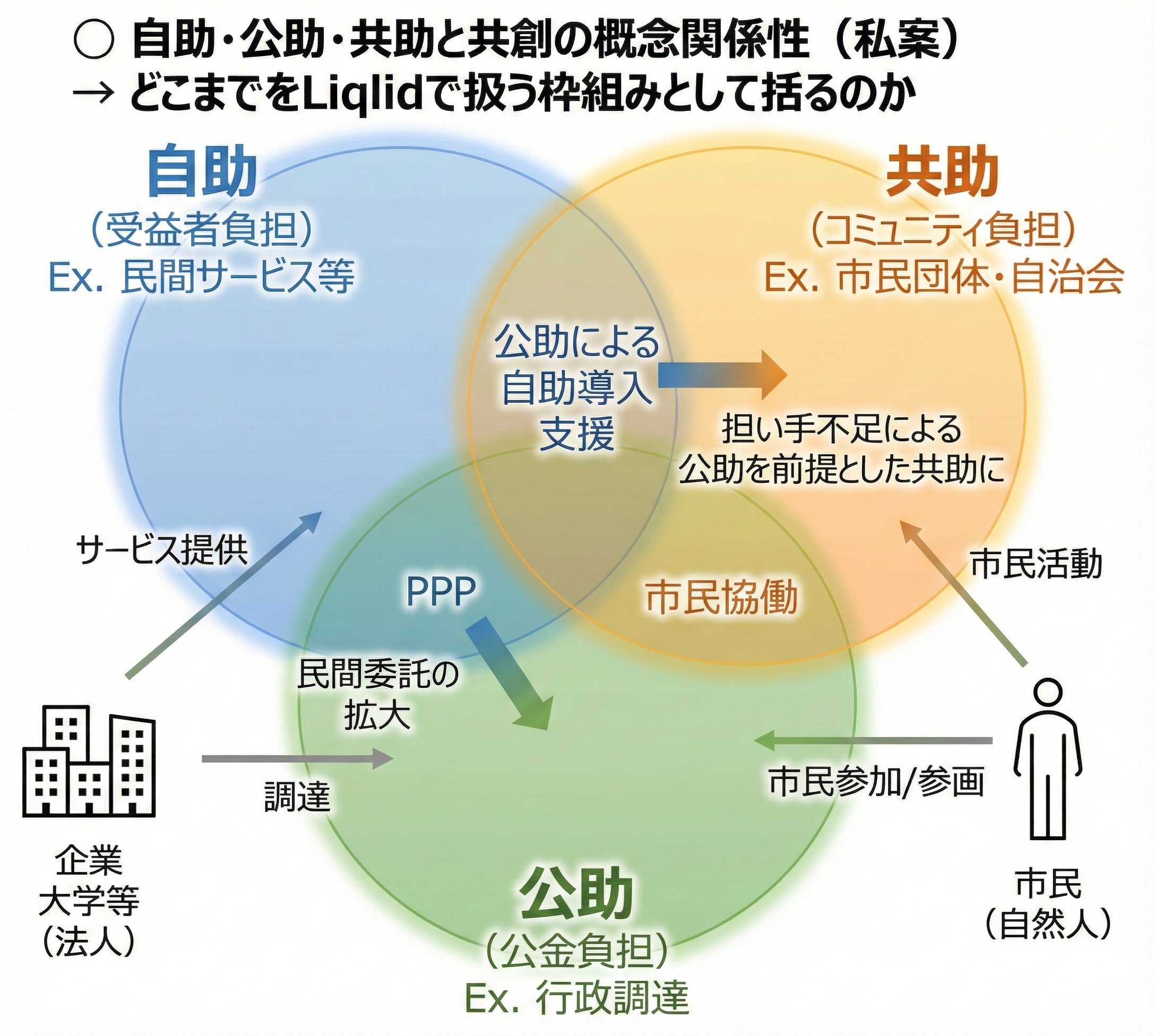
When we advance projects in various regions, our online platform “Liqlid” is often labelled “co‑creation”. As a tool for the “functional co‑creation process” described above, the platform should not simply be a posting board evaluated only by the number of posts or participants. First, it is essential to deliberately present issues, constraints, cost structures, comparative information and future outlooks, allowing the administration’s concerns to surface within the platform so that observers can understand the premises behind the administration’s deliberations. Only then can participating citizens and other stakeholders see both the scope for their input to influence decisions and the limits of the process.
Another crucial point is not to invoke co‑creation while leaving responsibility and burden unclear. Instead, with courage, the core conditions of the process – such as “What is the real problem?”, “Who will pay?”, and “Who decides?” – must be clarified and the process executed accordingly. Without sharing this core information, merely chanting “co‑creation” as a slogan will not move the process forward, leaving it floating and ultimately losing public interest.
Through co‑creation, we need to “redraw the line” to enhance the sustainability of public services – that is, to consider the future shape of services, the way burdens are shared, and who will take on future service roles – and to do so we must “articulate the line that is currently drawn,” “melt that line and rethink it,” and then “draw a new line again (and keep redrawing).”
Changes in the value of co‑creation expected over short‑term and medium‑to‑long‑term horizons
I personally recognize that co‑creation should be discussed on the basis of democratic values. Needless to say, I am a defender of those values. However, merely stating an idealistic goal without explaining the rationality of that ideal, and without abundant resources to devote to achieving it, is unrealistic—especially at the local level, where I see significant challenges. Therefore, I believe it is crucial to examine and demonstrate the rationality of co‑creation.
In my experience, I have spoken with many people across various regions—municipal leaders and managers, frontline staff, local businesses, university representatives, and citizens. From these conversations I have become absolutely clear that, in Japan, future public services cannot simply be an extension of today’s public services. Consequently, in the short‑ to medium‑term, a strict return to economic rationality will advance. Emotional support will give way to logic and evidence; policies that cannot be clearly explained causally will be more harshly criticized and possibly cut. What is required in that context is transparency of the relationship between policies, budgets, measures and outcomes, and fulfillment of accountability. In the short‑ to medium‑term, I think the practice of “co‑creation” will progress as an effort to strengthen this “guarantee of transparency.”
In the long term, an even harsher situation will arise. With population decline and economic contraction, maintaining everything will become impossible, and a retreat strategy—or a smart downsizing and enrichment “shrink‑and‑fill” transition—will become unavoidable. At that stage, we need not only “guarantees of transparency” but also solutions that citizens can accept, based on logically correct answers. If we try to push policies through top‑down alone, communication costs will rise, and because public elections exist, policy continuity may become even less assured than now. I believe that at this point the value of co‑creation will converge on creating “acceptable solutions as a democratic‑cost outcome.”
Whether or not the timeline I described holds, the practice of co‑creation will change its meaning step by step. In the short‑ to medium‑term it will serve as a foundation for transparency and accountability; in the long term it will become a practice for generating acceptable solutions. Yet, regardless of the stage, the necessity of co‑creation does not change. Therefore, we must build and operate mechanisms to practice co‑creation starting now.
Examples of practice I am involved in – operating co‑creation as a process
Below I introduce three practices that my company and I are involved in. All of them treat co‑creation not as a buzzword but as initiatives that embody the nuances I have described, which is why they are especially noteworthy.
Toyooka City: Trial of shortened public counter opening hours – the practice of “try first, decide later”
From fiscal year 2025, Toyooka City in Hyogo Prefecture introduced our online platform Liqlid as “Civic Toyooka.” As one of the projects on the platform, the city was trial-running a reduction of municipal public counter opening hours from 9:00 a.m. to 4:30 p.m. for four months (December 1, 2025 – March 31, 2026). The experiences of service users during this period were being collected as idea submissions on Liqlid.

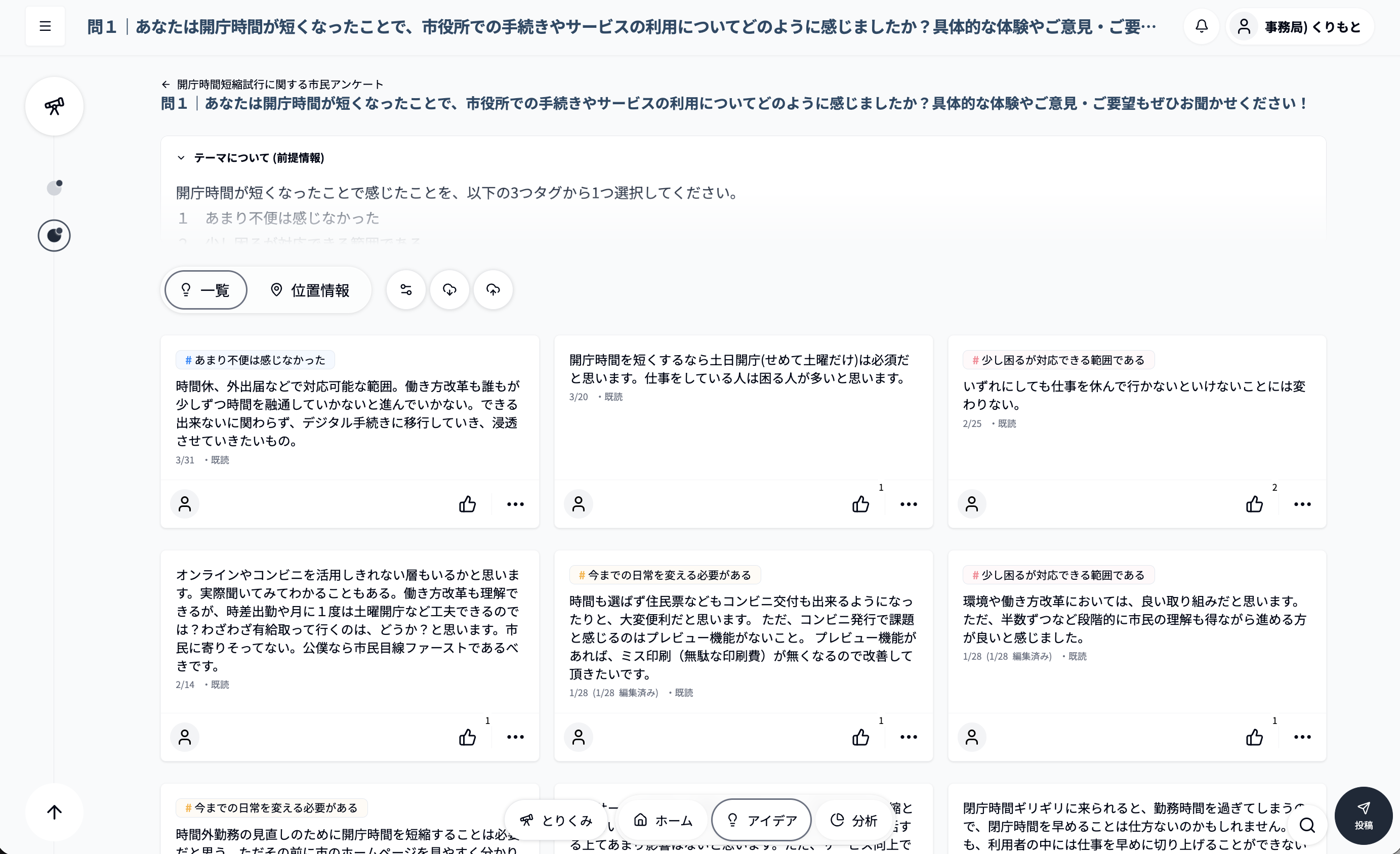
https://toyooka-city.liqlid.jp/spacem3sh78r0
What makes this initiative interesting is, for example, the installation of pop‑up notices at counters to first hear voices on the ground and then use those results as material for the next operational design. For people who visit the counter on weekdays, the earlier closing time may subtly affect them as they juggle sudden errands or work breaks. For those who usually handle matters via convenience‑store issuance or online applications, the change may be barely perceptible. Even within the same municipality, the feel of the same operational change varies depending on how people interact with the service.
The municipality also has reasons to need a trial. Opening a counter means staffing it. Shortening public counter opening hours creates slack in work schedules, allowing staff to devote more energy to consultations outside the counter or field work in the community. However, if the decision is made solely on paper calculations, people with unexpected difficulties may be left out. Therefore, the city must set a trial period, observe which groups are affected, in what situations, and what burdens arise, while operating the service.
The questionnaire follows this stance as well. It asks respondents to verbalize how they felt about the shorter public counter opening hours and to indicate whether they used alternative services. Even within the same household, a weekday employee, a person who uses electronic applications, and an elderly family member who needs in‑person consultation will perceive the same time change very differently. By capturing both emotions and actions without losing granularity, the data can go beyond a simple “convenient/inconvenient” dichotomy to reveal high‑resolution issues such as “who, in which situation, used which alternative, and what was missing.”
What Toyooka’s effort demonstrates is a concrete form of opening up the policy‑making process. It is not a “persuasion” that places conclusions first, nor a postponement that merely adds more debate; it inserts a trial, shares the operational experience with citizens, and co‑creates the evaluation criteria. Such design not only reduces backlash and misunderstanding after implementation but also raises the quality of policy decisions and curbs the invisible costs that disappear into rework. From the perspectives of consensus building and economic rationality, I am convinced this is the proper approach.
Nagaokakyo City: Inukawa walking trail – rationality of public space starting from scenery
The Inukawa walking trail runs from Kaida‑4‑chome to Kotari‑3‑chome in Nagaokakyo City. When you walk it, weeds sometimes grow more than expected depending on the season. The edge of the path can feel narrow at times. Looking at the ground, you notice uneven pavement that would concern stroller or wheelchair users. At night, the brightness and spacing of the lighting become noticeable. You may want to sit and rest briefly, but there are few rest areas and they are not very comfortable. While the trail feels pleasant overall, these small inconveniences accumulate and can deter people from using it.
From fiscal year 2024, Nagaokakyo City and our company have built an online platform called “Voice NAGAOKAKYO” using Liqlid, and are promoting its use across all municipal departments.
As part of that effort, about 20 years have passed since the development of the Inukawa promenade in Nagaokakyo City, and wear and inconvenience such as damaged paving, lighting, and rest areas have become apparent. In response, we are moving forward with a renewal initiative using “Voice NAGAOKAKYO” to gather the “feelings” and “ideas” of citizens to think about the future together.
https://nagaokakyo-city.liqlid.jp/spaceu3iut2y8
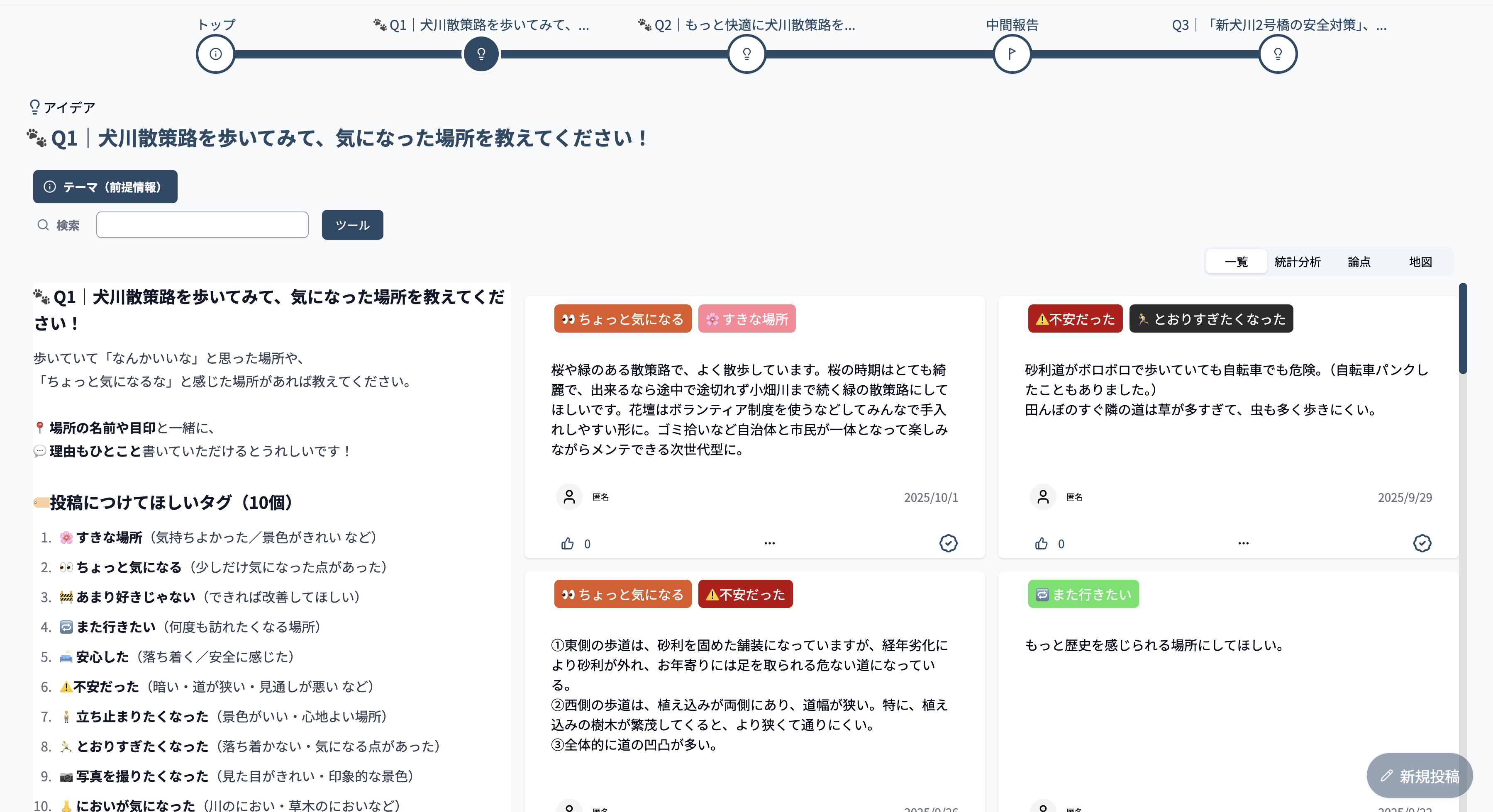
I personally believe that hard‑infrastructure development is the area where the rationale for co‑creation is most evident. This is because, while design can be adjusted, once construction has started and been completed, rework becomes difficult. If a decision later turns out to be “different,” it cannot be easily redone. Therefore, investing in observation and dialogue before decisions are made is highly valuable. Weeds, uneven surfaces, lighting, rest areas—incorporating this experiential knowledge into decision‑making is not merely a request intake; it is rational information gathering needed to reduce the execution of unnecessary resource allocation. When unnecessary resource allocation is reduced, the investment‑to‑effectiveness ratio improves.
Public spaces do not end their value at the moment they are built. Their value emerges only through continued use. When citizens develop attachment and the way the space is used matures, the premises for considering long‑term maintenance investment will also change. Co‑creation in hard‑infrastructure projects therefore extends beyond the construction phase; it continues to generate value after completion and can be designed to enhance the site’s value and to reconsider the nature of investment even after the work is finished.
Sakata City: Urban Grand Design – Multiplying Consensus‑Building Paths
In Sakata City, as the downtown core continues to hollow out, especially around Nakamachi, the city is advancing the formulation of an “Urban Grand Design” that will serve as a future blueprint to revitalize the area.
From fiscal year 2025 onward, the online platform “SakaPos,” which our company launched in partnership with Sakata City, allows the city to continuously publish draft documents and proposals for the Urban Grand Design while citizens can submit comments and ideas. The city then provides feedback through SakaPos, creating a “let’s think together about the future of Sakata’s downtown” initiative.
https://sakata-city.liqlid.jp/spacek5jzkkdr

The theme of downtown revitalization is not limited to scenery or events. It involves land use, transportation, public facilities, private investment, and daily life flows, all intertwined over a long time horizon. Consequently, achieving consensus in the region and making administrative decisions become highly complex. Without consensus, momentum stalls, investment in the area halts, and opportunity costs accumulate.
Based on this thinking, Sakata City is diversifying opportunities for hearing opinions during the formulation of the Urban Grand Design. The online platform “SakaPos” and the “Town Meeting” held at the private commercial facility MUJI Sakata are conducted separately for the general public and for students. In addition, individual interviews with merchants, organizations, real‑estate developers, and neighborhood associations are carried out, so that multiple channels overlap in the process of reaching consensus on downtown revitalization, thereby reducing bias.
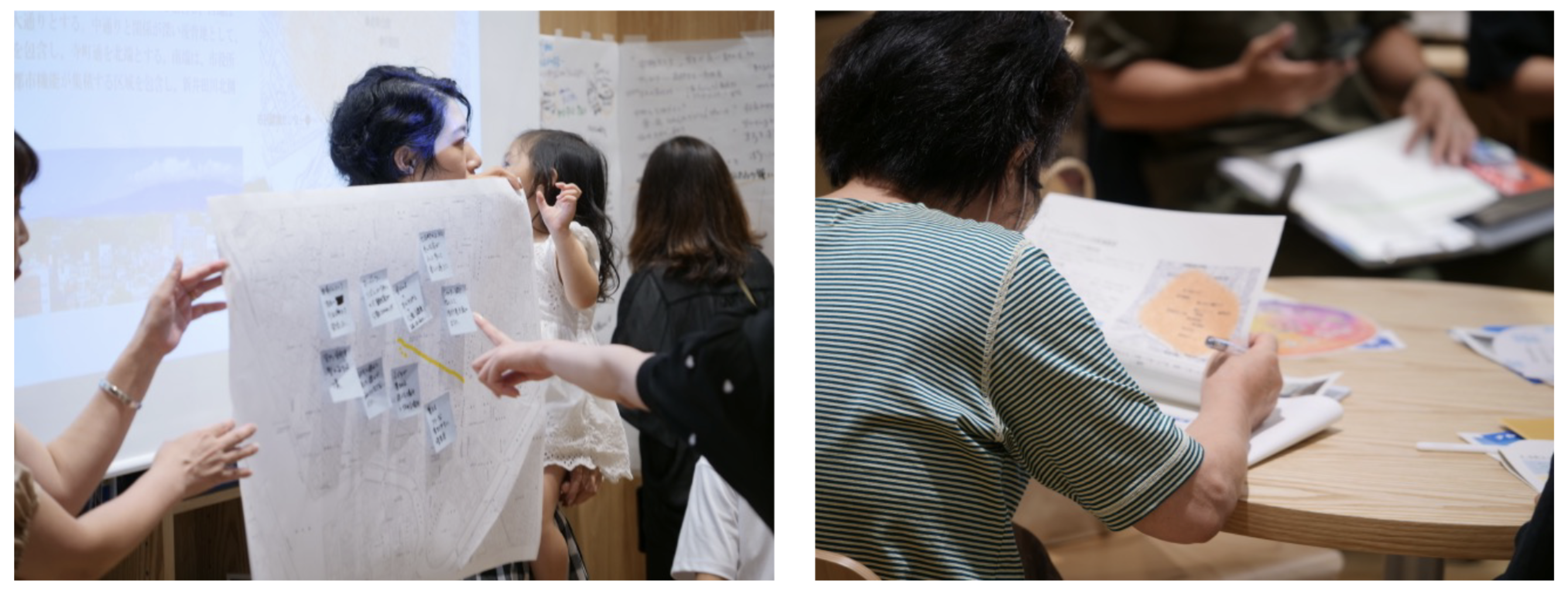
By reducing bias in opinions, building a sense of procedural legitimacy, and minimizing friction during implementation, the future vision is shared among stakeholders throughout the process. This makes it easier not only for the administration but also for citizens and the private sector to act. While downtown revitalization is closely related to public services, it is difficult for the administration to take the leading role; active participation by private enterprises is essential. Therefore, designing a process that embodies co‑creation may appear time‑consuming, but it is actually extremely rational.
Conclusion – Co‑creation Is an Advance Payment of Democratic Costs and a New Form of Administrative Reform
The three cases described above belong to different policy areas, each with its own background for why co‑creation is required. However, they share a common characteristic: they involve themes where “once a decision is made, it is difficult to redo.” Whether it is window‑service hours, Saturday office openings, promenade development, or downtown regeneration, these are not matters that end with a single decision. Operations continue, environments change, and at some point updates or revisions become necessary. Hence, rather than treating them as one‑off projects, embedding dialogue and feedback loops as part of co‑creation from the outset carries great significance.
I consider co‑creation to be an advance payment of democratic costs. Creating consensus requires time and effort, which are costs. Yet, if these costs are not paid, later stages become more expensive. Redoing work is costly. Friction is costly. Damage to trust is even more costly. Therefore, shouldn’t we pay those costs up front? Design and operate co‑creation processes early, and create a state where feedback functions effectively. This is the value of co‑creation when viewed from the perspective of economic rationality.
Continuously pursuing administrative reform will always require attention to efficiency, but that alone cannot guarantee the sustainability of public services. Even if it seems like a detour, we must question whether administration and policies are democratic, accept democratic costs, and implement circuits that lower the total cost from a medium‑ to long‑term perspective. I want to advance this as a “new administrative reform.” I will continue to pursue this work persistently at Liquitous.
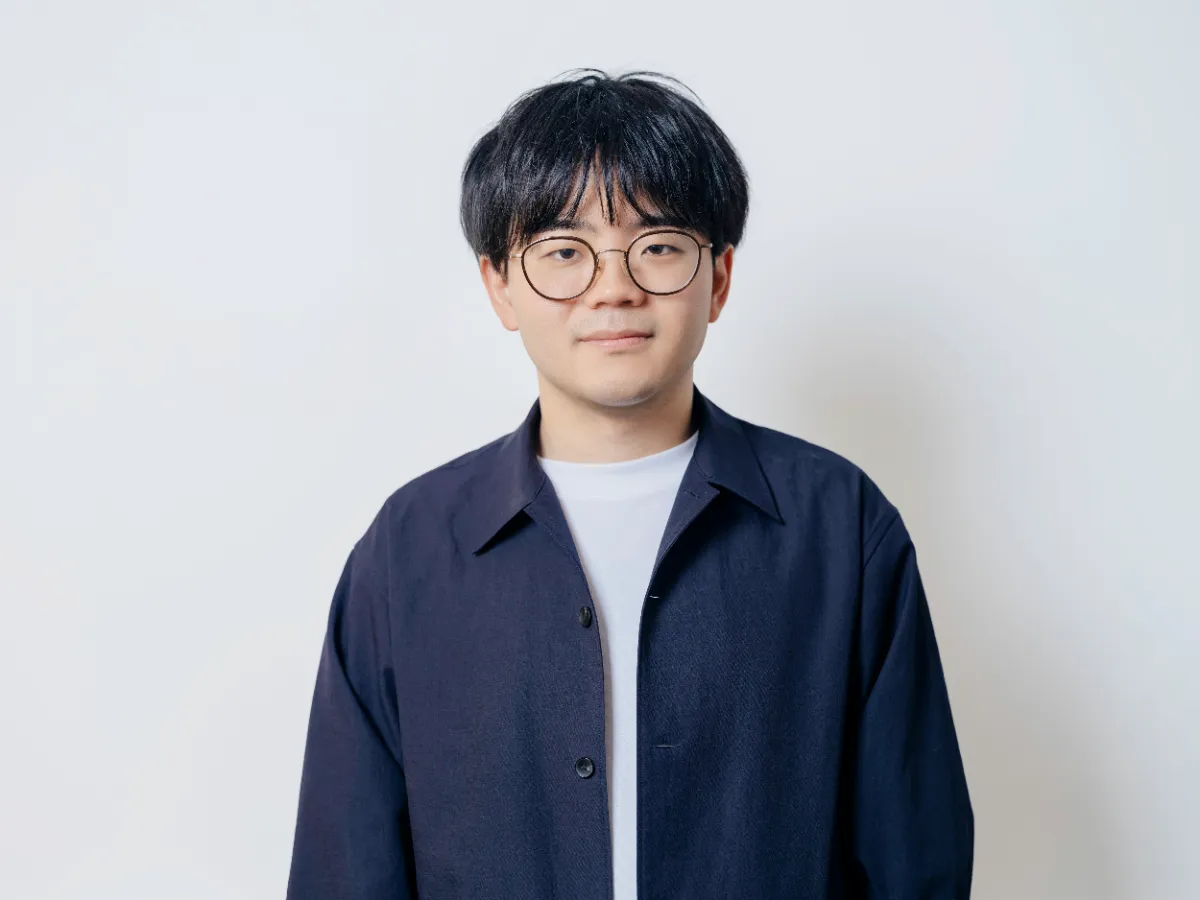
(Authored by CEO Hiroyuki Kurimoto)
Note: This article is based on publicly available information and reflects the author’s personal views; it does not represent the official opinions of the municipalities mentioned.