
Institutional Design of Citizen Participation in Italy’s National Strategy for Inner Areas (SNAI)
Can an Institution That Makes Participation a 'Condition for Funding' Be Established?
In the process of formulating Japan's regional policies (regional comprehensive strategies, and by extension, comprehensive plans in local governments), pathways for citizen participation are not entirely absent. Opportunities for participation, such as public comment procedures during plan formulation, consultations with councils, and the holding of resident workshops, have actually been steadily established.
However, all of these are procedures intended to ensure the propriety of the formulation process; the presence or content of participation does not structurally influence the allocation of funds or the validity of the plan. While participation is guaranteed as a procedure, it is not connected to the outcomes of the institution. This is a characteristic feature of citizen participation in Japan.
In contrast, there is a national policy that institutionalizes participation as a prerequisite for funding: Italy's National Strategy for Inner Areas (SNAI: Strategia Nazionale per le Aree Interne). This article will examine the implications for Japan's depopulation countermeasures by first reviewing the overview of SNAI, organizing its institutional design of participation into three characteristics, and considering the results and limitations of its effectiveness verification.
1. Target Definition Based on 'Distance' to Services
SNAI was formulated in 2013 under then-Minister for Cohesion Policies Fabrizio Barca. It can be positioned as an application of the place-based approach that Barca proposed in a 2009 report to the European Commission—namely, a policy philosophy that mobilizes the knowledge of stakeholders in accordance with regional contexts rather than applying standardized prescriptions from the outside—to the peripheral regions of his own country.
First, the method of defining target regions is distinctive. While Japan's Depopulation Law (Special Measures Act for the Sustainable Development of Depopulated Areas) designates target municipalities using indicators that show the 'results' of decline, such as population decline rates and fiscal capacity, SNAI defines targets based on access to basic services. Specifically, municipalities that have a complete high school curriculum, a hospital equipped with emergency response (DEA), and a railway station of a certain standard are designated as 'hubs,' and approximately 8,000 municipalities nationwide are classified based on the time required to reach these hubs. They are categorized as 'intermediate' (roughly 20–40 minutes), 'peripheral' (40–75 minutes), and 'ultra-peripheral' (over 75 minutes), and these three categories (covering about 60% of the national territory, about half of the number of municipalities, and just over 20% of the population) are designated as 'inner areas' for policy targets. The distance to services that citizens should originally enjoy directly serves as the basis for support.
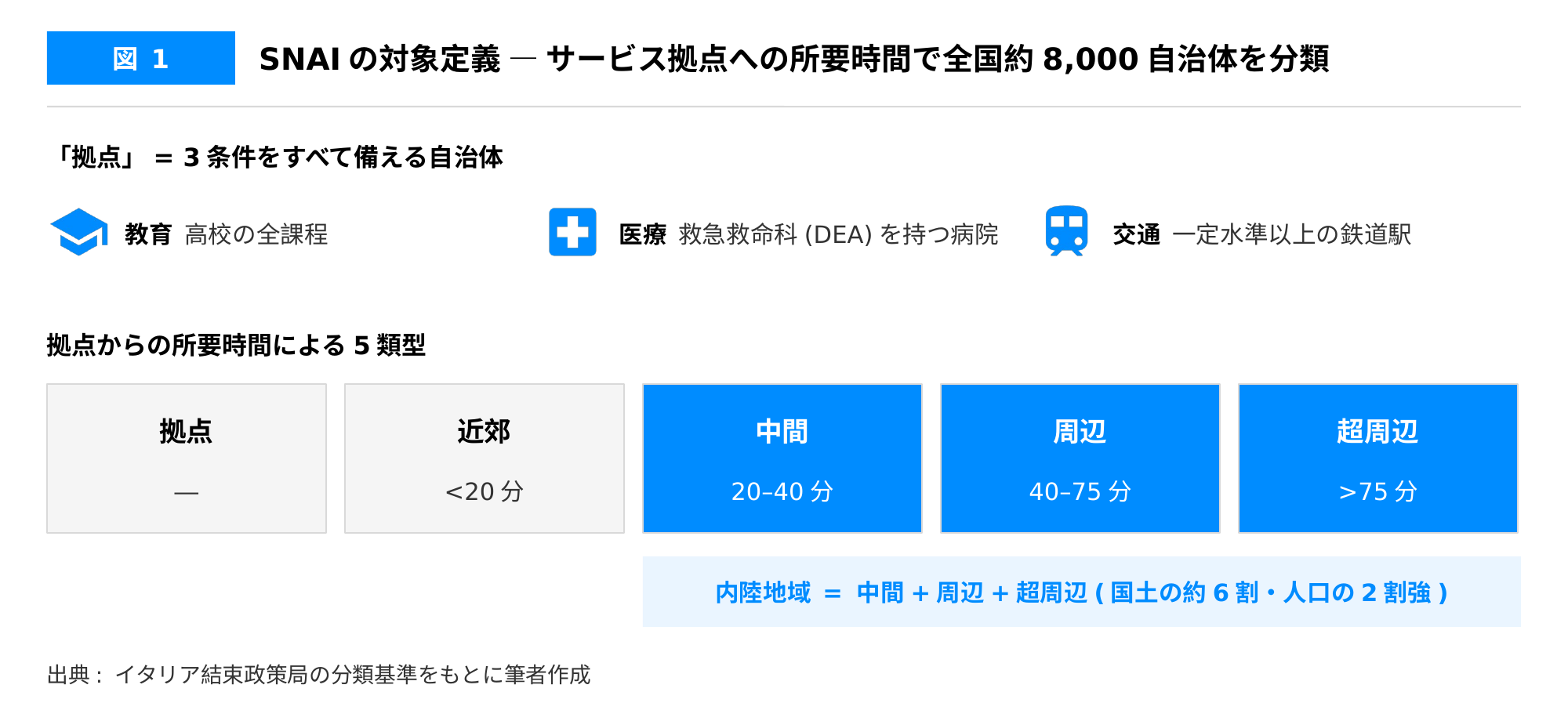
The targets included 72 areas (approximately 1,060 municipalities and approximately 2 million people) in the first phase starting in 2014, and expanded to 124 areas, 1,904 municipalities, and approximately 4.57 million people in the second phase (2021-27). As for funding, approximately 118 million euros from national funds and EU structural funds were allocated in the first phase, while the second phase includes national funding of 4 million euros per new area, in addition to funds related to the Recovery and Resilience Plan (PNRR).
2. Institutional Design of Participation - Three Characteristics
The institutional design of participation in SNAI can be organized into the following three points.
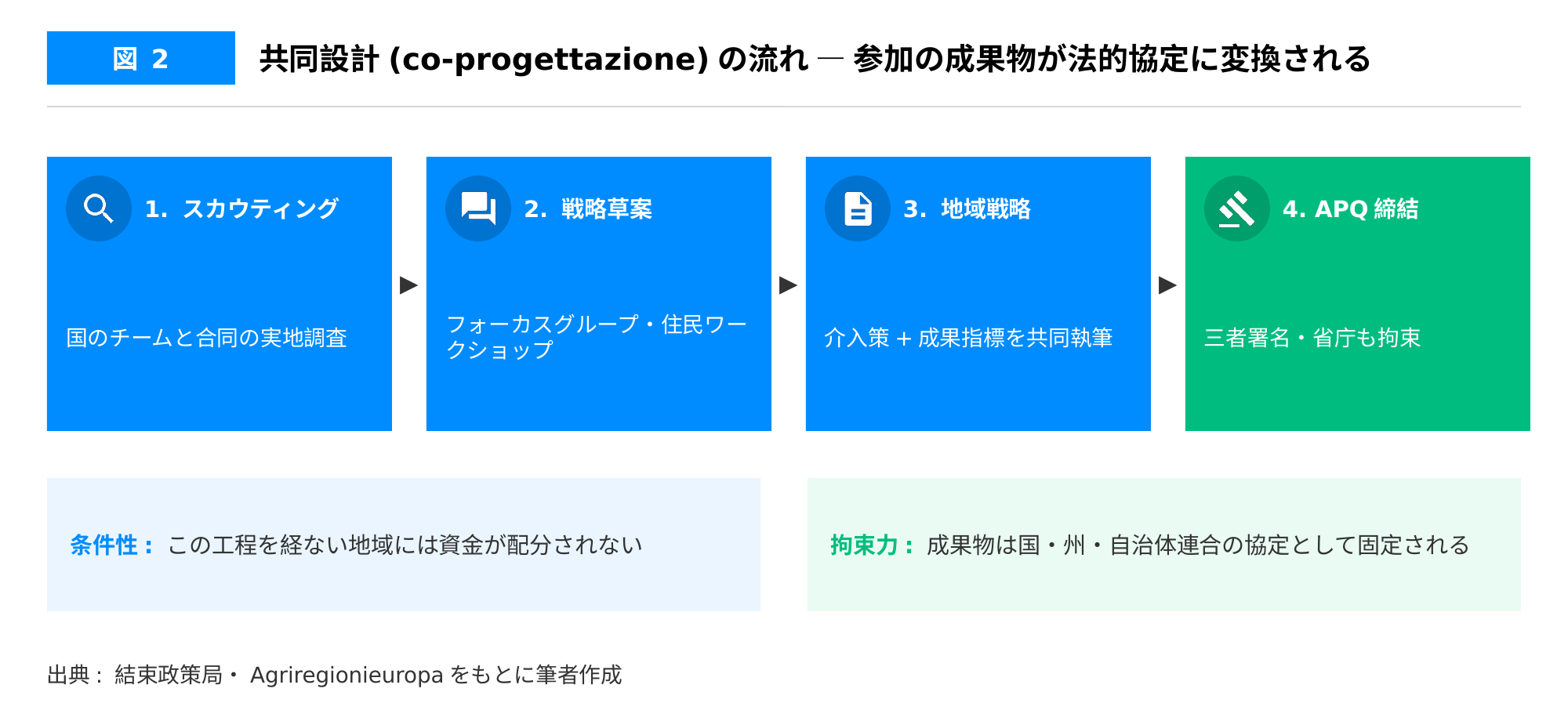
First is the 'conditionality' of participation. Municipalities selected as target areas are first required to form a union with neighboring municipalities (participation is not possible individually). On this basis, they create a draft strategy through 'scouting' to identify regional challenges and resources, focus groups involving school principals, family doctors, farmers, and business operators, and resident workshops, and then finalize it into a 'regional strategy' that includes intervention measures and outcome indicators in thematic working groups. Regions that do not complete this process, called co-progettazione (joint design), are not allocated funds. Participation is not a recommendation but a requirement for disbursement.
Second is the conferral of binding force on the deliverables of participation. The regional strategy, which is the deliverable of joint design, is ultimately converted into a framework agreement (APQ) signed by the three parties: the state, the region, and the municipal union. The APQ is a legal agreement that specifies intervention measures, funding, schedules, and expected outcomes, and it binds national ministries. Issues raised in focus groups become intervention measures accompanied by outcome indicators and become part of the agreement document. The incentives for participants are entirely different between a structure where whether the results of participation are reflected in the plan is left to administrative discretion and a structure where the deliverables of participation are fixed as an agreement.
Third is accompaniment by the state. A team from the National Committee for Inner Areas, which spans relevant ministries, enters the field from the scouting stage and participates as the side writing the strategy with the region, rather than as the side reviewing the submitted plan. In the Marche region's Appennino Basso Pesarese e Anconetano, which was the first pilot area, and in the Alta Irpinia union of 25 municipalities in the Campania region, national officials accompanied the regions until the establishment of the strategy document. This can be understood as a mechanism where the state complements the disparity in planning capacity among small municipalities, including the fact that participation methods are not standardized uniformly nationwide but are adjusted according to regional contexts.
In a previous draft, I argued that for how much longer will local governments continue to be 'entities that possess the answers'.
In SNAI, the entity being asked the same question is not the local government, but the state. Since responses to depopulation vary by region in terms of population composition, industry, and resources, there is no pre-determined correct answer. It is precisely a 'wicked problem.' Nevertheless, the state has traditionally been involved by providing uniform national systems or menus and reviewing the suitability of plans submitted by localities. SNAI transformed this form of involvement. The state stepped down from the side providing the correct answer and moved to the side searching for answers with the regions. Moreover, it did not leave this to the individual mindset of the person in charge, but formalized it as a series of processes from scouting to the conclusion of the agreement and has operated it for 10 years. It is no exaggeration to say that the uniqueness of SNAI lies in this point.
3. What Effectiveness Verification Shows, and Its Limitations
What about the effects? A verification using the difference-in-differences method by Monturano et al. (2023) confirmed a statistically significant increase in the number of establishments in target municipalities, while no effects were detected on population dynamics or the ratio of the population aged 65 and over. While there are signs of change in terms of economic activity, it will still take time to reverse population dynamics, which is a reasonable assessment at this point.
Limitations are also becoming apparent. First is the time cost. Careful joint design takes several years, and it was not until 2022, eight years after the start, that the conclusion of APQs was completed in all of the initial 72 areas. For municipalities with populations in the hundreds, this process itself is a heavy administrative burden, and reliance on external consultants has also been pointed out. Second is the regional disparity in the quality of participation. The main body of strategy formulation is a union of mayors, and the extent of resident participation is greatly influenced by the leadership of the mayors and the trust between mayors and staff, that is, relational capital. While institutions can be transferred as documents, relational capital cannot be transferred. Third is the limitation of outcome indicators. Criticisms have been raised regarding the existence of indicators that cannot be defined at the municipal level against an indicator grid of approximately 70 items, and the fact that the value of cultural resources is captured only by proxy variables such as the number of tourists.
Earlier, I discussed the “maintenance cost” of democracy. Placing participation as a prerequisite of the system is nothing less than declaring a commitment to bear that maintenance cost on an ongoing basis. Italy has taken on part of that cost through a national “accompanying team” model. In 2025, a national strategic plan (PSNAI) was drafted to convert more than ten years of “experimentation” into permanent policy, focusing the priority sectors on education, transport and health, and during the drafting process an online call for opinions was carried out via the government’s participation platform “ParteciPa”.
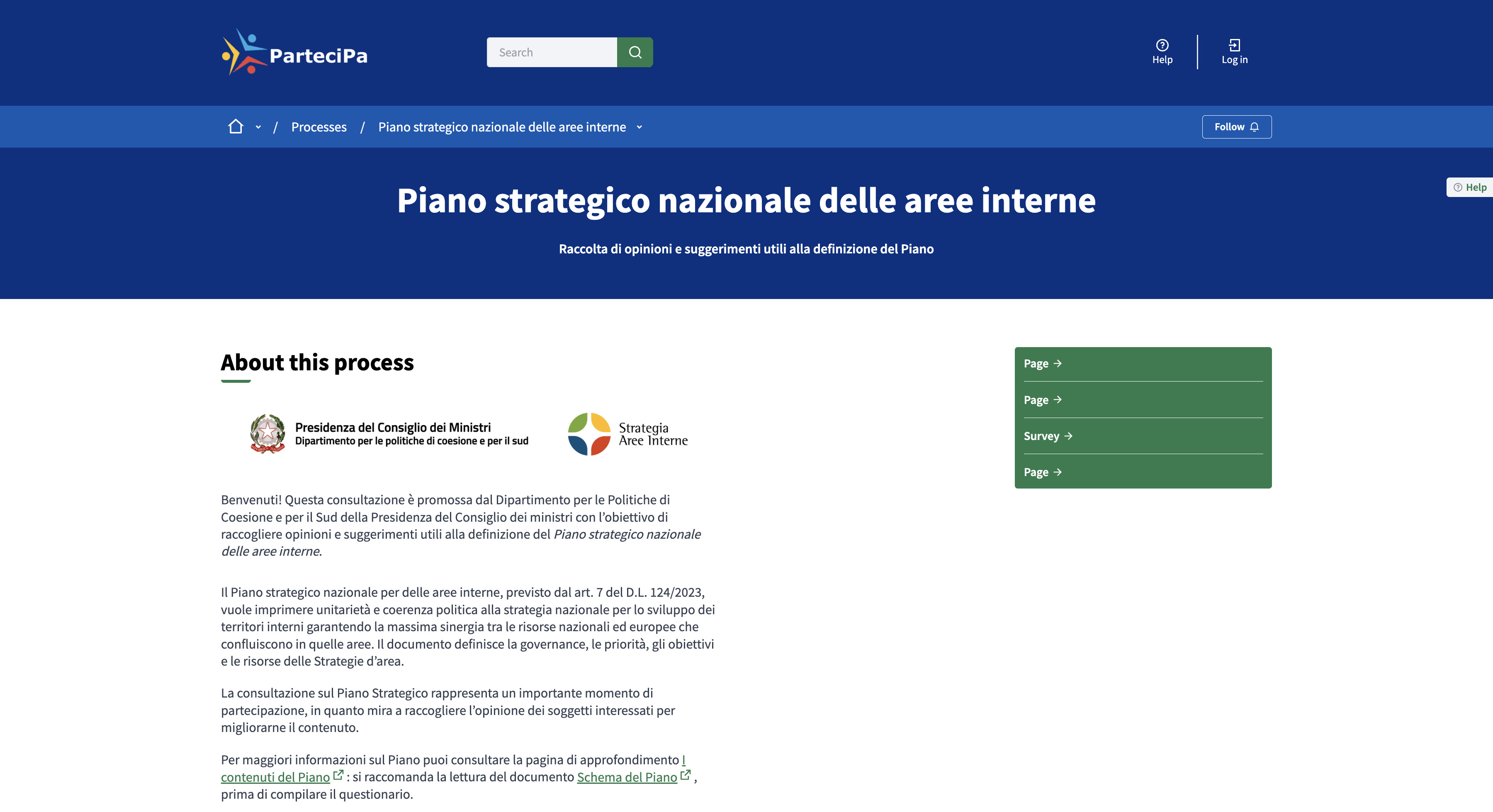
https://partecipa.gov.it/processes/piano-strategico-nazionale-aree-interne
This reflects a decision to embed pathways for participation even in national‑level plan making, indicating a direction to have the system and its infrastructure shoulder the maintenance cost of participation rather than relying on individual dedication.
4. Implications for Japan
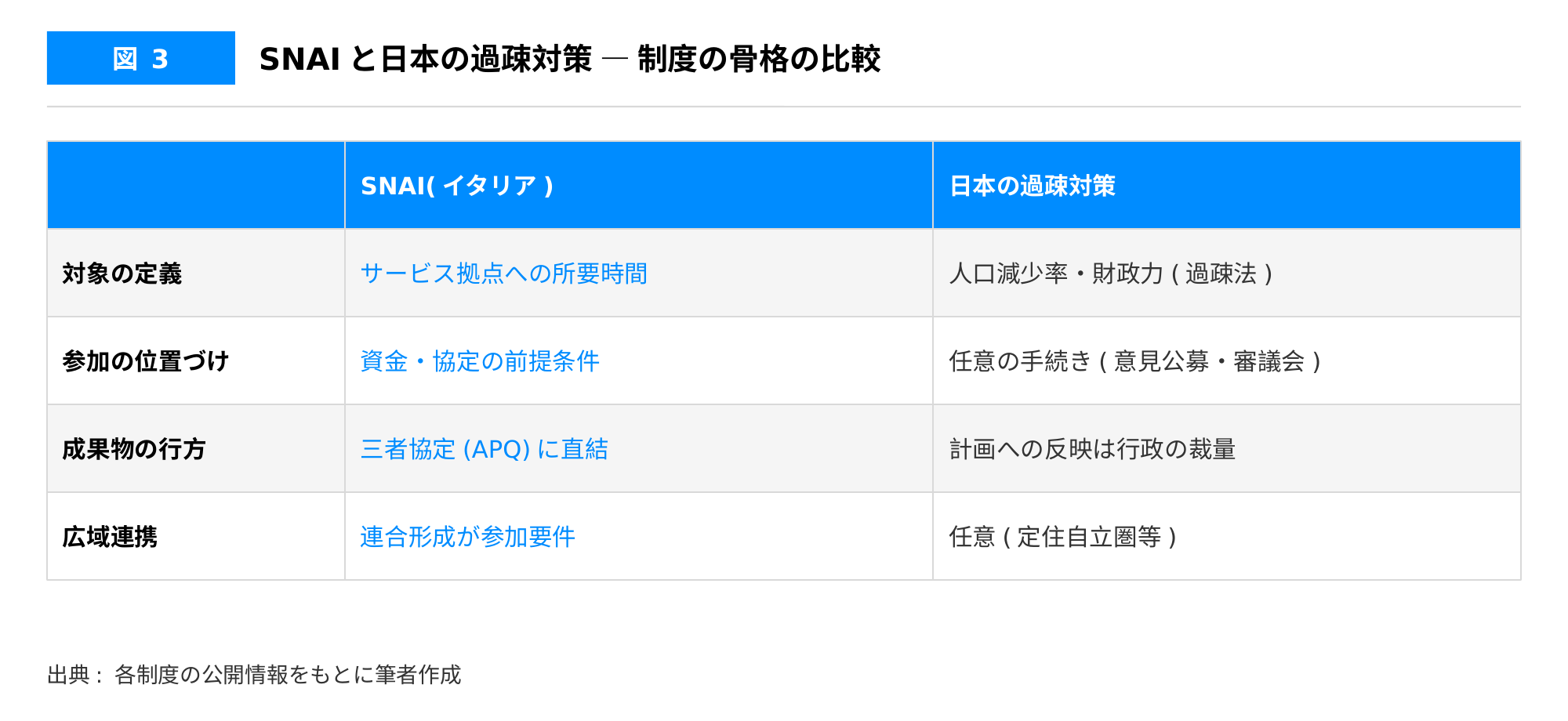
When comparing SNAI with Japan’s depopulation measures, what stands out is not the difference in individual measures but the difference in the skeletal structure of the systems. The definition of the target (outcome indicator versus access indicator), the positioning of participation (procedure versus requirement), the fate of participation’s deliverables (discretionary reflection versus linkage to an agreement), and the role of wide‑area collaboration (voluntary versus prerequisite). Ignoring these structural differences and merely transplanting policies will not work. Since relational capital cannot be transferred, this applies equally to the side importing the system.
Nevertheless, questions worth examining remain. How can a design that makes participation a requirement and gives binding force to its deliverables be incorporated into Japan’s existing frameworks (Sustainable Development Plans for Depopulated Areas, regional comprehensive strategies, or individual grant schemes)? It is not a question that can be answered immediately, but there is room to explore partial adoption—for example, positioning the quality of resident participation in plan formulation as a grant condition or evaluation criterion, or explicitly documenting the correspondence between participation deliverables and the plan/budget in writing.
Moreover, the ParteciPa case illustrates both the limits of sustaining multi‑year co‑design solely through face‑to‑face meetings and the option of supplementing it with a permanent digital participation platform. This aligns with the direction we are pursuing together with local governments domestically, offering considerable insight.
Finally, I would like to add a reservation. The paper does not fully reveal how the participation system design functions on the ground. In other words, it is unclear from publicly available sources whether the conditionality “no funding unless you participate” has actually changed the behavior of mayors and residents, or who has taken on the practical work of converting focus‑group statements into agreement documents. This is a limitation of the paper. Nonetheless, the very fact that a system making participation a requirement and giving its outputs binding force has been operated for ten years and has reached the stage of becoming permanent is, in my view, sufficiently worthy of reference when considering citizen‑participation system design in Japan.
(Authorship: Liquitous Co., Ltd., CEO Hiroyuki Kurimoto)
Note: This paper expresses the author’s impressions based on publicly available information.
Main reference information
Barca, F. (2009) An Agenda for a Reformed Cohesion Policy ( https://ec.europa.eu/regional_policy/archive/policy/future/barca_en.htm )
Italian Agency for Territorial Cohesion / Department for Cohesion Policies – SNAI official page, PSNAI final document (2025) (https://politichecoesione.governo.it/media/jhld12qn/psnai_finale_30072025_clean_ministro.pdf)
OECD "National Strategy for Inner Areas (SNAI) In a nutshell" ( https://www.oecd.org/content/dam/oecd/en/about/projects/cfe/shrinking-smartly-and-sustainably--compendium-of-good-practices-/multi-level-governance-and-finance/ITALY-National-Strategy-for-Inner-Areas.pdf )
Agriregionieuropa「Effetti della co-progettazione degli interventi nella SNAI」( https://agriregionieuropa.univpm.it/it/content/article/31/56/effetti-della-co-progettazione-degli-interventi-nella-strategia-nazionale-aree )
Monturano, Resce & Ventura(2023, SSRN)( https://papers.ssrn.com/sol3/papers.cfm?abstract_id=4575900 )
MDPI Sustainability(2021)( https://www.mdpi.com/2071-1050/13/12/6927 )
ParteciPa (partecipa.gov.it): PSNAI opinion solicitation page (https://partecipa.gov.it/processes/piano-strategico-nazionale-aree-interne)