
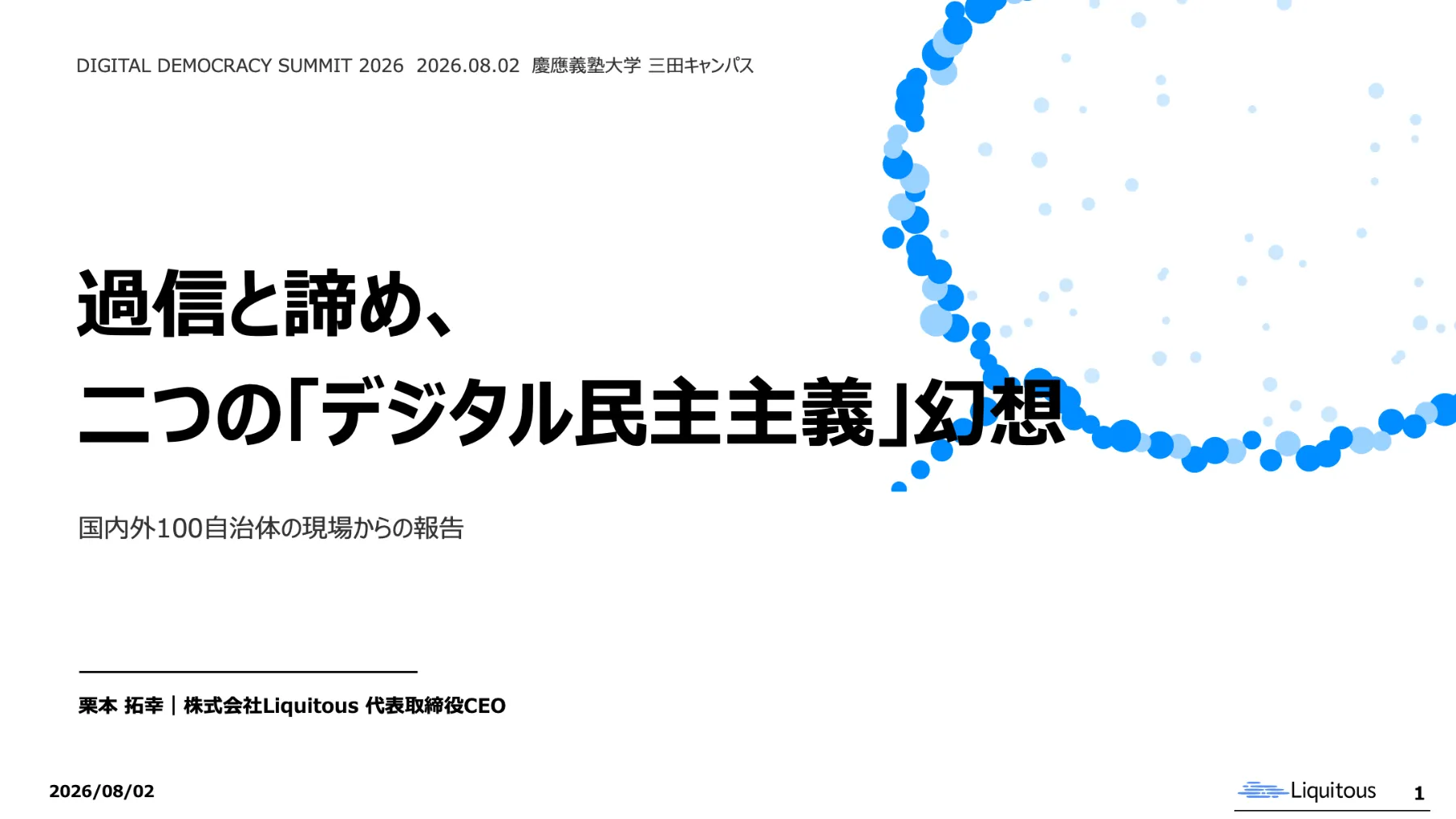
Lecture Record: 'Overconfidence and Resignation: Two Illusions of "Digital Democracy" — A Report from the Frontlines of 100 Local Governments, Domestic and Abroad'
Lecture Record | Digital Democracy Summit 2026 (August 2, 2026, Keio University Mita Campus)
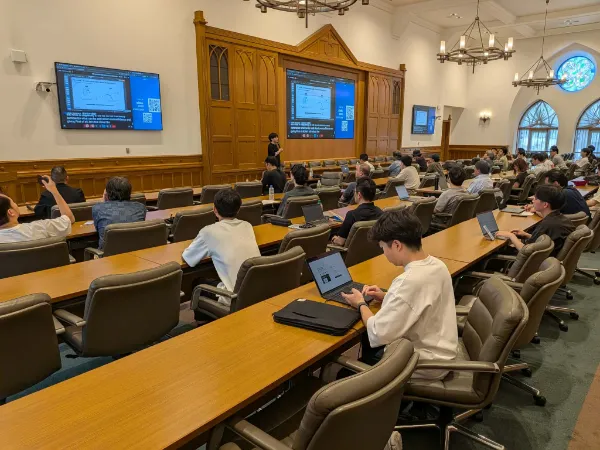
At the "Digital Democracy Summit 2026" held on August 2, 2026, at Keio University Mita Campus, our Representative Director, Hiroyuki Kurimoto, delivered the lecture titled above.
This subcommittee session addresses how to advance digital democracy within local governments and communities, using real-world examples. This article is a record of the day's lecture, organized and restructured while preserving the conversational tone. Additionally, we received comments from Mr. Takeshi Matsumoto, Section Chief of the Strategic Planning Section, Smart City Strategy Department, Osaka Prefecture, with whom we are collaborating on the Broad Listening demonstration project in Osaka Prefecture.
Please note that the examples and figures cited in the text are as of the time of the lecture.
1. Overconfidence and Resignation - Starting with Two "Illusions"
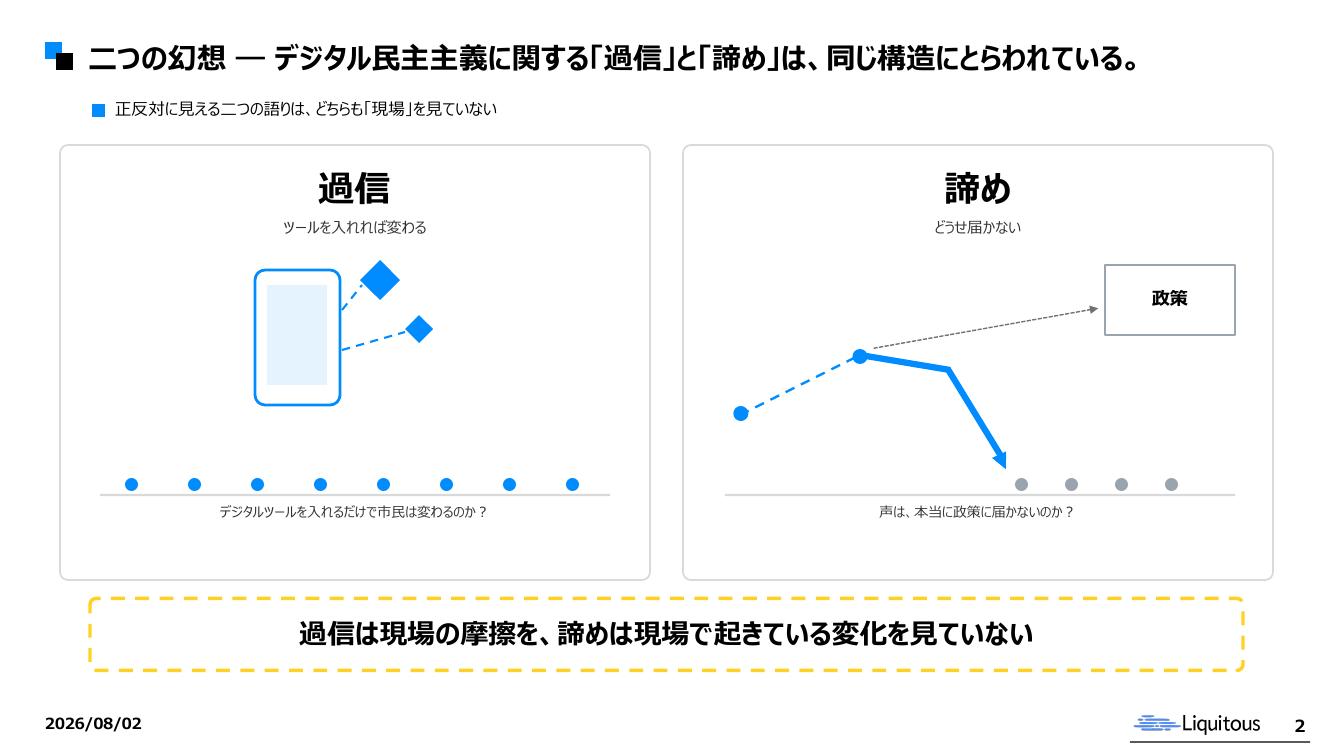
I included the words "overconfidence and resignation" in the title. As was also seen in the morning session, there are moments when the term "digital democracy" runs wild on its own, or when the term "broad listening" runs wild on its own. From my position on the frontlines, I honestly feel this is a reality. On the other hand, I do not believe that these concepts are meaningless or valueless. Today, I would like to discuss how these "illusions" are actually illusions and what is happening on the ground.
Overconfidence is the idea that things will change if we just introduce some amazing tool. The belief that if we have a platform, citizens will raise their voices more. But will citizens really change just by introducing a tool? Resignation is the opposite: the feeling that merely collecting voices will not change things, and that they will not reach policy. Whether it is resignation toward tools or toward democracy itself, it is hard to say, but the existence of such resignation is also a reality. In any case, observing the frontlines reveals many points that make one think, "hmm." I will be discussing these points today.
2. Giving Up on the Word "Democracy" Once - In Lieu of a Self-Introduction
My name is Hiroyuki Kurimoto. I am 26 years old. I founded this company in February 2020. I was originally a student at Keio University, but not in Hiyoshi or Mita, rather in SFC. However, due to my poor performance, I left SFC, and the company is now entering its seventh year. I feel a deep connection to giving a talk at this Mita Campus. I also assist local governments in various regions as an Advisor for Strengthening Management and Financial Management of Local Public Entities for the Ministry of Internal Affairs and Communications.
What I am very happy about today is that this summit can use the word "democracy." When I founded the company in 2020, I once gave up on using the word "democracy." At the time, we were talking about liquid democracy or the DX of democracy, but the moment the word "democracy" was mentioned, both academia and local governments would pull back. It was perceived as something extremely ideological, making it impossible to have a conversation. I still clearly remember trying to say "digital citizen participation" or "citizen engagement," and more recently using the term "co-creation with citizens." I consider it a great privilege that I can now discuss this topic starting from the word "democracy."
3. As a Civic Process Company - Liqlid and Accompaniment Work
Our company proclaims itself to be a Civic Process Company. We prioritize handling the design, design, execution, and evaluation of citizen participation processes in local governments in an integrated manner. This includes creating unified systems across all municipal departments, as well as process design for formulating administrative plans and advancing individual policies and projects together with citizens.
However, simply creating a tool does not necessarily lead to success. The online platform Liqlid has three major aspects. The first is collecting voices. It serves as a venue for information provision from the administration to citizens, allows citizens to write directly, and can be used for participatory budgeting or broad listening to collect voices from social media. The second is a database. Administrations already collect voices in various forms, such as surveys, workshops, councils, and public hearings. These can be integrated and analyzed together with new voices collected through this tool. The third is a foundation for analysis and visualization.
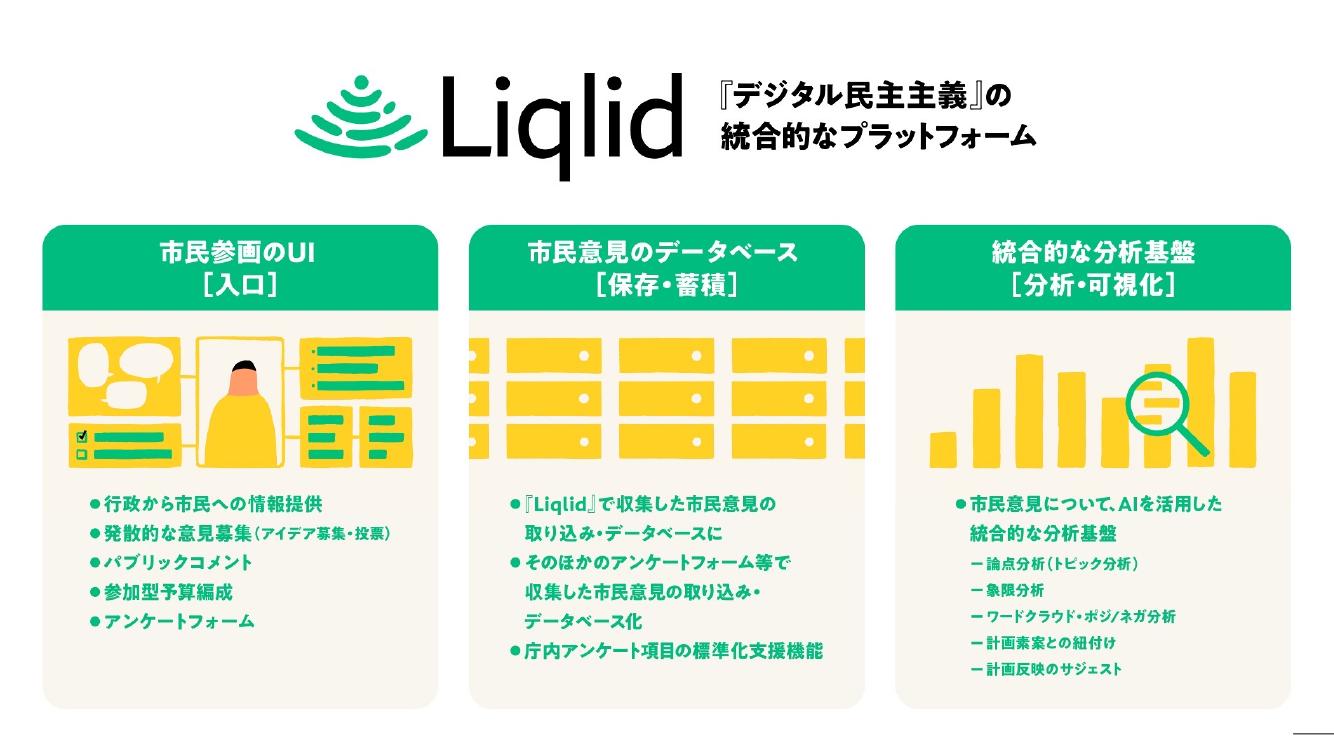
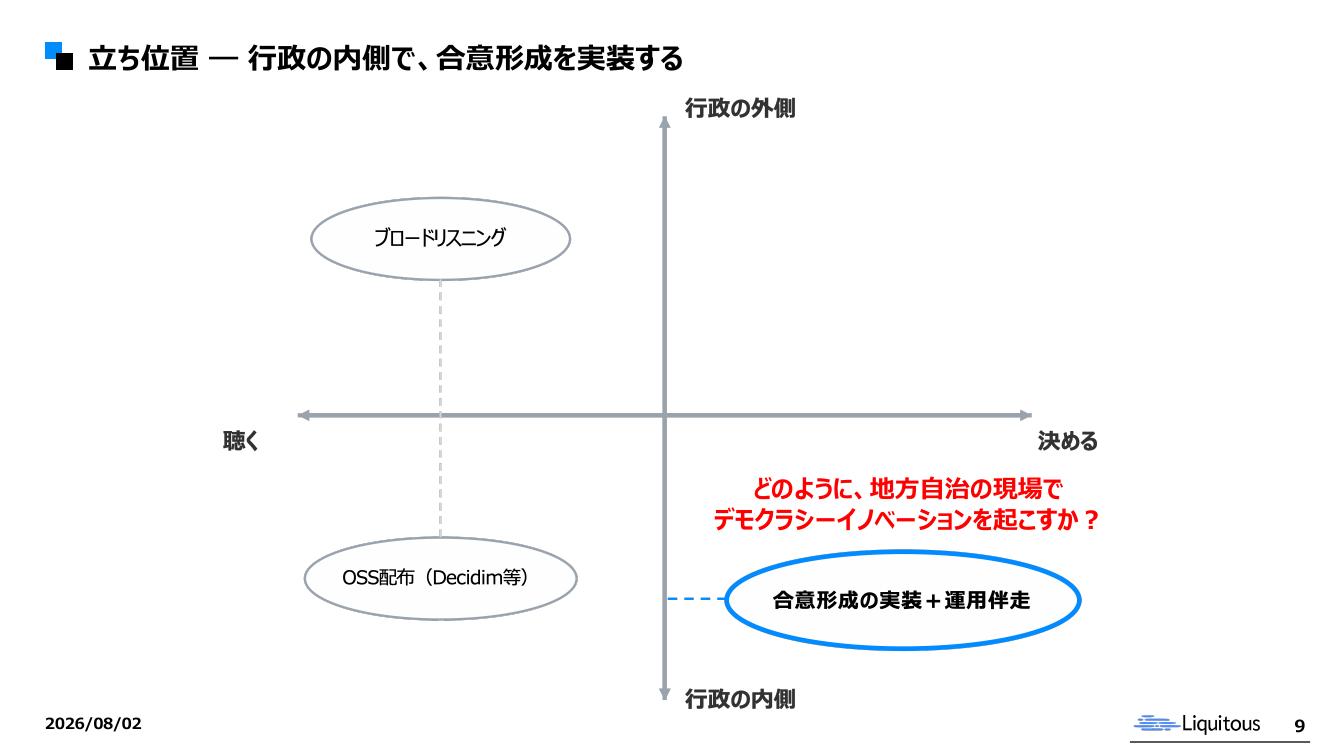
On this basis, rather than simply introducing the tool, we aim to create democracy innovation on the ground by doing things that have not been done before. By working together with local governments, we aim to increase the number of "democracy innovationpreneurs" among frontline staff. It is not enough for participation to happen just once; by continuously repeating participation, we aim to create a culture of participation and engagement. Our position is to enter the administration to implement new citizen-participatory consensus building and to accompany its operation.
4. The Structure of Public Comment - Listening at a Stage That Can No Longer Be Changed
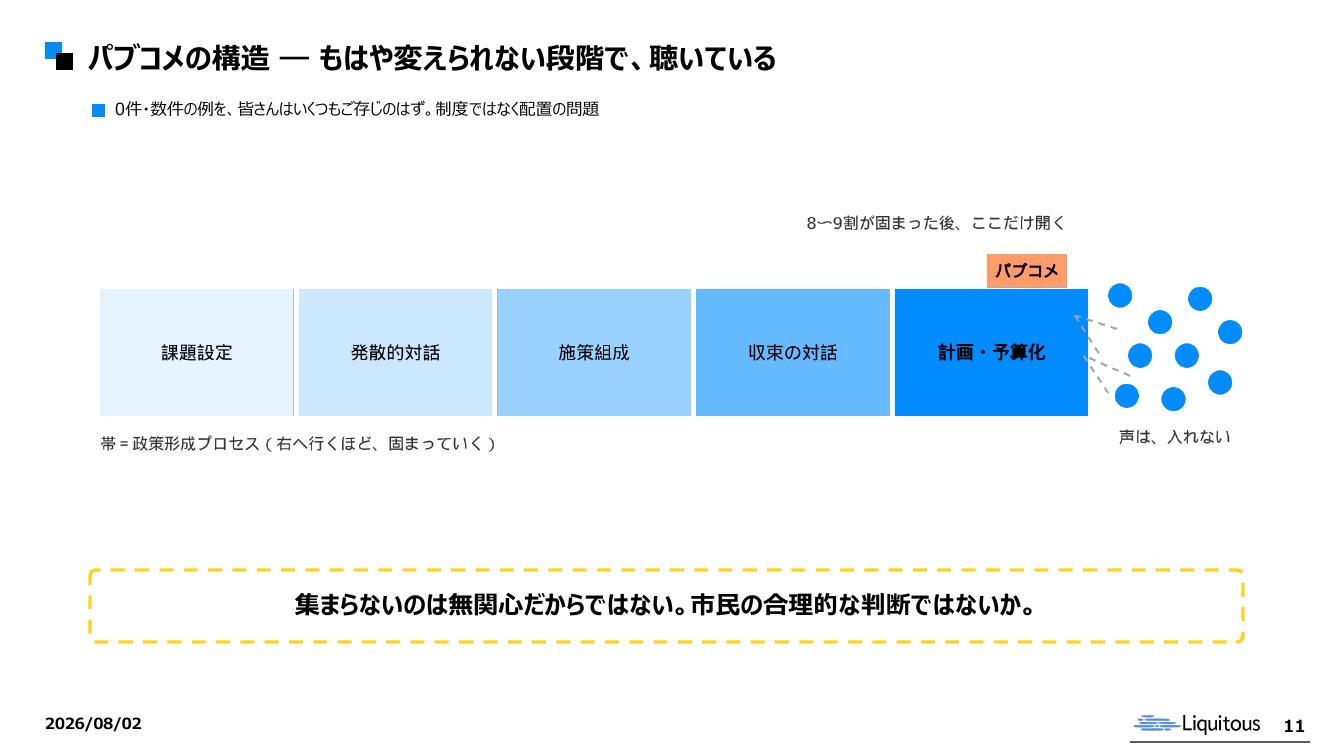
So, what is democracy innovation aiming for? Local governments have a public comment system. This is a mechanism for listening to voices when the administration creates a plan, but in reality, listening happens almost at the very end of the creation process, after 80% to 90% of the work is completed internally within the administration. I believe the reality is that we are listening at a point when, both practically and in terms of schedule, it is no longer possible to reflect the feedback, after internal adjustments within the government office are finished and, in some cases, after explanations to the assembly have already been given. No matter how much we digitize this stage, new voices will not be incorporated.
The democracy innovation we speak of means opening up this policy formation process to citizens at an earlier stage. It is not at all about doing the previous public comments online; it is about opening the process from the stage where the administration has not yet finished setting the agenda, or is still in the consideration phase. The target of this opening might be administrative plans or citizen collaboration initiatives. As is often said regarding public-private partnership and public-private co-creation, public endeavors are not carried out by the power of the administration alone, so we also open up initiatives led by the private sector.
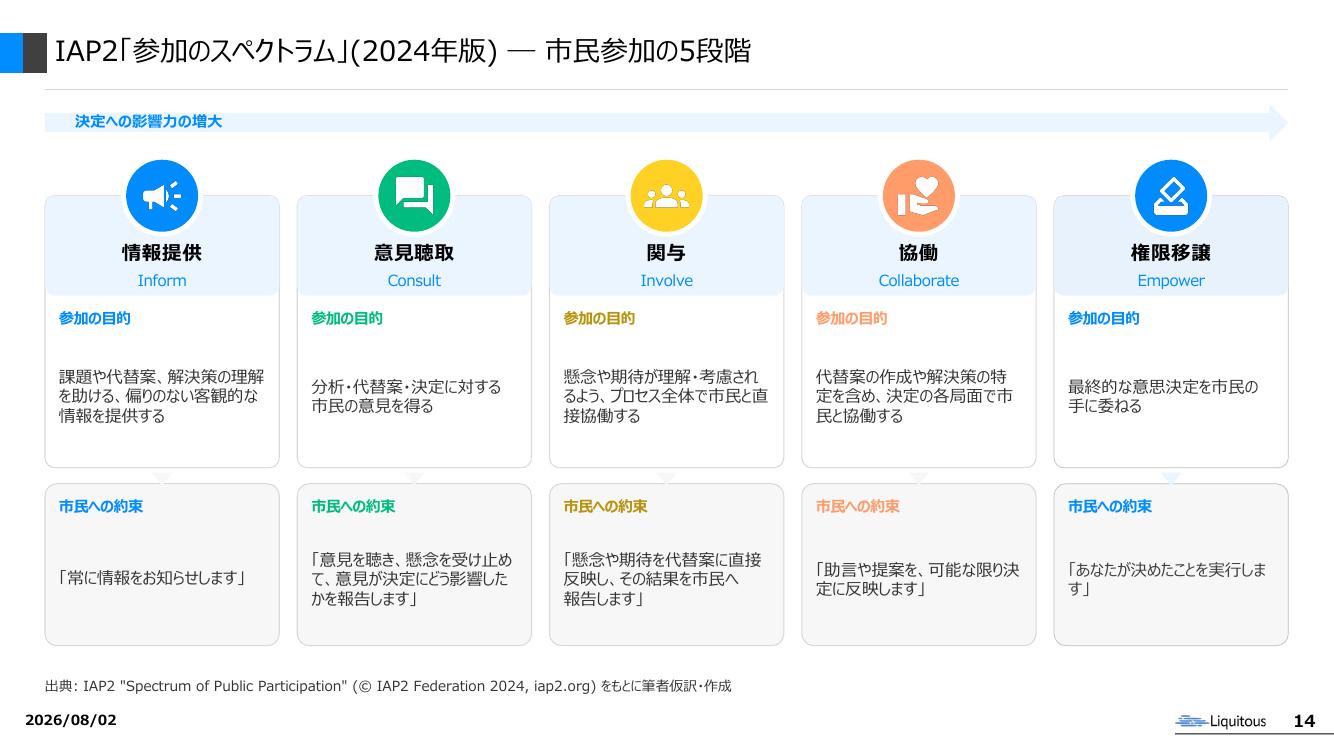
In doing so, we emphasize the "Spectrum of Participation" by the International Association for Public Participation (IAP2). Even the single word "participation" encompasses five stages: information, consultation, involvement, collaboration, and empowerment. It is not a matter of which is best, but rather an organization where, as you move to the right, the scope of citizen involvement expands and their influence on decision-making increases. Previous citizen participation has remained at the second stage from the left, consultation. In addition to listening at an early stage, how to create more elements on the right side is also considered an important element of democracy innovation.
5. Opening Up at an Early Stage - Toyooka, Kamakura, Fukuchiyama
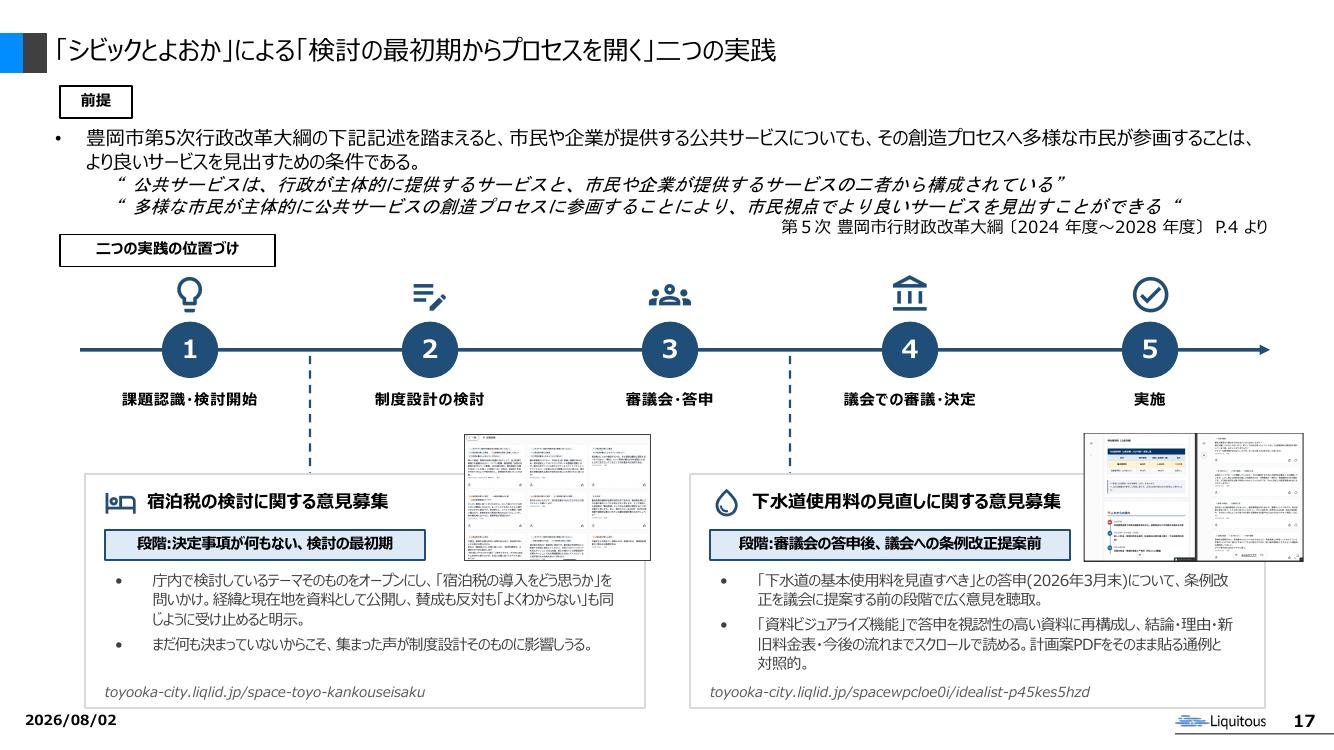
In Toyooka City, Hyogo Prefecture, we have been using our platform across all municipal departments as a foundation for co‑creation with citizens since fiscal year 2025. Among themes such as shortening office hours, children’s spaces, and comprehensive strategies, the two practices I would like to highlight are those that opened the process to the public from the very early stages of deliberation: a call for opinions on a proposed lodging tax and a call for opinions on sewer usage fees. For the lodging tax, while the internal team was still sorting out the issues, we opened the process to citizens and listened to their voices – something that would previously have been done only after the administration had set a direction. The sewer usage fee is normally determined by ordinance; however, before an ordinance draft was prepared, a council recommendation to raise the fee was issued to the city. At that moment we used the platform’s visualisation function to turn the formal administrative documents into easy‑to‑understand graphics and asked, “This recommendation has been made; what do you think?” Traditionally, public comment on an ordinance draft would be collected just before the council vote, but here we sought input far earlier. We consider this a major initiative.
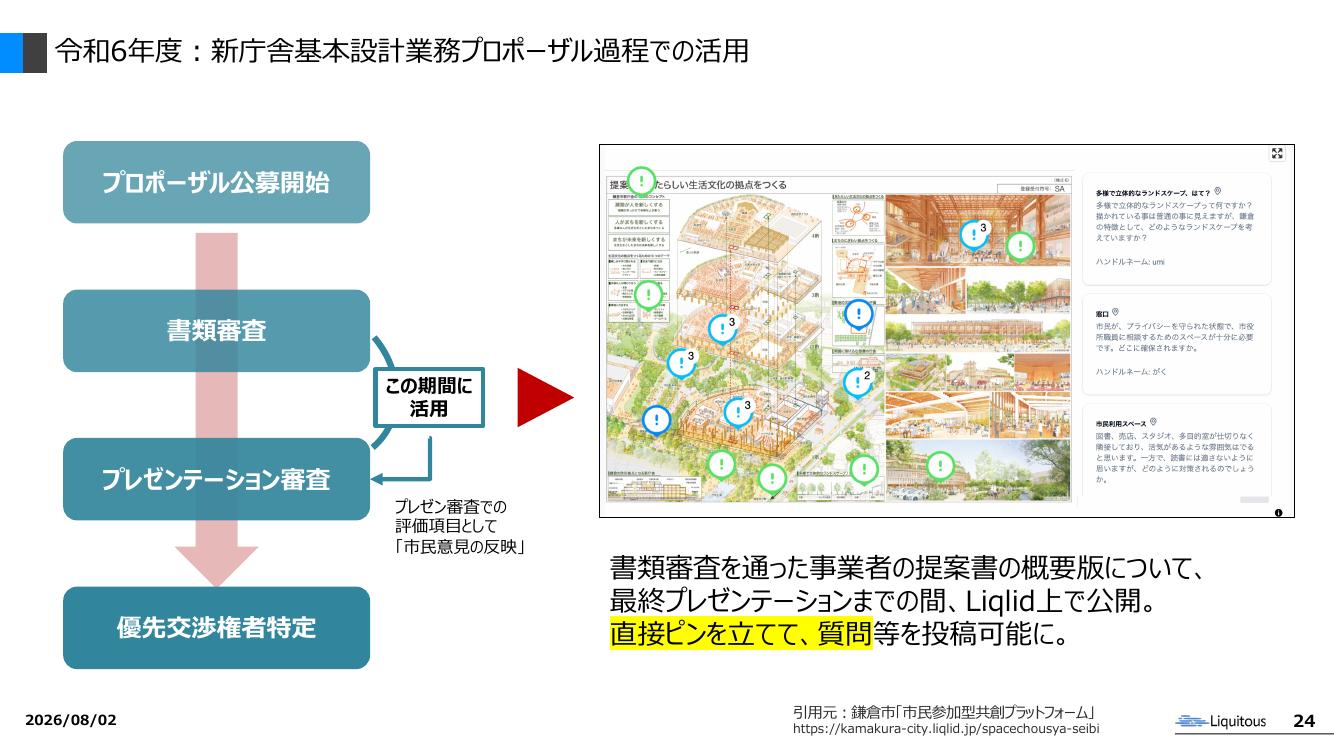
Kamakura City in Kanagawa Prefecture started using the platform in fiscal year 2022, making this the fifth year of use. What was distinctive is that it was employed during the proposal stage for a new municipal building. Such hard‑infrastructure proposals had previously been selected by committees composed of a limited number of people. Instead, the city used the platform to bring the voices gathered from residents into the presentation review process.
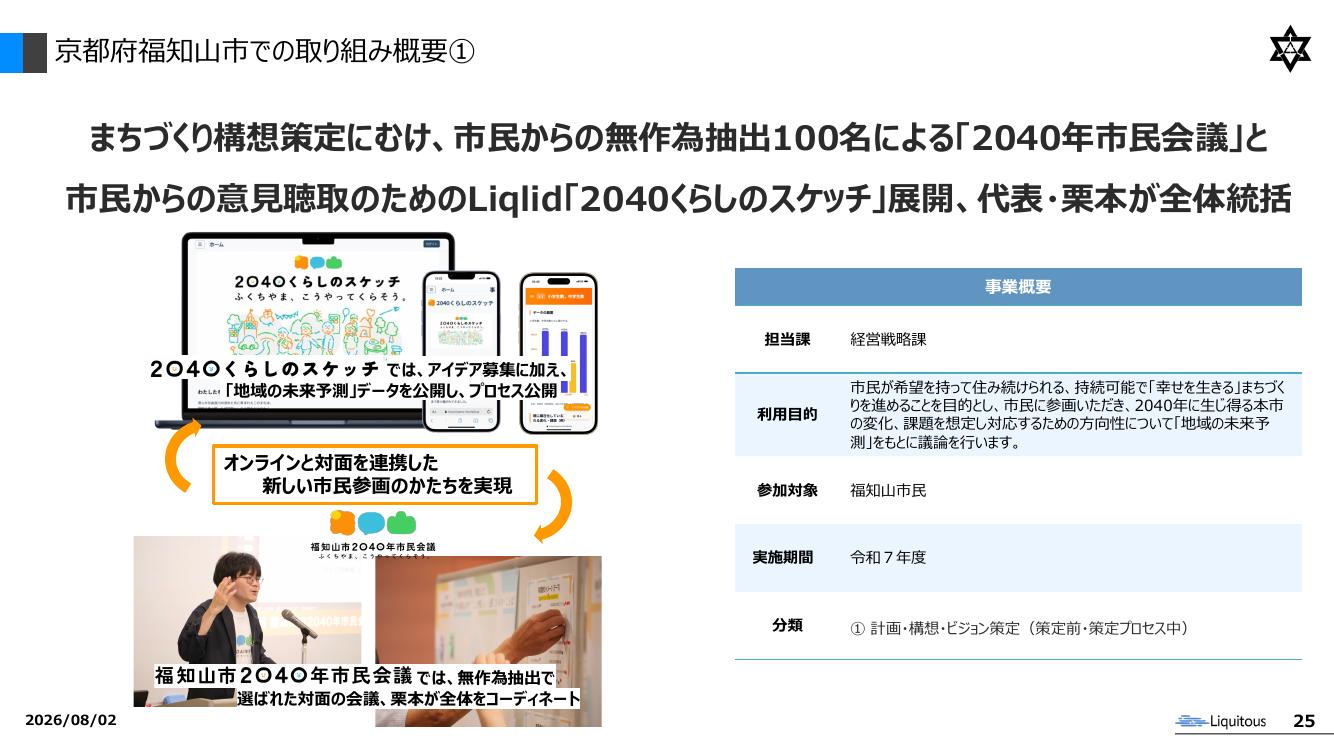
The case of Fukuchiyama City in Kyoto Prefecture illustrates that digital tools are not a panacea. The question was how to reach a more diverse set of citizens. Last year, alongside an online platform, the city sent random notifications to 2,000 residents selected from the basic resident register and held a lottery‑type meeting five times a year. The interesting finding was that the in‑person side, being lottery‑based, attracted participants who had never interacted with the administration, but over the five meetings the participation of younger people gradually declined. In contrast, the online side consistently retained a high proportion of younger participants. This shows that relying solely on online methods is insufficient; a thoughtful combination of both face‑to‑face and digital approaches is essential.
6. Questioning the Premises Itself – Children’s Opinion Gathering in Shizuoka Prefecture
In Shizuoka Prefecture, a prefecture‑wide initiative to gather opinions from children and young people began in fiscal year 2024, following the enactment of the Basic Act on Children in April 2023. When local governments consider or evaluate policies concerning children, they are now obligated to hear children’s voices. Every municipality struggled with how to make this obligation concrete. A small town might be able to hold wide‑reaching workshops, but a large, geographically dispersed prefecture like Shizuoka faces difficulties. Hence the decision to use an online platform.
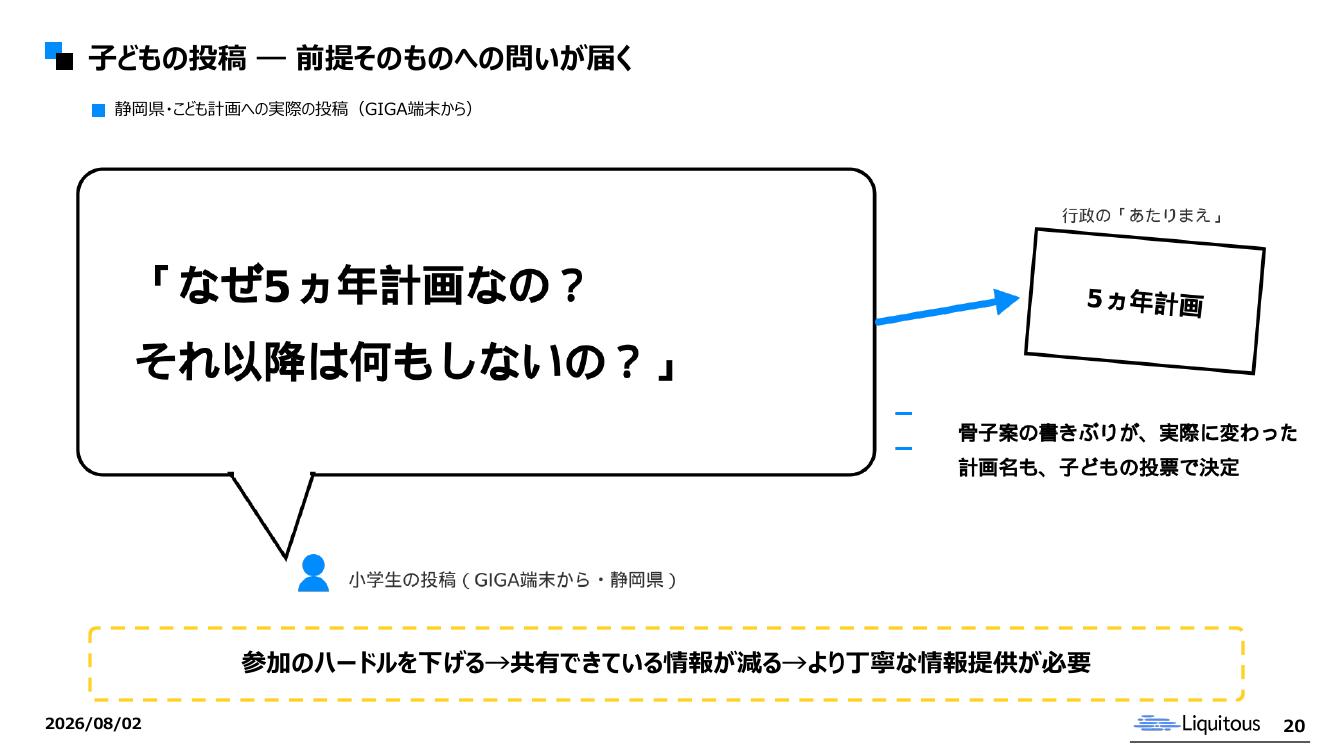
What was striking was the opinion‑gathering exercise for the children’s plan in fiscal year 2024. The traditional method attracted only those who could read a great deal of information and who already shared the underlying assumptions, so few comments questioned those premises. When the online platform lowered the participation barrier, comments such as “Why is this a five‑year plan?” emerged, directly challenging what the administration takes for granted. Of course, the prefecture does not intend to finish the plan in five years; a review is scheduled after five years, but the previous methods had not effectively shared those underlying assumptions. Therefore, the prefectural government feels that a strong mission is to determine how to share premise information when using the platform for opinion gathering. The very emergence of such awareness within the administration is, in itself, meaningful.
7. Not Limited to Administrative Actors – Kashiwa‑no‑Ha Smart City
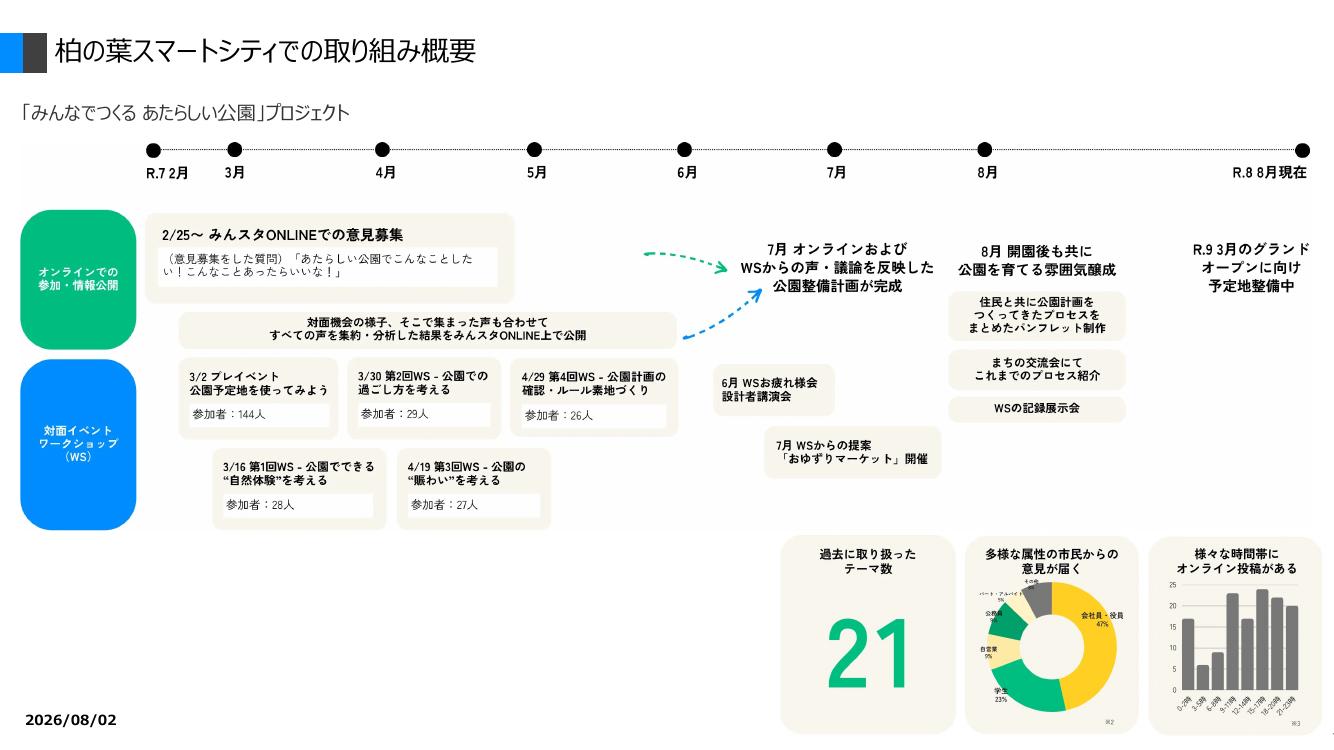
The platform's use is not limited to government bodies. Kashiwa‑no‑Ha Smart City, an area of about 20,000 people around the Kashiwa‑no‑Ha Campus Station on the Tsukuba Express line in Kashiwa City, Chiba Prefecture, is managed by a private area‑management organization called Urban Design Center Kashiwa‑no‑Ha (UDCK), which includes Mitsui Fudosan, Kashiwa City, the University of Tokyo and Chiba University. This private consortium uses the platform to collect a wide range of resident opinions. Over roughly the past three years, about 21 topics have been addressed. For a park‑creation project, the UDCK gathered online feedback while also holding face‑to‑face workshops, mixing various voices to shape the park – a process that is actually taking place.
8. Expansion to Designated Cities and New Themes – Kyoto, Nagoya, and Public‑Facility Management
Government‑led initiatives have also spread to designated cities. In Kyoto City, the platform was used in fiscal years 2024 and 2025 as part of the citizen‑participation mechanism for drafting a long‑term comprehensive plan that will guide the city for the next 25 years. Designated cities are very large, and face‑to‑face workshops alone cannot cover all needs. Building on this effort, from this fiscal year the city is conducting a “listening‑DX” project that jointly advances the analysis and advanced processing of citizen opinions already collected by the administration. A similar effort started this fiscal year in Nagoya City.
At the same time, the renewal of public facilities built during the period of rapid economic growth is a nationwide issue that often lacks consensus, and we see platform utilisation as one possible entry point for tackling it.
9. Combining with Broad Listening – Osaka Prefecture (with Section Chief Matsumoto)
Osaka Prefecture combines the platform with a crawl of social‑media posts, known as broad listening. Last year Osaka revised its smart‑city strategy and proclaimed a resident‑participation‑oriented smart city. In line with the strategy revision, the governor’s press conference invited people to post on social media with a designated hashtag or to submit comments via the platform. This fiscal year, broad listening is being rolled out across the entire prefectural administration as a pilot project.
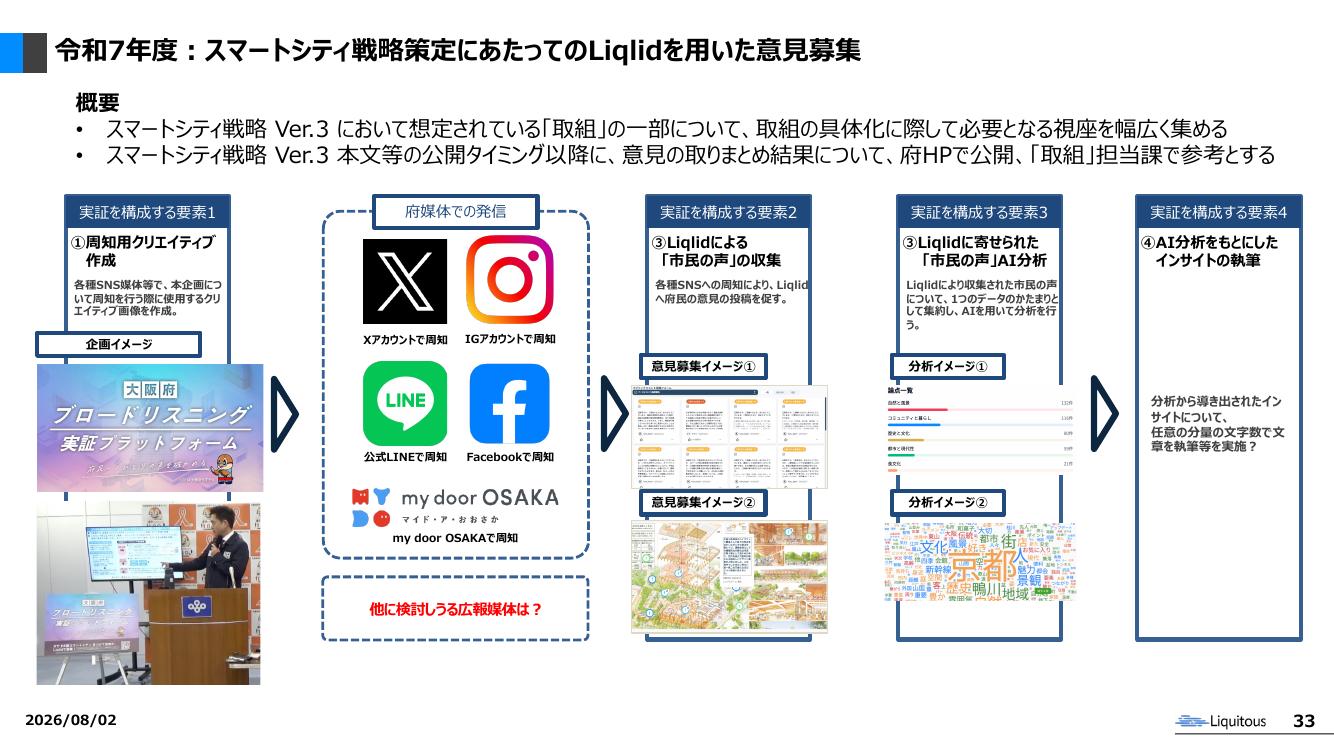
We also received comments from Section Chief Matsumoto of the Osaka Prefecture Smart City Strategy Department's Strategic Planning Division, who is collaborating on this project. The gist of his remarks is as follows.
"Prefectures primarily support municipalities rather than deliver services directly to residents, but they do run some direct‑service initiatives such as libraries and services for inbound foreign tourists. This fiscal year we are examining whether we can conduct broad listening for about 20 services that are directly delivered to residents. While I, as a civil servant with over 20 years of experience, agree that public comment can be too late, the world of social media has been expanding for more than a decade. We want to see what kinds of voices we obtain from SNS, whether they differ from the voices we have traditionally captured, and, with the help of Mr Kurimoto's expertise and Professor Eiji Kawano of Osaka Metropolitan University's sociology department, we will test this as a pilot and, if valuable, move toward implementation." (Matsumoto)
10. It Is the Decision That May Be Late, Not the Response – Nagaokakyō City’s Community‑Activation Contest
My concern is that it is acceptable for the decision itself to be delayed, but not the speed of feedback.

In Nagaokakyo City, Kyoto Prefecture, we have been using the name "Voice NAGAOKAKYO" since fiscal year 2024. There are various themes such as the redevelopment of the station area, renewal of walking routes, and integrated renovation of the library and community center, but the initiative we are especially advancing this year is the "Town Activation Contest." The administration provides subsidies to citizen‑activity groups, and citizens take part in the decision‑making process. Among the projects already selected, citizens vote on which ones should receive additional funding. Because citizens are involved in the decision‑making itself, we consider this a major step into the far‑right of the IAP2 spectrum, into the delegation‑of‑authority side.
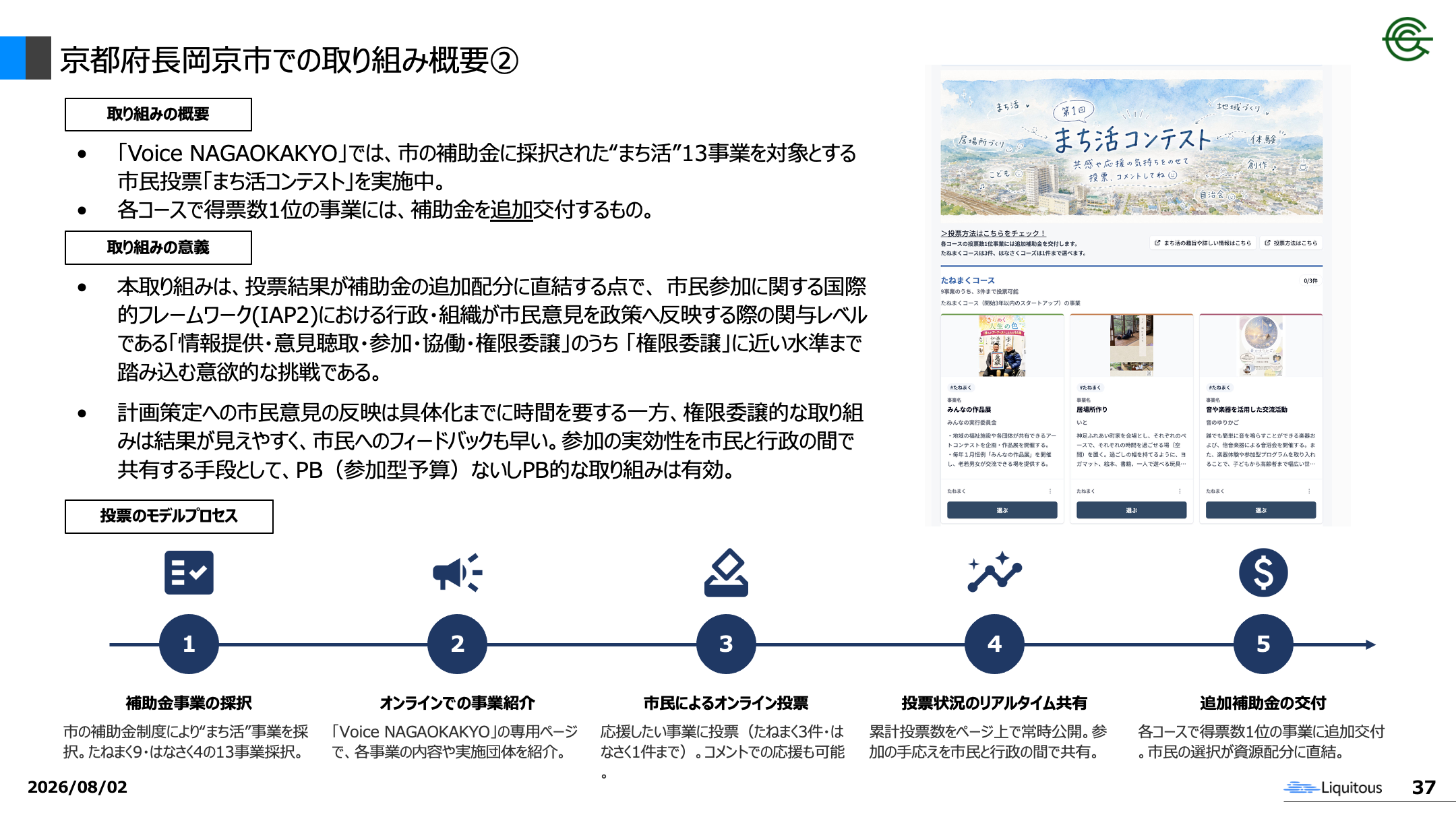
Speed is also important. Public comment processes take time to receive responses, and even when something is written into a plan, it takes even longer for it to be reflected in everyday life. With this initiative, the time from participation to seeing actual ripple effects is very short. I am not saying everything must be done this way, but if we do not include such methods, citizens will wonder, "Does participation really matter in the end?" Expanding the use of platforms in citizen‑collaboration initiatives and delegation of authority is therefore essential.
11. Exporting Soft Infrastructure – Practice in Indonesia
My basic idea is whether we can spread such activities, which originated in Japan, to other countries. For several decades after the war, Japan exported hard infrastructure—roads, railways, power generation, water and sewage systems—through ODA, and that has become the foundation of Japan’s presence abroad. From now on, perhaps we can export the practical knowledge of democracy as soft infrastructure.
In fact, last year in Indonesia, under the Ministry of Foreign Affairs' Japan‑NGO partnership grant, we conducted a "Program Review" that evaluates government projects through citizen participation. The review covered a central‑government ministry project and a project in Pekalongan City in central Java (population about 300,000). Voices were collected online in advance, then reviewed in a face‑to‑face meeting while looking at those voices, and finally the self‑evaluation was conducted again on an online platform.
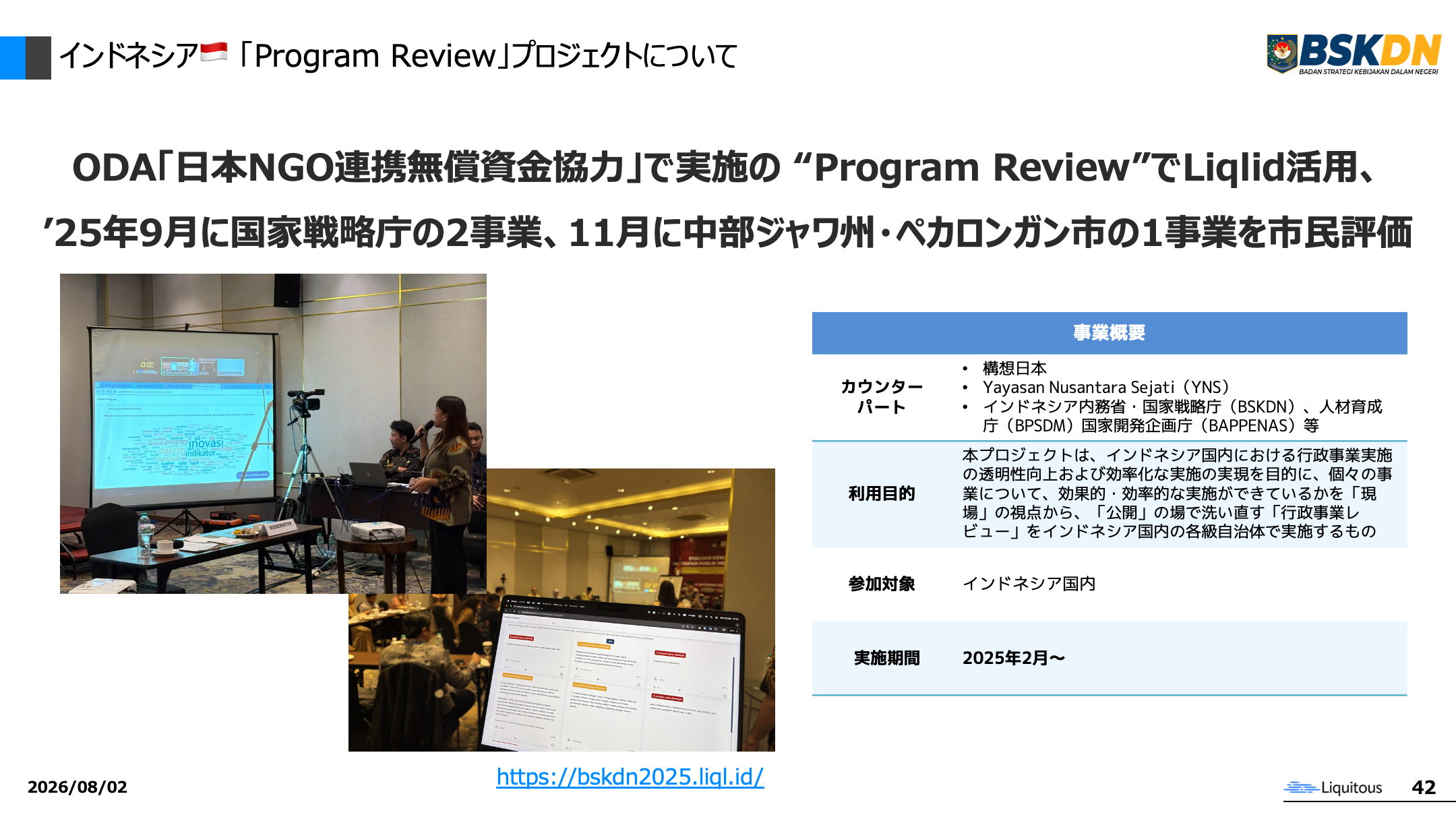
Many may wonder how such initiatives will be received in Southeast Asia, but I think they are very compatible. In Indonesia, the law requires a citizen‑participation process called Musrenbang when deciding budgets and urban plans. Officials have struggled a lot with digitising this process, which has traditionally been done only face‑to‑face. That makes the fit especially good, and the approach is spreading not only in Indonesia but also in other Asian countries.
12. Relationship with Representative Democracy – Parliament and Political Leadership
When advancing these initiatives, the thing I always worry most about is how to combine them with representative democracy.
There was a time when people said that if everyone had a device, direct democracy would be possible. Will such an era really arrive? It may sound surprising coming from my position, but I personally believe that representative democracy is important in its own right.
In fact, local assemblies and online platforms are beginning to blend well. The platform is provided by the administration, yet the voices that gather there are being referenced effectively by council members. Cases are increasing where a council member says, “We saw these voices on the online platform, there was this trend, this issue came up—what do you think about it?” and uses them as a reference automatically.
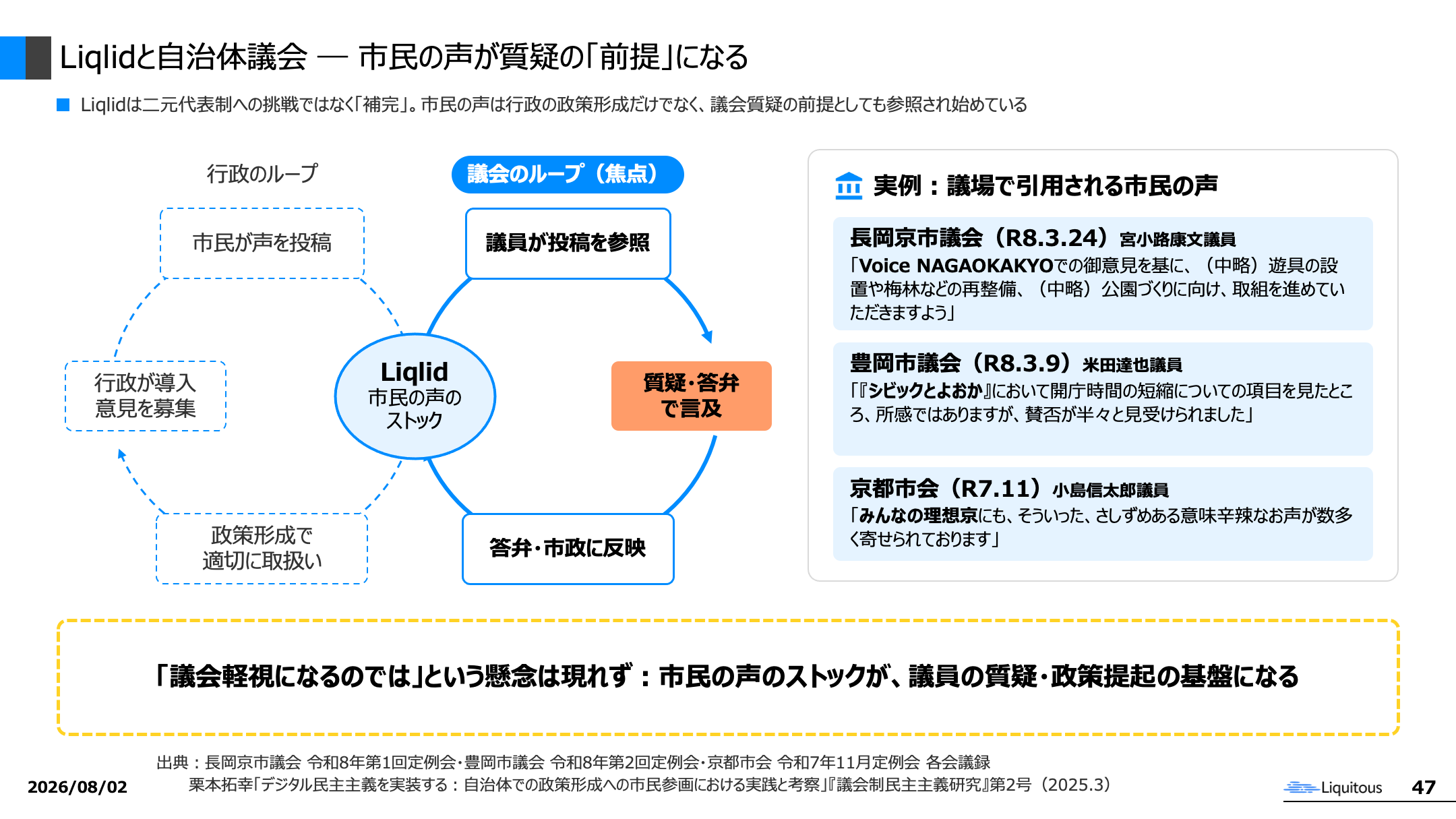
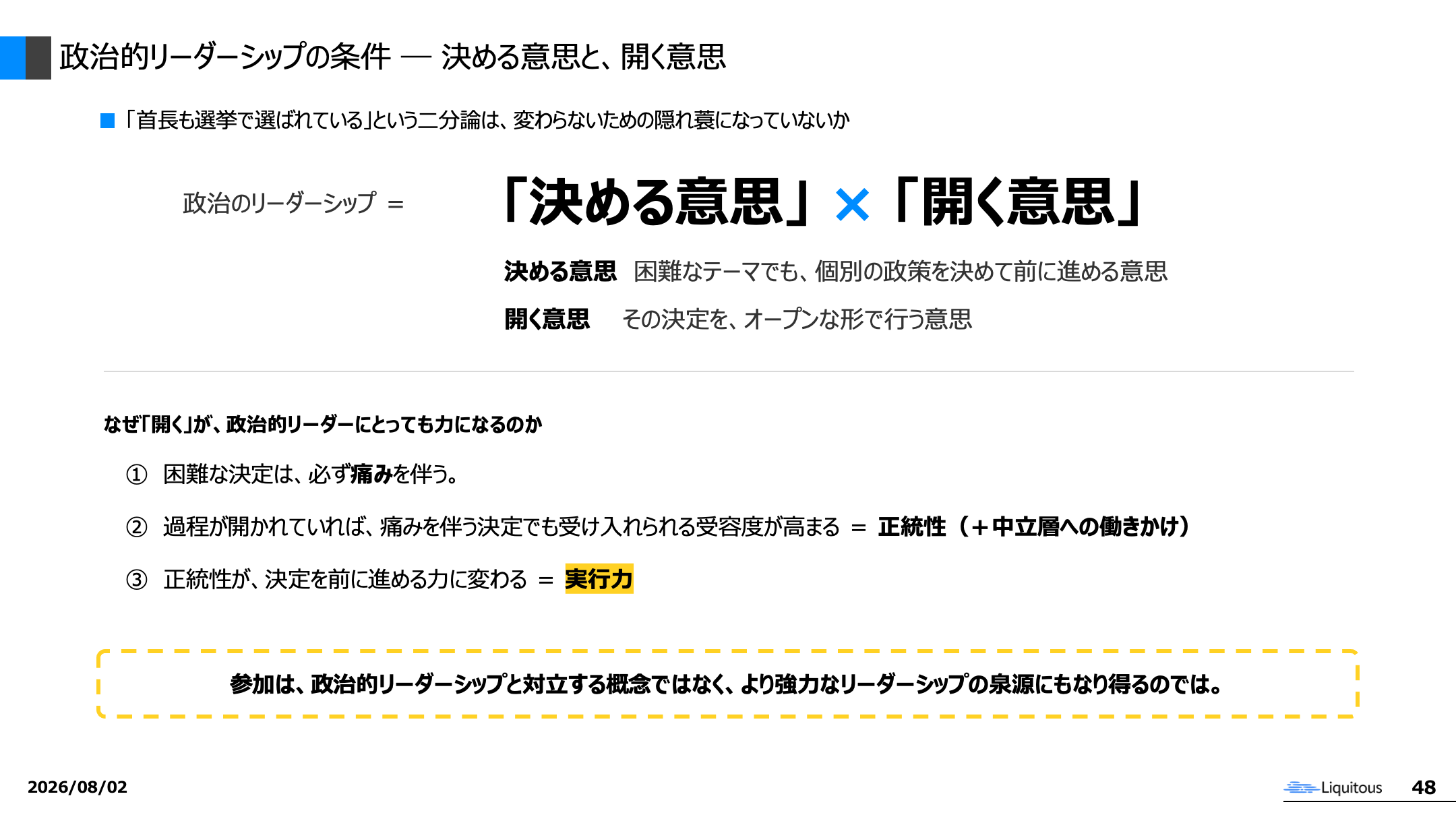
Moreover, the most important factor when creating participatory processes is political leadership. Without the willingness to open up, there is no listening to voices. And after hearing a wide range of voices, if the political leader does not intend to make a decision based on them, the listening will not happen. This platform appears to champion direct democracy, but in reality it is questioning the meaning of representative democracy. That aspect is significant.
13. By the Numbers – From Our Own Research
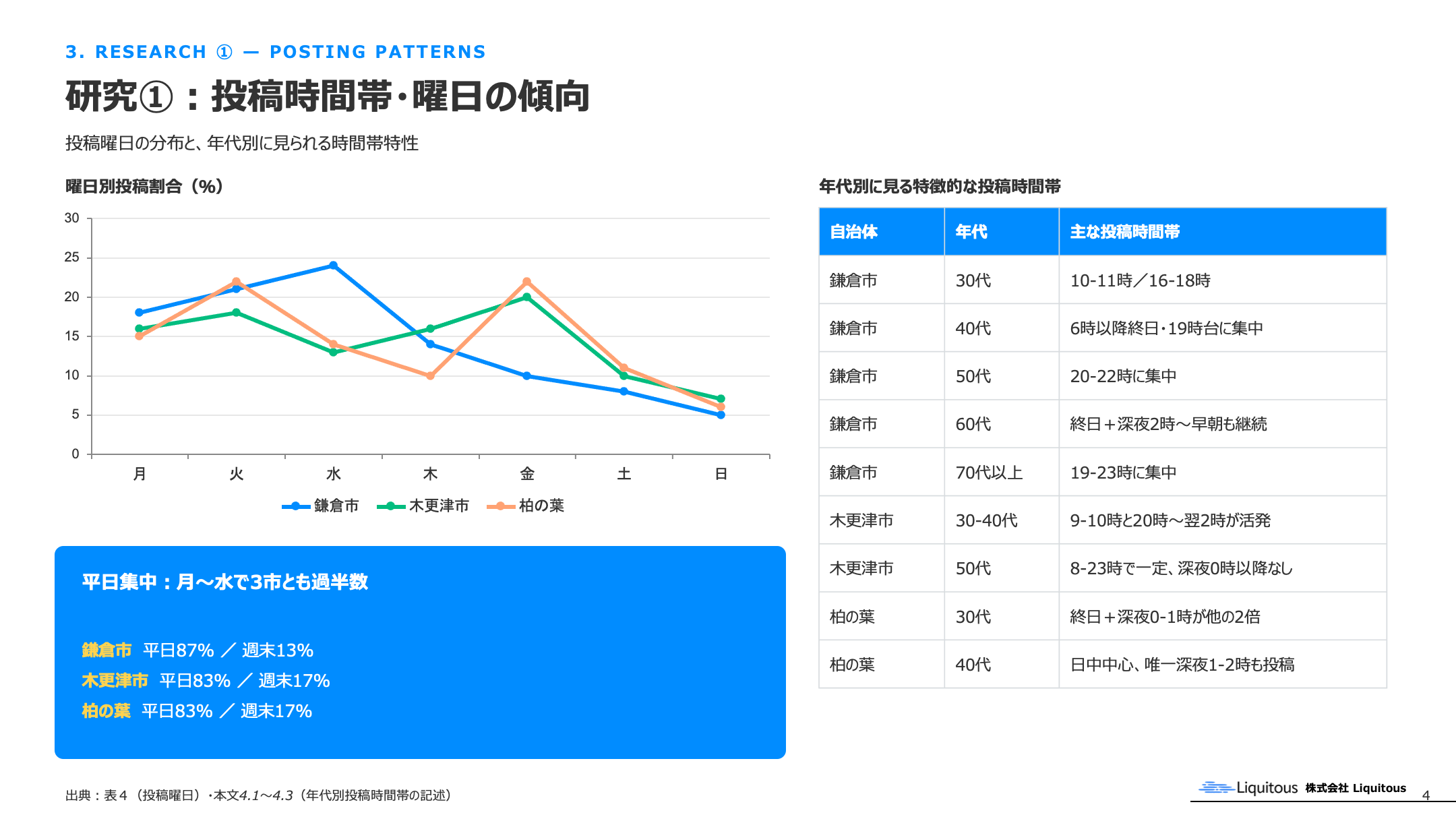
We conduct various independent surveys and studies. In the research we are currently pursuing, the introduction of such platforms consistently increases participation among people in their 30s to 50s, regardless of which organization is integrated. At the same time, about half of all posts occur during times when offices are closed or on weekends. We see this as capturing voices that the municipal offices could not otherwise collect. When looking at days of the week, strong regional patterns emerge; in commuter‑town type municipalities, weekday posts are especially prominent. Participation therefore tends to be a weekday activity, with relatively little engagement on days off.
We are also working with the University of Helsinki to quantitatively assess how municipal staff attitudes change through platform and citizen‑participation/co‑creation initiatives. Using their twelve indicators, we evaluate staff readiness for participation. In municipalities that have introduced platforms using grant funds, some have built a self‑review system that uses IAP2 indicators to ask, “What have we achieved this fiscal year, and have we gone beyond mere opinion gathering?”
14. Technology Is Not Neutral – Rights‑Based Requirements Definition
Since this is a good opportunity, I will also talk about the parts that trouble me regarding how we deal with technology. Around 2018, when I thought about founding this company, there was truly no way to run digital democracy as a startup. As someone who had also run an NPO, I chose the corporate form after much deliberation. That is why we constantly keep the question of whether we can truly be neutral in mind.
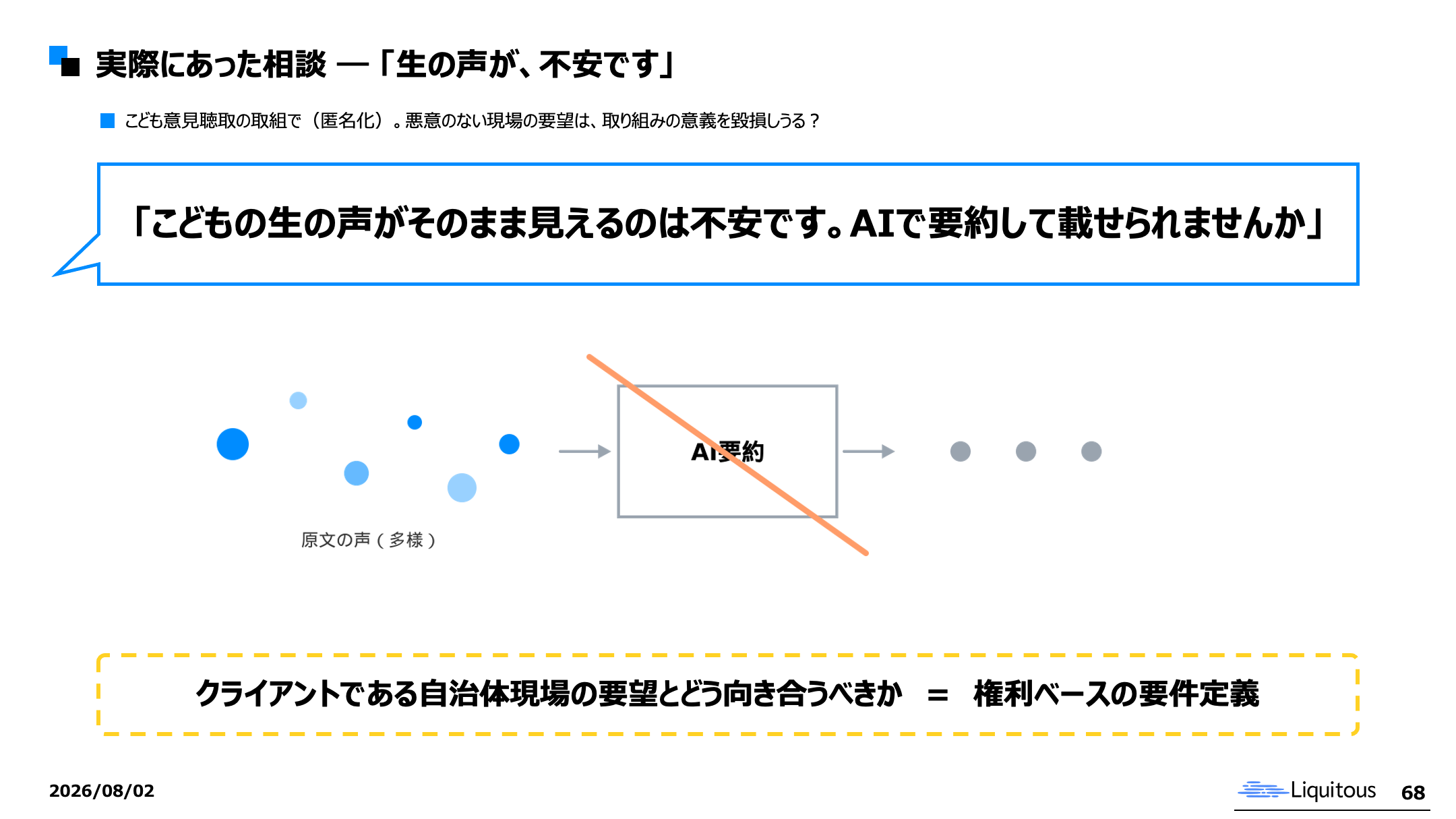
For example, a municipality that wanted to install a platform for collecting children’s opinions asked, “Because we are uneasy about seeing children’s raw voices directly, could you summarize them with AI and post the summary?” Technically it is easy to develop. Without a decision‑making axis, we might simply say, “Sounds good, let’s do it.” But is that really appropriate? We call this a rights‑based requirements definition, and we recognize that it is essential to consider why the function exists before proceeding.
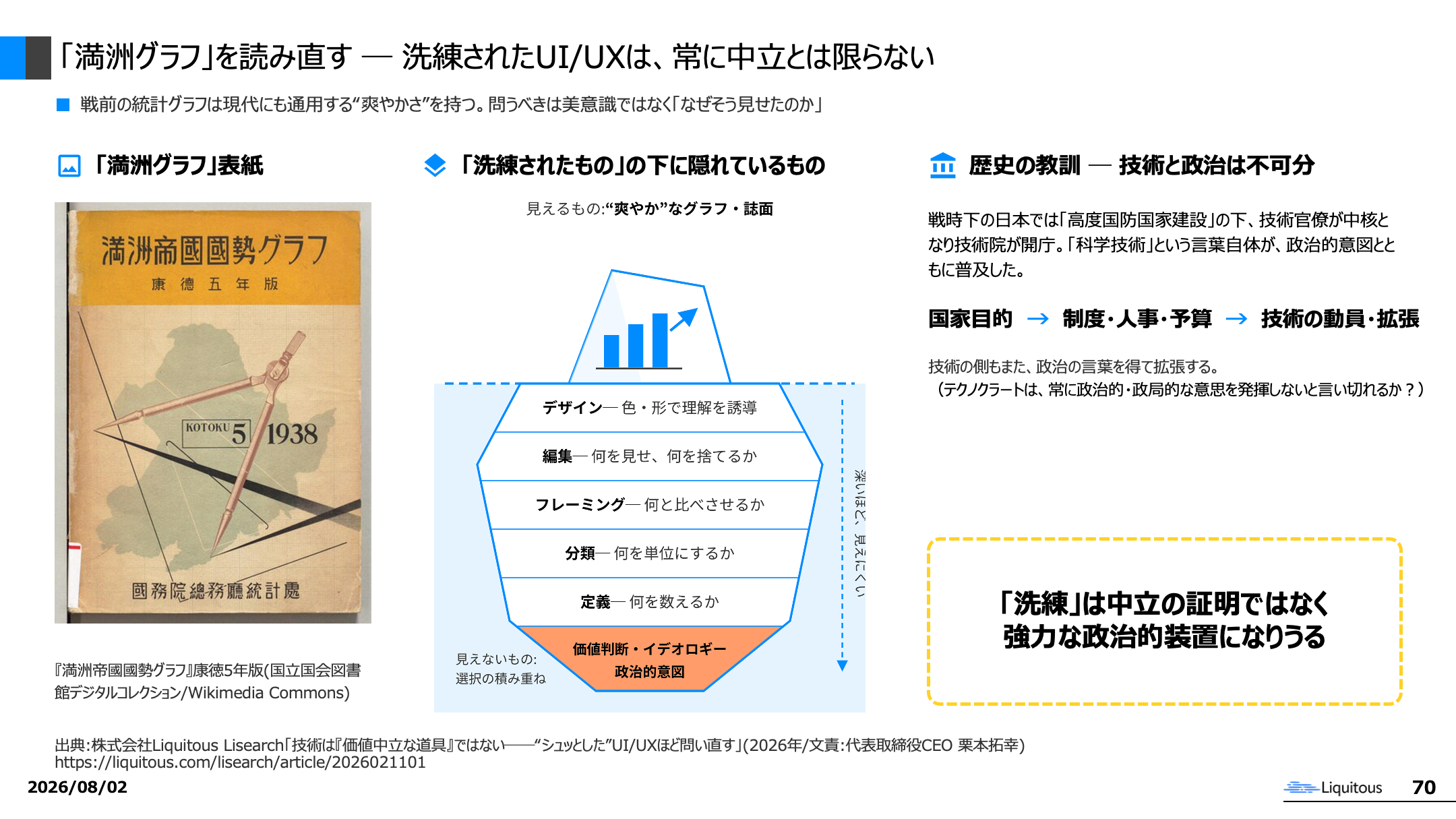
In fact, participatory platforms now exist in authoritarian states such as China. At first glance they have a sleek UI similar to ours, but they are not necessarily operated under democratic values; some countries use them as tools that complement authoritarianism. In short, a cool UI or open‑source status does not guarantee neutrality. That is precisely why, at the technology design stage, it is extremely important to break down what this is for and what the purpose is while defining requirements.
I believe we also need to learn from history. Before the war, when Japan went out to Manchuria, the local area used designs that were, for the time, extremely sophisticated. We must clearly recall why they were used. Even a single platform function or a single design carries deep values and beliefs, and can, depending on the case, become a device with specific political purposes. We always work on this with full understanding. At the same time, we address accessibility by issuing a report every month and continue to improve it.
15. The Next Step of the System – Returning to Article 1 of the Local Autonomy Law
What I would like to say at the end is that perhaps it is time to move beyond purely technical discussions. I often reflect on Article 12 of the Constitution. The freedoms and rights guaranteed to the people by this Constitution must be maintained through the people’s continual effort. I think we must constantly consider what that continual effort entails.
And, from the standpoint of working with local governments, when we read the Local Autonomy Law after Article 92 of the Constitution, Article 1 states, “the assurance of democratic and efficient administration in local public entities.” Various initiatives have been undertaken to digitize administration and improve efficiency—administrative DX. But how far have we actually addressed the “democratic” part of that clause?
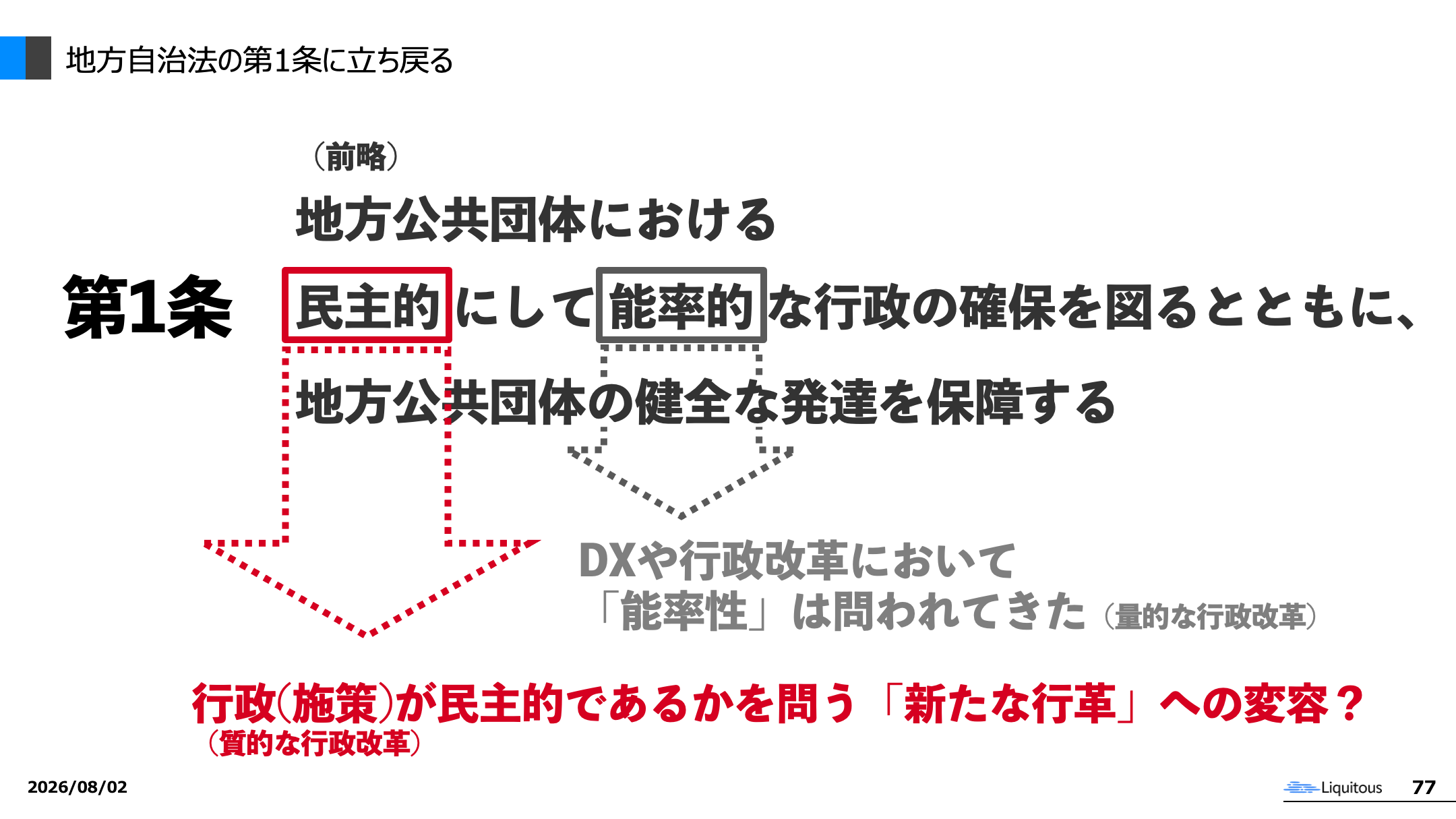
In fact, the 1994 report of the Local System Research Council states that administrative reform should be carried out with the understanding and cooperation of residents, and that this would greatly contribute to the revitalization of local autonomy and democracy. My proposal is to try to do that again.
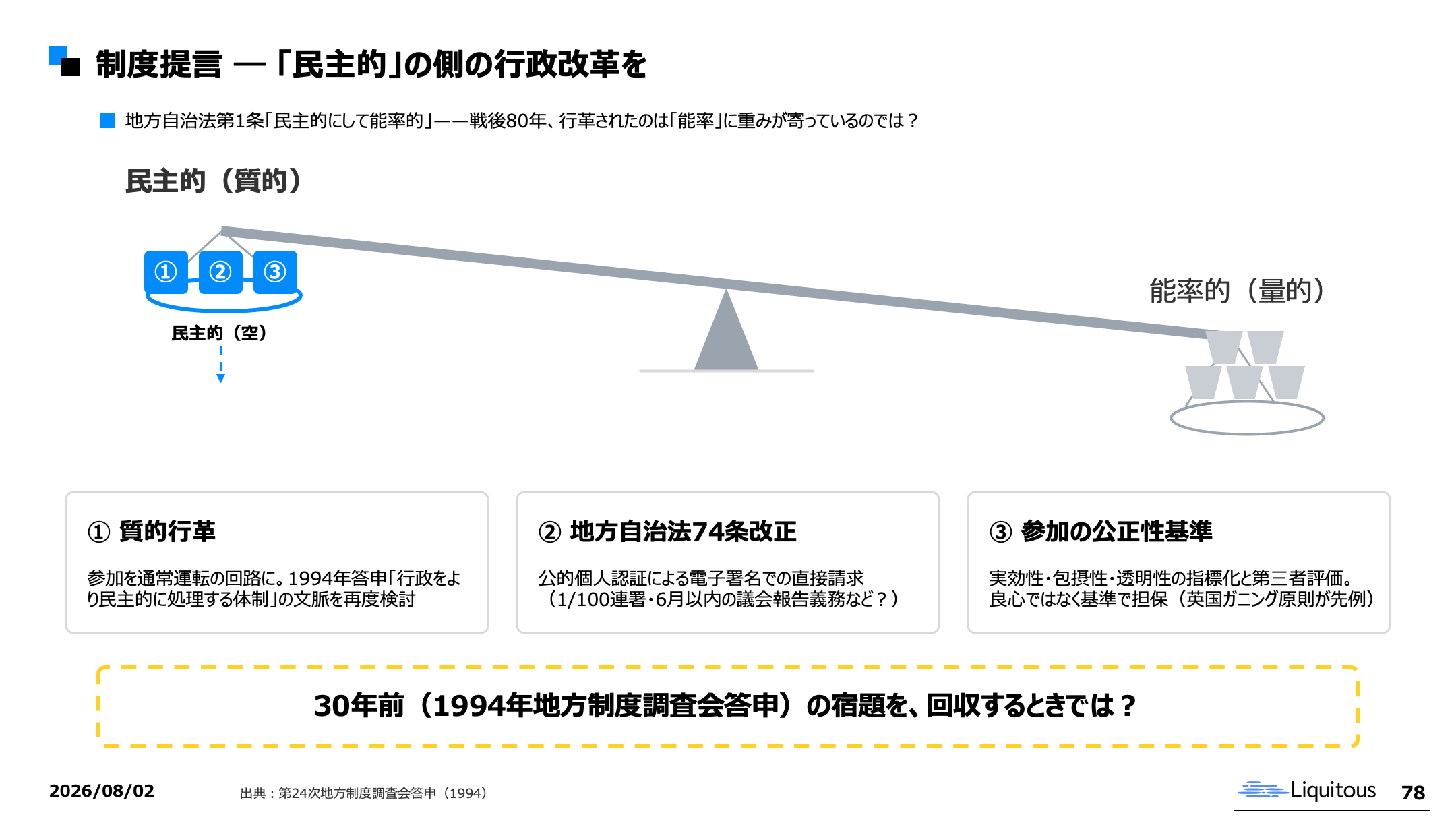
At that time, changing the direct petition provision of Article 74 of the Local Autonomy Law to allow the use of online platforms might be one option. Principles such as England's Gunning principle—where an administrative decision cannot be recognized without appropriate consultation—and movements to codify the right to participate are also useful references. Like participatory budgeting, it is important to translate the voices gathered from citizens into concrete budget measures.
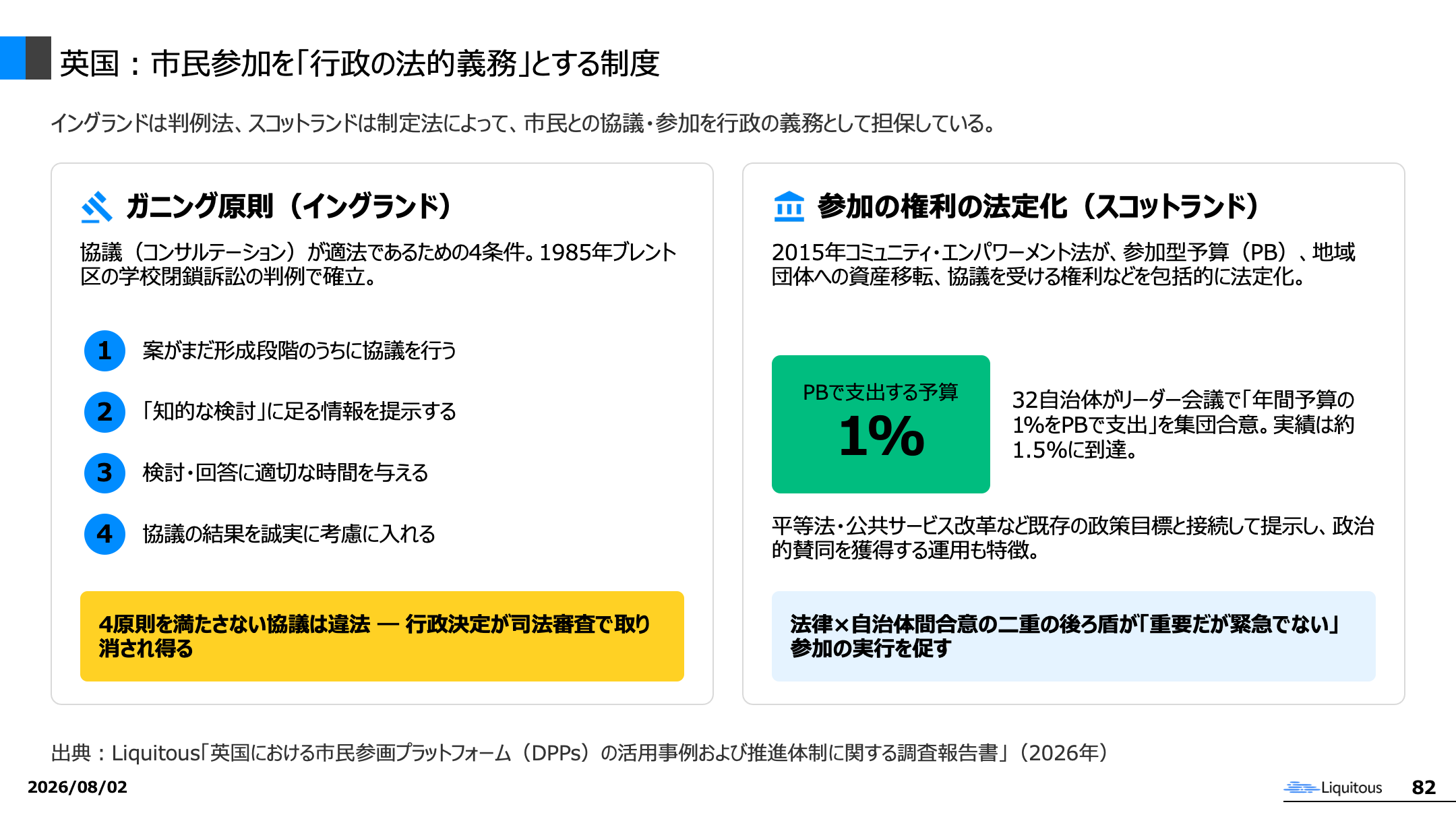
At the national level, the Administrative Oversight Committee’s investigative office in the House of Councillors aggregates petitions from municipalities, and I think it is conceivable that a digital platform could be used as an evolved form of that aggregation.
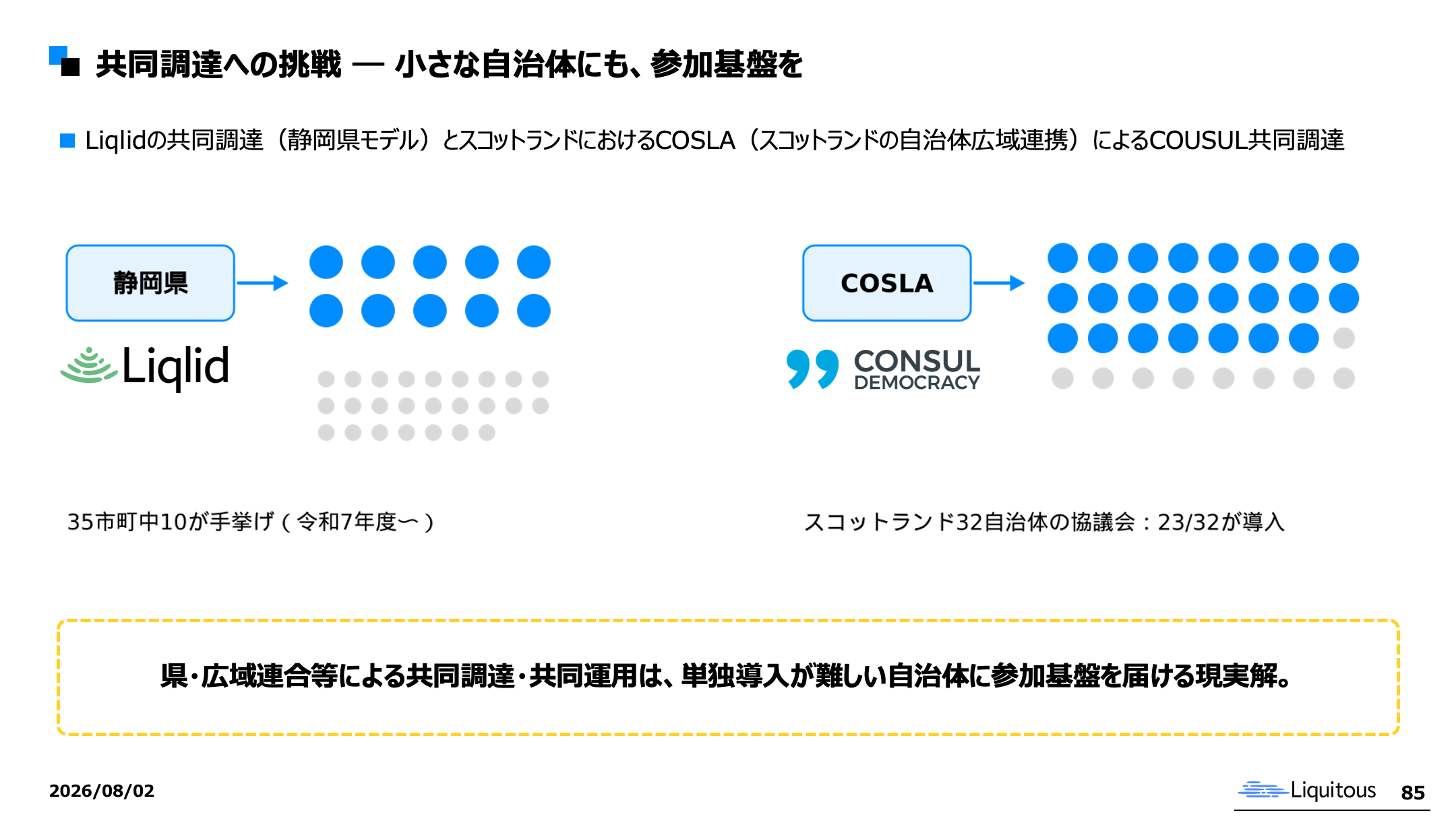
The perspective changes, but because the hurdle is high for each municipality to adopt it individually, creating a joint‑procurement model is also important. We are working on this in Shizuoka Prefecture, and a similar approach exists in Scotland.
16. Responding to Questions from the Audience
In the second half of the talk, I selected several questions and comments from the audience in order of the highest number of “empathy” votes.
The comment that gathered the most empathy was, “When I look at how the administration captures citizens’ voices, I feel despair.” Honestly, I feel that way too. There are far more municipalities that are not doing well, and many that have truly never listened to voices before. However, it is useless to simply say, “This municipality is hopeless.” We must patiently work on the ground, explaining that a voice has meaning beyond its size, that looking at the breadth as well as the count matters, and that providing feedback is essential—not just collecting. Without that, change will not happen. That is why we value not only building tools but also working together with municipalities.
Another important theme is “how to reach groups that do not like to participate via platforms.” It is essential to gather voices through various methods, including but not limited to this system. At the same time, if the analytical side is not made more efficient, public‑sector staff will think, “If it’s that troublesome, we might as well stop collecting voices.” Ensuring efficiency is therefore also necessary.
"Wouldn't random sampling be good for avoiding bias?" is a very important point. However, simply turning it into a lottery does not automatically solve the problem. Many government surveys are already conducted using random sampling, yet response rates remain low, and younger generations do not answer lengthy paper questionnaires. If we introduce a lottery, we also need to consider what to send and how to design it thoughtfully.
The final comment was, "Shouldn't we start by teaching citizens that they have the opportunity to voice opinions to the administration?" I completely agree. I have been following the 2015 amendment to the Public Office Election Law that lowered the voting age to 18, and the subsequent wave of civic education. At that time, the emphasis was not on voter education for elections, but on education that cultivates citizenship. Even when municipalities solicit children's opinions, many do so because "the law requires it," not out of a sense that they are listening to citizens and engaging in dialogue with them. This effort is actually about civic self‑government and is inseparable from democracy. The challenge is how to share that understanding with local governments, and I see this as a major issue.
17. In Closing
It is often said that democracy is quietly shrinking. That may be a critical view of the current situation. At the same time, even if progress is not dramatic, we can still make it better.
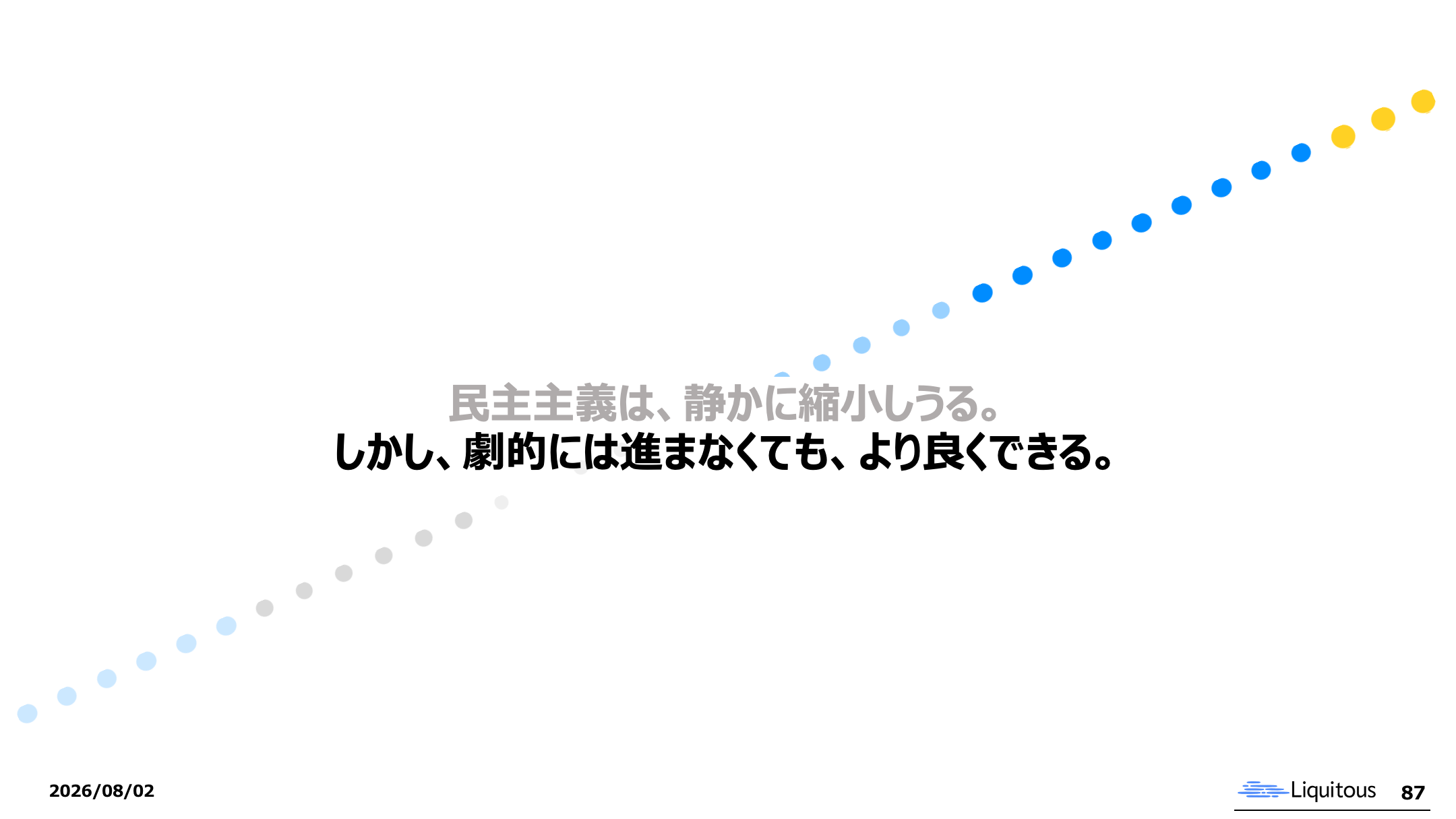
I would like to work together with everyone present here to improve democracy. If you are interested in collaboration, please feel free to contact us.
Today's graphic recording
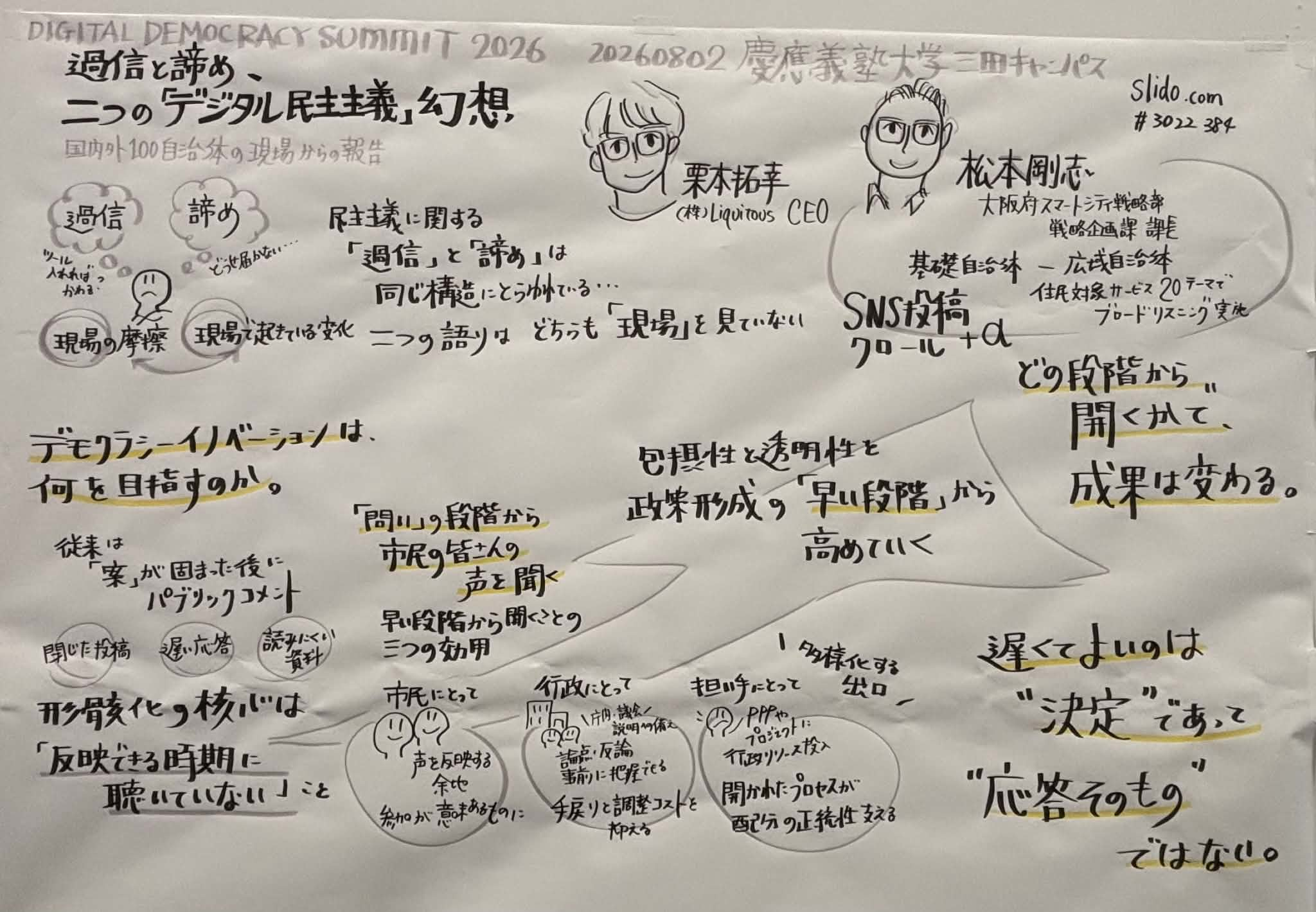
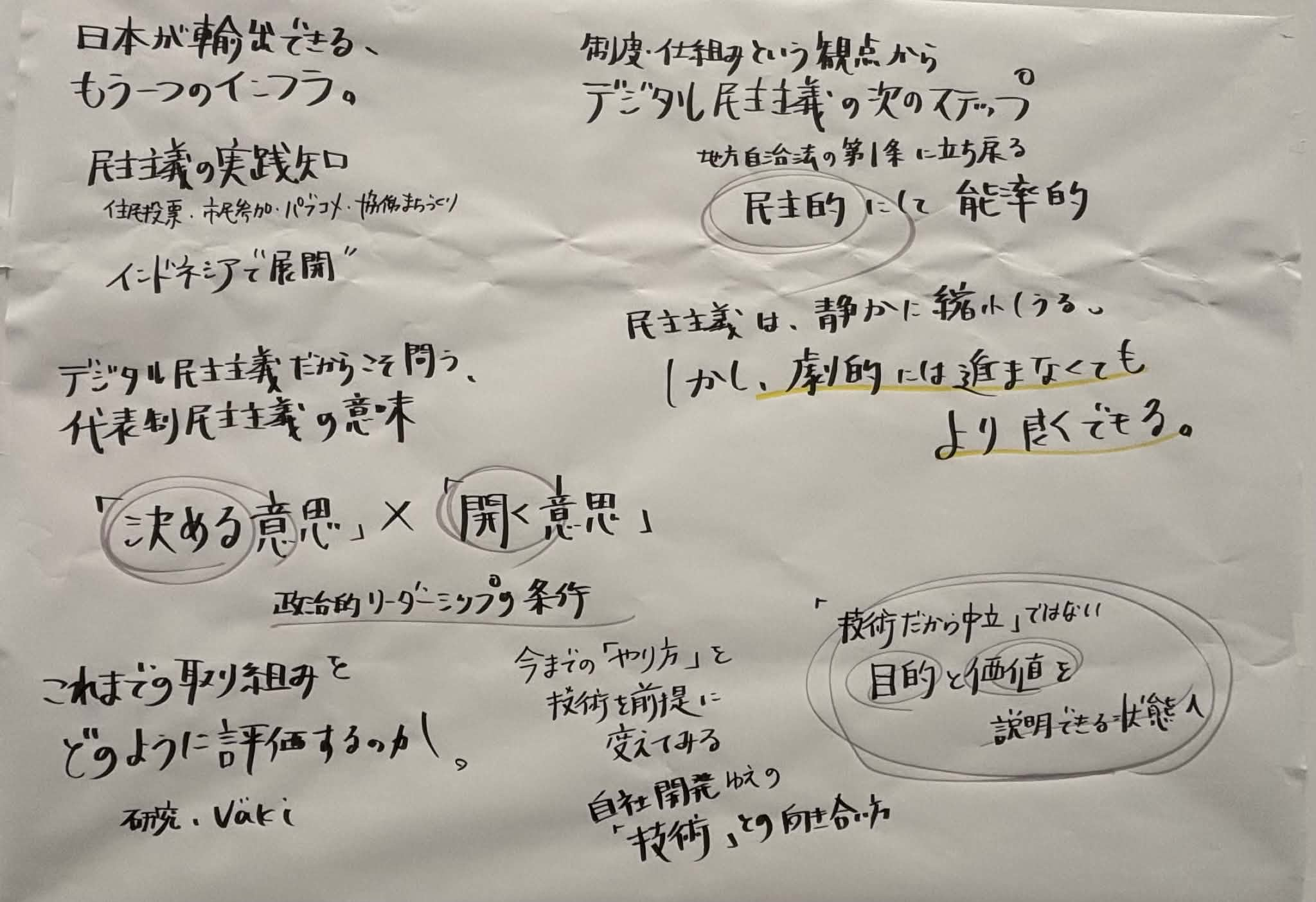
*Created by our senior researcher Reiko Ishimoto.*
(This article has been reorganized and edited for readability based on the speech delivered on the day.)