

Kashiwanoha Smart City
Kashiwanoha Smart City is home to Minna-no-Machizukuri Studio (“Minsta”), a platform for co-creation centered on local residents and involving businesses, government, and universities. Using a living lab approach, residents and other local stakeholders think about their community together and experiment as they create and operate new services and projects. Liquitous works with Minsta to bring in the opinions and ideas of more residents. By introducing Liqlid under the nickname “Minsta ONLINE,” we support the foundations for community development.
Highlights of the Collaboration
⚫︎Building a foundation for ongoing civic participation
Minsta ONLINE covers a wide range of community development topics, including new parks and neighborhood centers, support before and after childbirth, and traffic safety measures. Residents can post opinions and ideas at any time of day, view records of in-person workshops, and follow the progress of discussions. This enables them to join projects whenever their interest arises, building a system that supports continuing participation without requiring attendance at a particular time or place.
⚫︎Complementing existing participation opportunities to broaden and deepen public input
Minsta ONLINE complements existing forms of civic participation, including in-person workshops. During these sessions, participants’ views are gathered and visualized in real time through the platform to deepen the discussion. Online posting also provides a way to participate for people who find attending in person difficult because of time constraints or psychological barriers. Compared with conventional processes in which a small group of participants can dominate, the platform brings together people with more diverse backgrounds and perspectives, increasing the depth and precision of discussion.
⚫︎Using AI to ensure transparency and free up resources for substantive work
AI conducts an initial analysis and structures posted views in real time, speeding up feedback to residents and information sharing with experts. The process of manually collecting and organizing opinions from sticky notes and large sheets of paper has become more efficient, saving time and costs. Staff can devote the freed-up resources to thoughtful replies to residents and multifaceted analysis by experts. Analysis results can be published directly on the platform, ensuring that everyone, including people unable to attend in person, can follow the progress and outcomes of discussions.
About the Area
Centered on Kashiwanoha-campus Station in Kashiwa City, Chiba Prefecture, the Kashiwanoha area has pursued smart city and living lab approaches to community development through collaboration among residents, government, businesses, and academia. At the center of these efforts are Urban Design Center Kashiwa-no-ha (UDCK) and UDCK Town Management. These intermediary community development organizations operate Minna-no-Machizukuri Studio and support the area’s development.
Population: 13,967 (Kashiwa City’s northern central area)
Overview of the Collaboration
Minna-no-Machizukuri Studio began its activities in 2020, launching a living lab approach to creating new projects and services together with residents. The collaboration with Liquitous started as the studio sought a system and platform that could gather and visualize more local voices, including those of residents who find it difficult to speak up.
Platform name: Minsta ONLINE
Partner: Minna-no-Machizukuri Studio (UDCK and UDCK Town Management)
Implementation period: From November 2022
Outcomes and Significance of the Collaboration *1
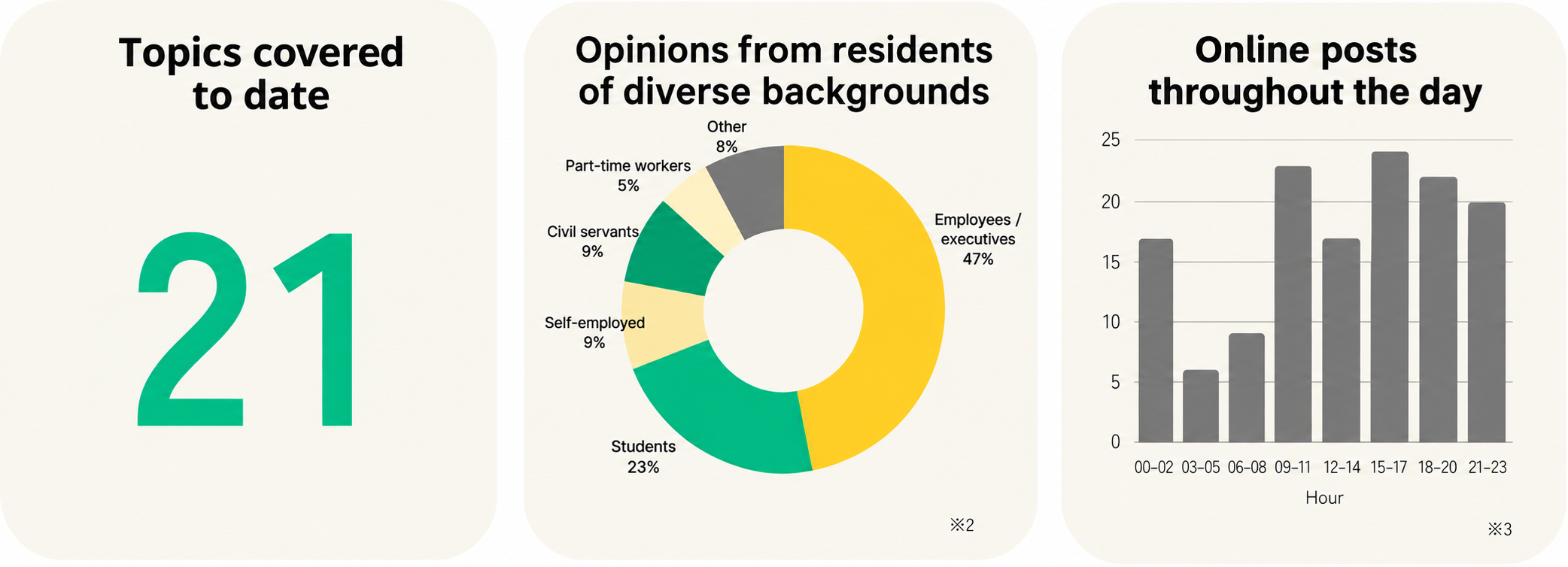
As of July 2026, our collaboration with Kashiwanoha Smart City continues, with an expanding range of activities. Public input and consensus building have addressed 21 themes in total. Residents from a wide range of backgrounds have participated, posting on Minsta ONLINE at different times of day to suit their individual lifestyles.
*1 Figures are based on data as of July 3, 2026.
*2 Demographic figures include only participants who provided this information.
*3 Posting data includes only asynchronous contributions to three Minsta ONLINE spaces: “Making KOIL 16 Gate a Place You Want to Visit More Often,” “Creating a New Park Together,” and “Building Community Support During the Anxious Period Before and After Childbirth.” Contributions made during in-person workshops are excluded.
Below, we introduce concrete outcomes from “Creating a New Park Together,” a project to plan a new park in the Kashiwanoha area with residents, including comments from UDCK and UDCK Town Management.
Overview of “Creating a New Park Together”
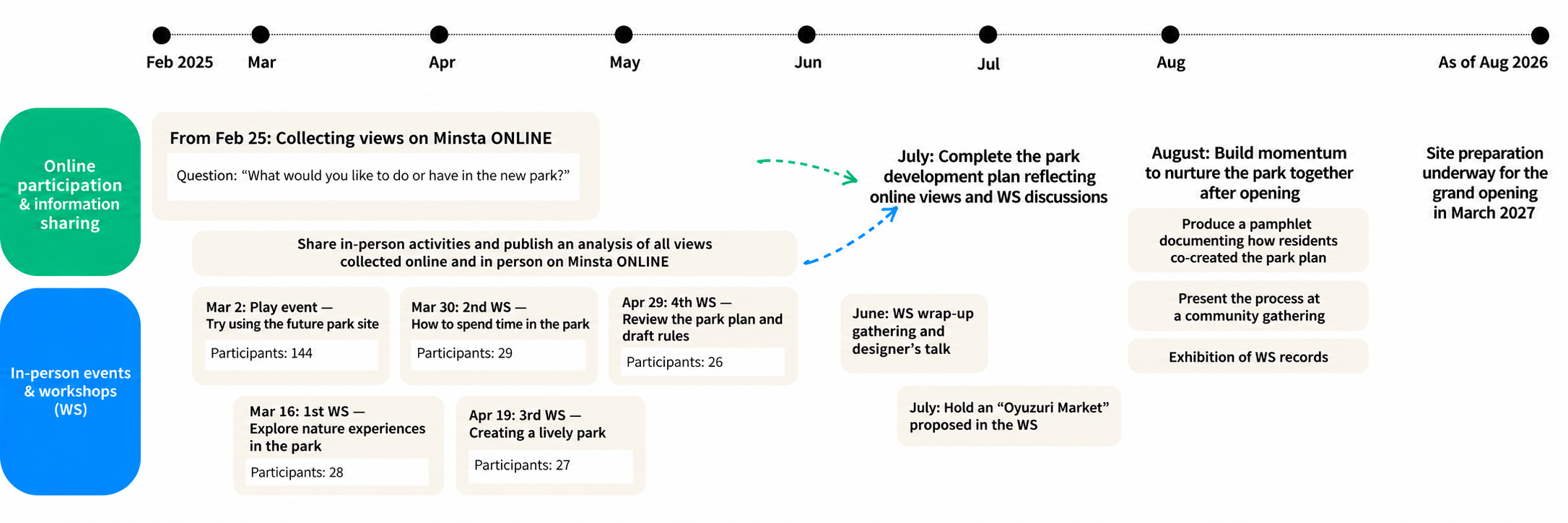
The project gathered views from a broad range of nearby residents and incorporated them into the plan for the new No. 2 Neighborhood Park between Kashiwanoha-campus Station and Kashiwa-Tanaka Station, with the aim of making the park fit more closely into everyday life. By collecting opinions online alongside in-person workshops, the resulting park plan reflects the voices of people from a wider range of ages and backgrounds.
The actual “Creating a New Park Together” project on Minsta ONLINE
Timeline from gathering public input to park development
Concrete Outcomes So Far (as of July 2026)
⚫︎Voices from people unable to attend reshape the park
Unfortunately, it is relatively uncommon for junior and senior high school students to attend community development workshops. To gather their views, this project included a QR code for Minsta ONLINE on flyers distributed through schools. Contributions believed to be from secondary school students included requests for a basketball hoop. These requests were shared at in-person workshops and resonated with parents’ desire for a place where their children could be physically active as they grew older. The views were also taken seriously in subsequent expert discussions. Following design work that considered noise, landscape, and layout, implementation is moving forward with budget provision. Stakeholders describe this as a meaningful example of a process in which residents’ voices change a plan, rather than ending with a simple thank-you for their input.
⚫︎Using dialogue to uncover the concerns behind support and opposition
Some residents concerned about fallen leaves and blocked drainage channels asked that trees not be planted. Others felt trees were needed for shade and contact with nature. Rather than treating this as a simple question of support or opposition, the project used it as an opportunity to discuss why people felt this way. Participants came to understand the concern: “We have struggled with this ourselves, and we do not want new residents to face the same difficulties.” Through dialogue, design options such as limiting tree height and moving trees inward away from park paths were considered. When the plan was shared at the final session, even those who had initially raised concerns reportedly responded with a sense of acceptance.
In Kashiwanoha Smart City, there are hopes for wider use of Minsta ONLINE in community development: not only for resident participation projects, but also as a place to preserve exchanges about local activities and open up project discussions involving government, businesses, and universities. At the same time, stakeholders have shared challenges and expectations for strengthening its role as community infrastructure, including raising awareness of Minsta ONLINE and updating notifications for contributors.
We will continue strengthening this collaboration through practical work and experimentation, so that the real voices of more stakeholders come together to shape Kashiwanoha Smart City.
(Published on July 31, 2026)