

Liquitous updates citizen participation consensus-building platform 'Liqlid' to an 'integrated platform for digital democracy'
Liquitous Inc. (Headquarters: Yokohama City, Kanagawa Prefecture; Representative Director and CEO: Hiroyuki Kurimoto; hereinafter 'the Company') announces an update to its proprietary citizen participation consensus-building platform, 'Liqlid'. In addition to the traditional citizen participation UI (entry point), we have expanded features that support the comprehensive analysis of citizen opinions and their linkage with policies using AI.
With this update, 'Liqlid' has evolved into an 'integrated platform for digital democracy' that supports not only the collection of citizen voices but also their interpretation and reflection into policies and plans as a unified process.
About 'Liqlid'
'Liqlid' is a citizen participation consensus-building platform developed in-house by Liquitous, based on the concept of 'deliberate discussion and solid decision-making'.
As a digital infrastructure for democracy that connects citizens and the administration, supporting everything from opinion solicitation and discussion to consensus building and policy reflection, it is utilized by local governments across the country.
The overall vision of 'Liqlid' — From the 'UI' of citizen participation to integrated analysis, completing the process on a single foundation: an efficient and effective foundation for participation and co-creation
Citizen participation is not complete simply by 'collecting opinions'. Satisfaction and trust are born only when it is visible how the collected voices are organized, discussed, and reflected into plans and measures.
On the other hand, in the field, as the volume and diversity of citizen voices rapidly increase, there have been many reports that the work of organizing, analyzing, and translating these into policies has become a significant burden for staff.
Therefore, to enable Liqlid to support the process from the 'entry point' to 'incorporation into policy', we have integrated and strengthened the following two elements.
Citizen Participation UI (Entry Point): Practical operations such as participation, posting, discussion, and voting
Integrated Analysis Foundation (Analysis & Visualization): Supporting issue organization, visualization, and reflection consideration using AI
Update 1: Strengthening the Citizen Participation UI (Entry Point) (Improving ease of operation)
We provide a UI for citizen participation that allows for a consistent flow designed from information provision by the administration to citizens, through opinion solicitation, discussion, and voting.
Based on our traditional strength in citizen participation operation functions (information provision / opinion solicitation / discussion / voting, etc.), we have developed more flexible pathways for planning and operation.
Main Features
Information provision from the administration to citizens
Divergent opinion solicitation (idea solicitation / voting)
Public comments
Participatory budgeting
Questionnaire forms
In particular, we have significantly expanded the functionality of the general-purpose questionnaire form feature that has been available from before, allowing staff to flexibly set questions themselves.
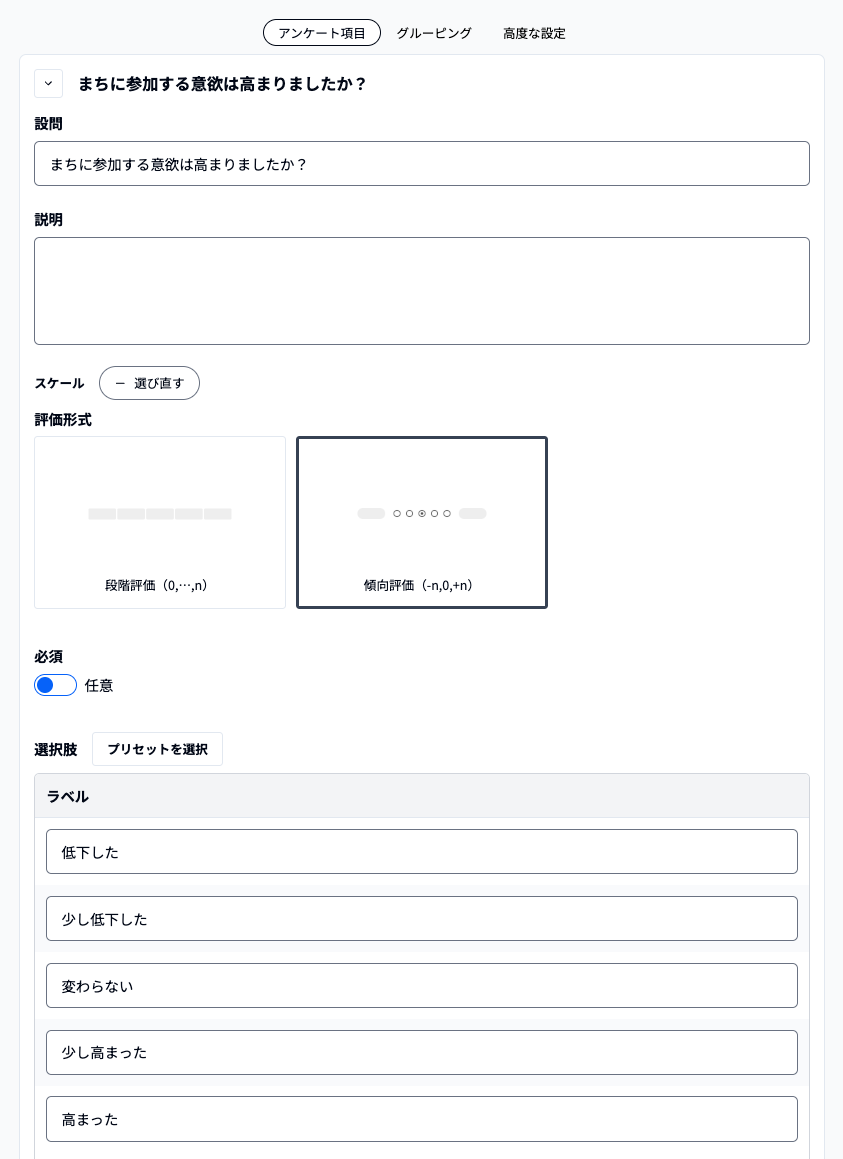
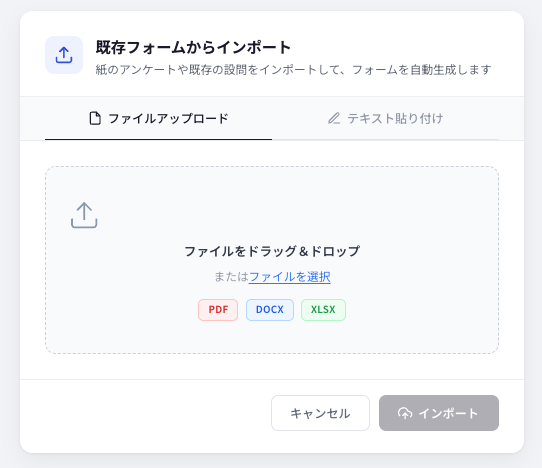
Furthermore, during the 2025 fiscal year (Reiwa 7), we began initiatives such as the 'Kodomo Wakamono Voice Action' in Amagasaki City using Liqlid, which involves participatory fund allocation. In connection with this, we have expanded the user interface and features for 'participatory budgeting' to broadly solicit citizen opinions for the selection of subsidy recipients and budget consideration.
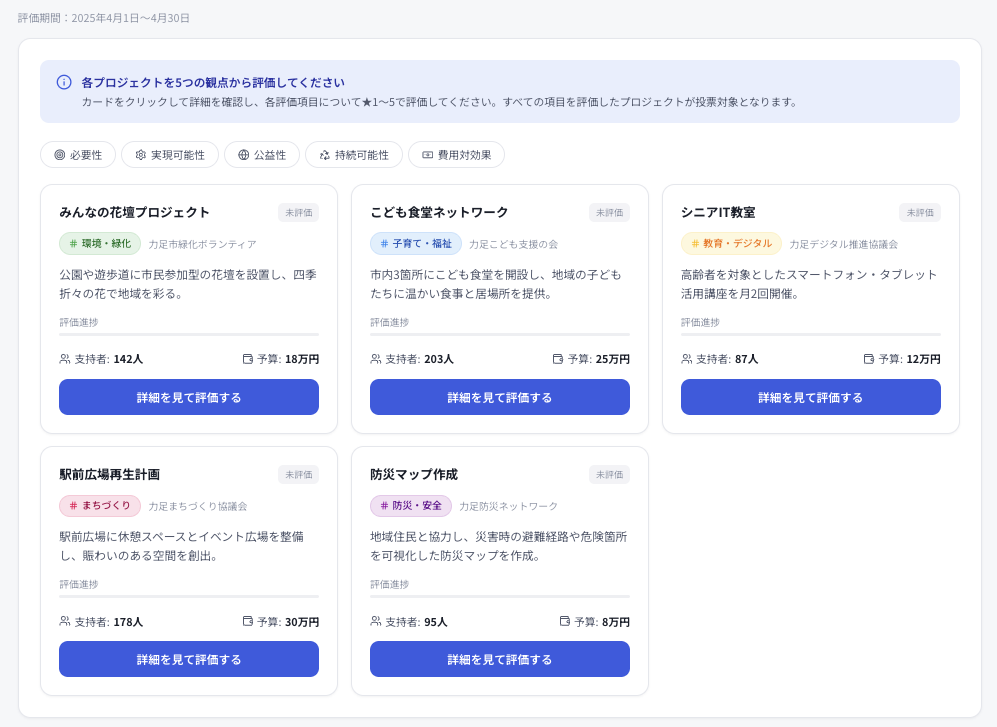
As an 'entry point' that is easy for citizens to participate in and easy for administrative staff to operate, it supports citizen participation processes in various regions.
Update 2: Expansion of the Integrated Analysis Foundation (AI Analysis & Visualization) (Strongly supporting from issue organization to reflection consideration)
As the volume of citizen opinions increases, it becomes difficult not only to 'aggregate' or 'classify' them, but also to grasp the overall picture of issues, understand relationships, and translate them into measures.
In this update, we have expanded analysis functions that utilize AI (LLM / Natural Language Processing, etc.) to create room for responsible staff to focus on consideration.
This enables grasping the overall picture, understanding the relationships between issues, and incorporating them into policies in a manner that can be justified and accounted for, rather than limiting large volumes of citizen opinions to mere aggregation.
What can be done with Integrated Analysis (Examples)
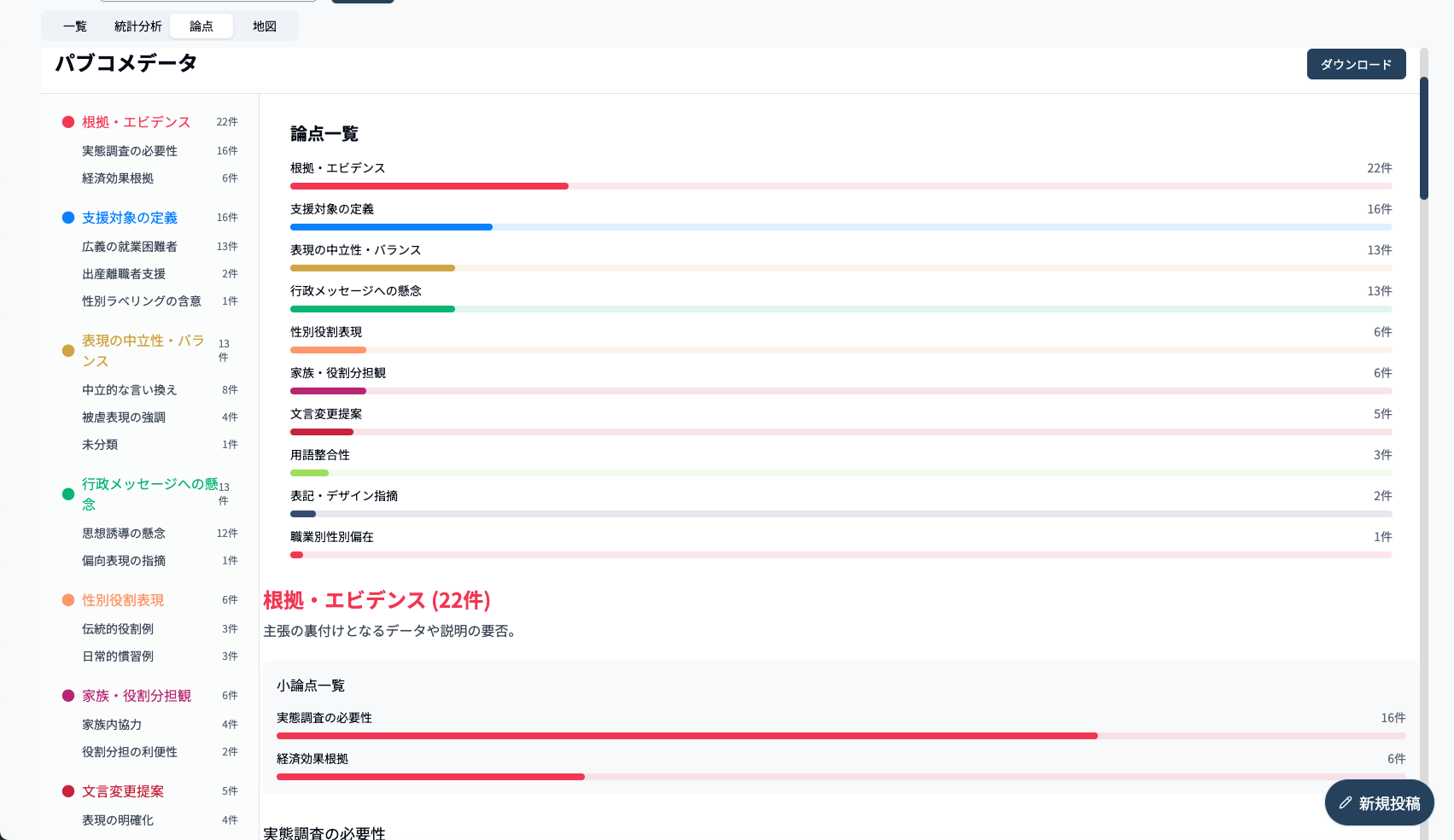
① Analysis of 'Major Issues' and 'Minor Issues' (Issue Analysis Function)
Analyzes posts and transcription texts to automatically organize major issues
Hierarchizes and lists major and minor issues, visualizing post counts and trends
Ensures the accuracy and explainability of issue organization by checking against the original text
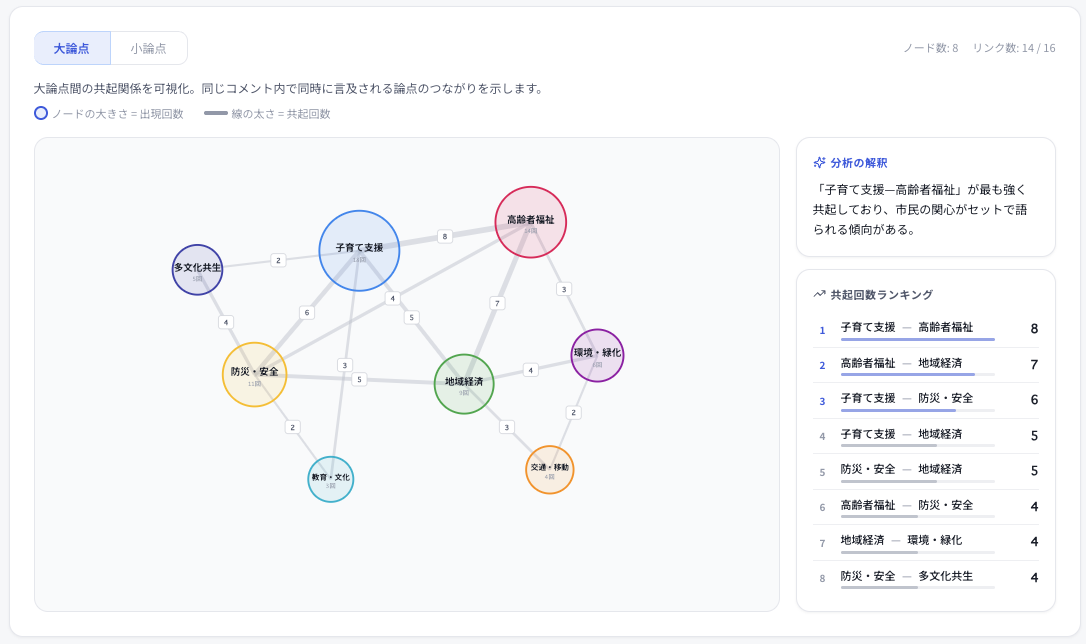
② Visualizing which major/minor issues are frequently mentioned in relation to each other (Relationship Visualization)
Displays the 'connections' between issues as a network
Supports understanding the frameworks of perception held by participating citizens
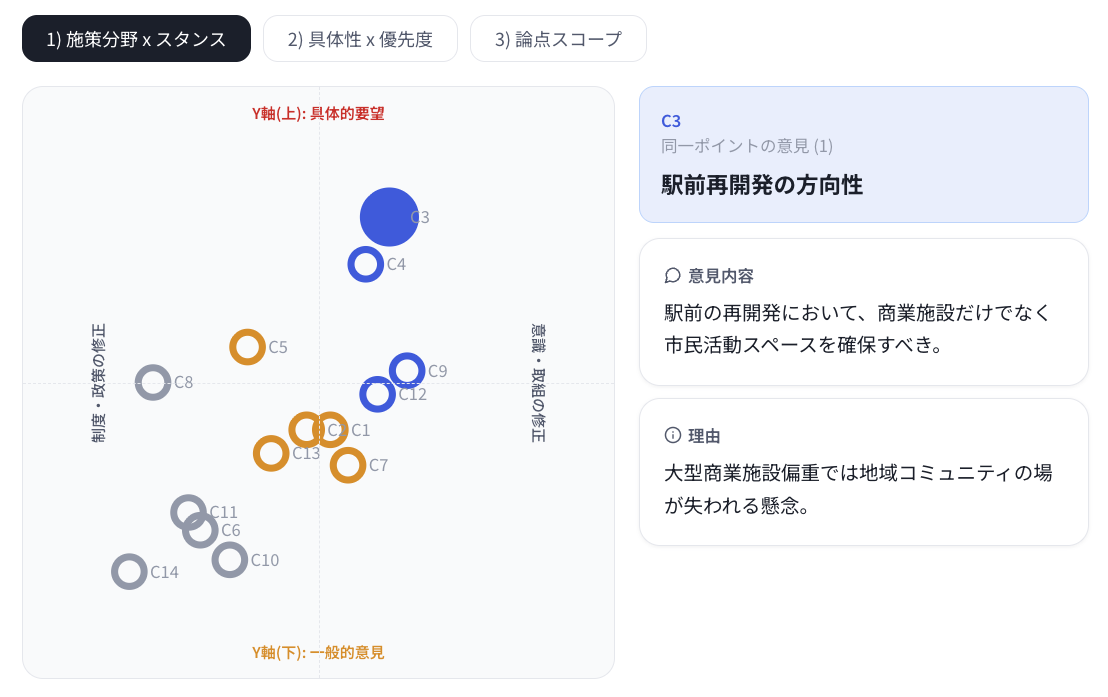
③ Visualization of citizen opinion trends through 4-quadrant classification
Organizes the distribution of opinions across multiple axes to grasp clusters and biases
Supports identifying areas that should be explored in depth and areas requiring additional research
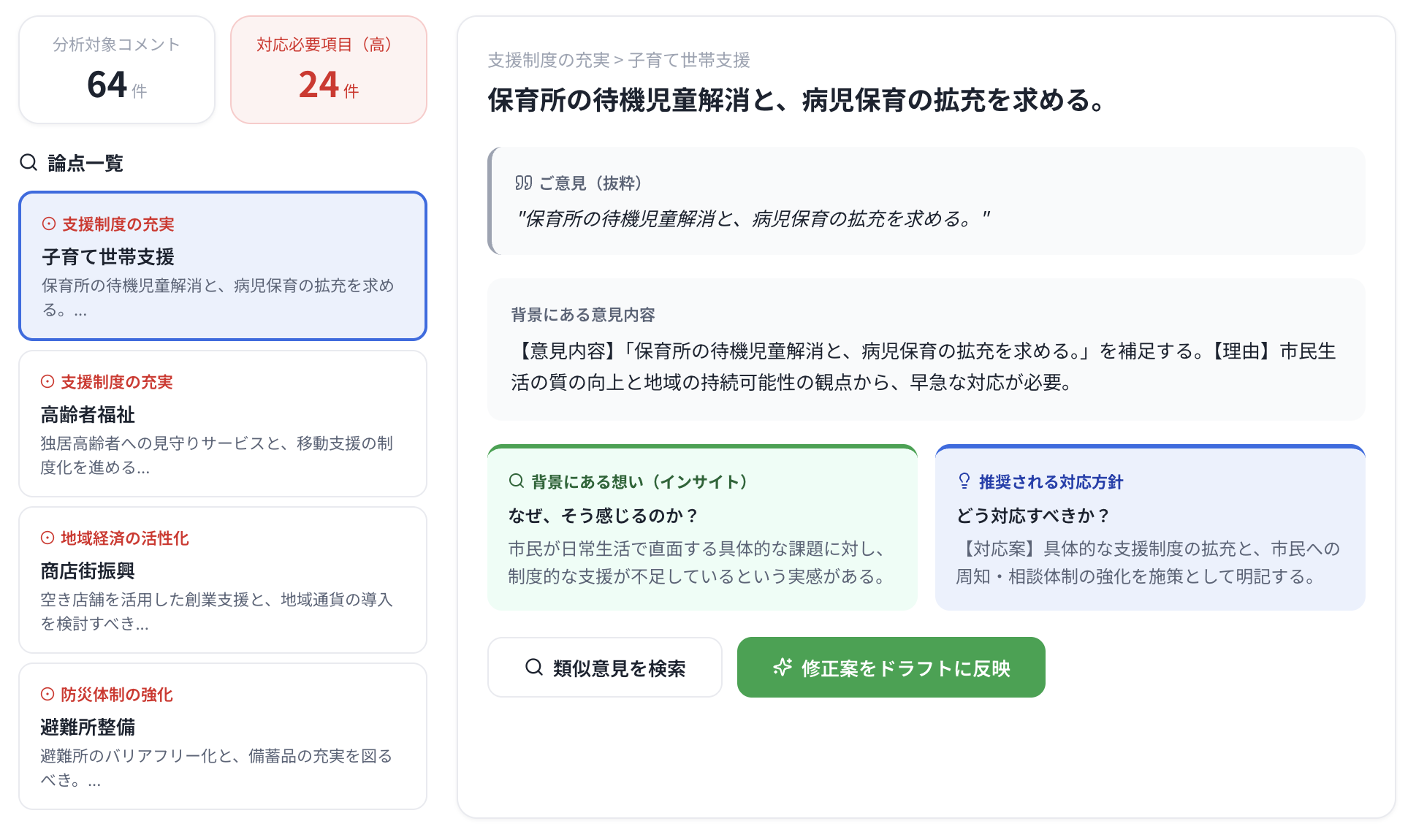
④ Prediction of background sentiments for each post and suggestions for incorporating opinions into draft plans, etc. (Policy Incorporation Suggestions)
Proposes consideration perspectives and directions for reflection based on the background context and sentiment trends of posts
Utilized for linking with plan drafts, and for organizing issues in explanatory materials, FAQs, and feedback
⑤ Linking with plan drafts, etc. (Organized by measure system / chapter structure)
Visualizes which parts of the materials explaining the solicited theme (such as plan drafts) the discussions on posted opinions are linked to.
May contribute to reducing the psychological burden on staff.
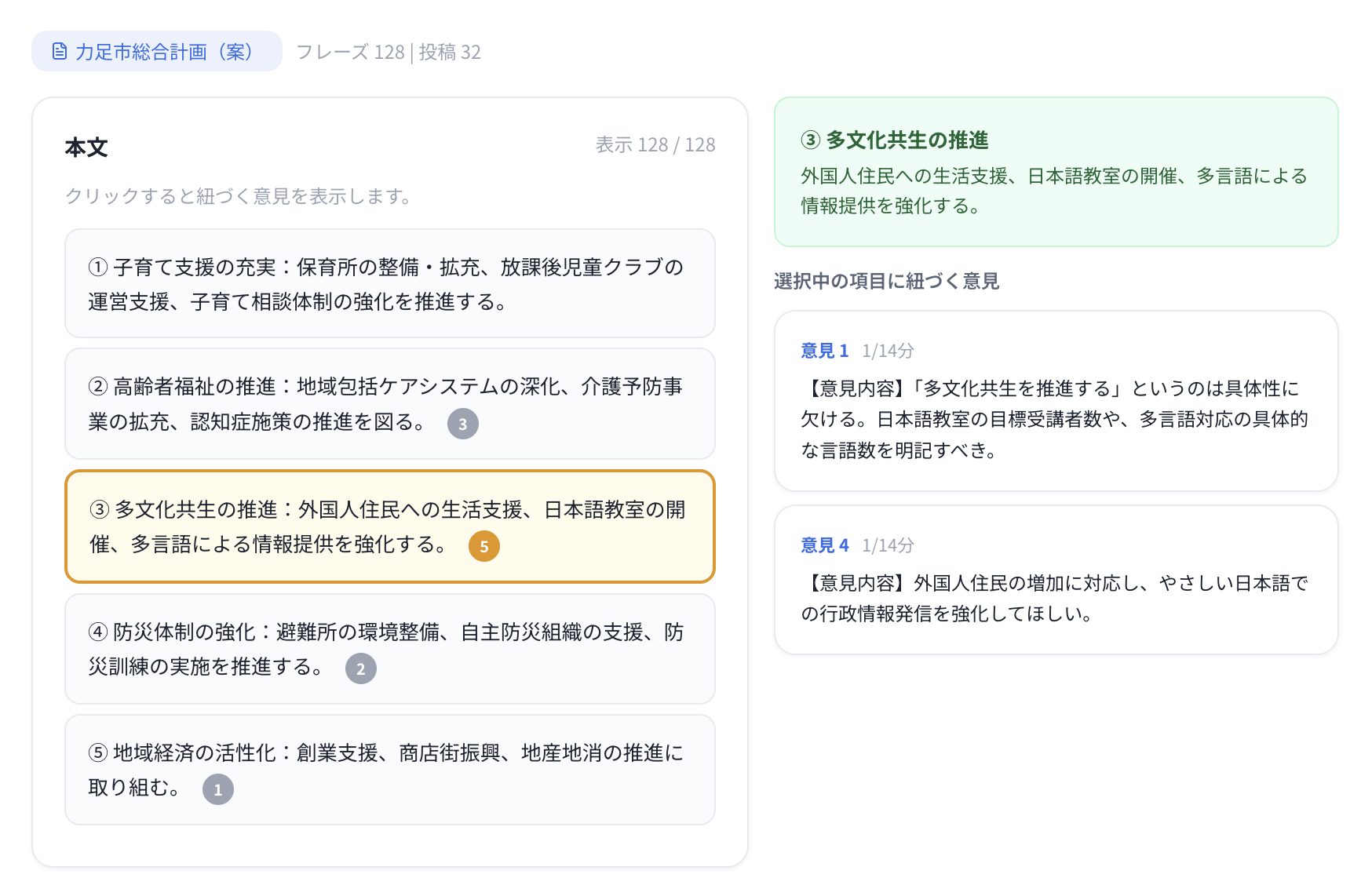
This is a group of functions aimed at utilizing 'collected voices' not as mere aggregation, but in a form that supports EBPM (Evidence-Based Policy Making) and meets accountability requirements.
Update 3: Expansion of Operational Knowledge and AI-based Configuration Support
We have also strengthened support functions to make Liqlid easier for administrative staff to operate. The administrator resource screen provided to all local government administrators allows users to check web manuals with FAQs, case studies for local governments, and release notes all in one place.
The web manual organizes not only how to operate Liqlid, but also the significance of citizen participation, process design for dialogue and co-creation, and question design, which are necessary for staff to plan and operate citizen participation. Furthermore, by summarizing frequently asked questions as FAQs, we have made it easier to check points where users may hesitate during configuration or operation. Case studies allow reference to the purposes of utilization and operational points in other local governments. Release notes allow continuous tracking of new Liqlid features and daily improvements.
In addition, as the first phase of configuration support AI, we are trial-providing Space Creation Support AI to all local governments. When staff input the purpose and background of opinion solicitation in natural language, the AI generates a space composition proposal including premise information for the entire space, opinion solicitation page, voting page, information provision page, and participation pathways. Staff can review the proposal, create it as a private space, make necessary adjustments, and then publish it.
In the future, we plan to expand functions to support everything from reviewing ongoing operations to creating premise information that is easy for participants to understand, starting from the Space Creation Support AI.
About Information Security
Our company has obtained ISO/IEC 27001 (ISMS) as an information security management system. In addition, we are also progressing preparations to obtain additional third‑party certifications.
Budgetary impact: cost reductions also achieved by revising budget requests for the initial FY 2026 (Reiwa 8) budget formulation process.
In multiple municipalities, these new Liqlid functions enabled the consolidation of items in departmental budget requests related to citizen opinion gathering and analysis during the preparation of the initial FY 2026 budget.
Previously, items related to gathering citizen opinions for plan formulation were requested by each department individually. Instead of demanding them separately for each initiative, we have centralized opinion solicitation and analysis in Liqlid, allowing a review of the request items from each department and optimization of outsourced items during the budget formulation process, thereby introducing Liqlid without increasing the overall budget or achieving cost reductions through its implementation. Moreover, by centralizing opinion solicitation and analysis in Liqlid, we also intend to standardize the data.
Comment from Liquitous Co., Ltd. CEO Hiroyuki Kurimoto
Over the past few years, Liqlid has spread across municipalities nationwide as a citizen participation interface, becoming a platform used daily by many residents and government staff. While it is becoming established as an entry point for opinion gathering and dialogue, we have also heard many practitioners say that as the volume and diversity of citizens’ voices grow rapidly, the next major challenge is how to organize, analyze, and incorporate them into policy.
With this update, our aim was to go beyond providing a space for citizen participation and build a foundation that connects the entire process of handling citizens’ voices.
Integrated analysis functions using AI create an environment where issue structuring and trend analysis, which previously required outsourcing, can be carried out within government as part of everyday work. This goes beyond reducing costs: it enables staff to spend their time considering how to reflect citizens’ opinions in policy, which should be their central focus, instead of compiling data.
Liqlid is not a tool for delegating decisions to AI. It is a foundation that, while returning to the original text to ensure explainability and credibility, draws a “guideline” to harness citizens’ voices in policy formation. Building on Liqlid’s expansion as a citizen‑participation UI, we intend through this update to further advance the implementation of digital democracy in a way that is rooted in the practical work of each local government.