
Sakata City
In Sakata City, the participatory consensus-building platform Liqlid is being used across a range of themes, including planning for a new compulsory education school, the regional public transportation plan, and the policy for revitalizing the downtown area. Through a repeated “catch-ball of dialogue” between information shared by the administration and ideas gathered from residents, the city is beginning to see futures for the community that were difficult to envision through conventional methods alone.
Highlights of the Collaboration
⚫︎ An iterative dialogue environment with a wide range of residents
Liqlid was introduced under the nickname “SakaPos,” creating a transparent environment in which city plans and issues can be shared openly with residents. Voices are collected from the earliest stage of planning, then reflected quickly in revised drafts that are presented back to the public, establishing an iterative communication process. By making the internet the main participation channel and designing an intuitive interface, the city has also built a system that makes it easier for younger people, who often found conventional participation methods difficult, to take part in social decision-making.
⚫︎ Multi-angled civic dialogue across departmental boundaries
In Sakata City, Liqlid is being used across multiple departments for projects such as the public transportation plan, school consolidation and compulsory education school policy, and the “Downtown Grand Design,” which sets the direction for revitalizing the Nakamachi area. In other words, Liqlid is being applied across the administration in a wide variety of contexts.
⚫︎ Using AI to visualize key issues instantly and create room for policy work
By analyzing the many comments submitted through SakaPos with AI, the city can quickly identify major discussion points and overall opinion trends. As a result, much of the administrative workload previously required for manual entry and tabulation of paper surveys has been eliminated. This efficiency gain is not just about reducing costs. It also helps staff secure time to think more deeply about how diverse public voices can be translated into concrete policies and plans.
About the Municipality
Sakata is a coastal city in the northwestern part of Yamagata Prefecture. It developed as a merchant town once described as “Sakai in the west, Sakata in the east,” and it is also one of Japan’s leading rice-producing areas thanks to the fertile Shonai Plain.
Population: 91,979
Households: 42,143
(As of January 31, 2026)
Based on the Sakata City Comprehensive Plan (Latter-Term Plan), the city has been promoting community development in which residents and the administration share a common vision and work together. At the same time, it had been exploring better ways to strengthen public communication and create broader opportunities for citizen participation and collaboration.
Overview of the Collaboration
Liquitous introduced its participatory consensus-building platform, Liqlid, as a pilot under the nickname “SakaPos.” Based on the Sakata City Comprehensive Plan (Latter-Term Plan), the city now has an environment that shares policies and issues transparently with residents while also enabling wide-ranging public feedback. The collaboration also designed a process for quickly analyzing and reflecting collected views, supporting both plan formulation and project implementation through two-way communication.
Platform name: SakaPos
Responsible departments: Urban Design Division, Planning and Management Division
Implementation period: From July 2025
Outcomes and Significance of the Collaboration
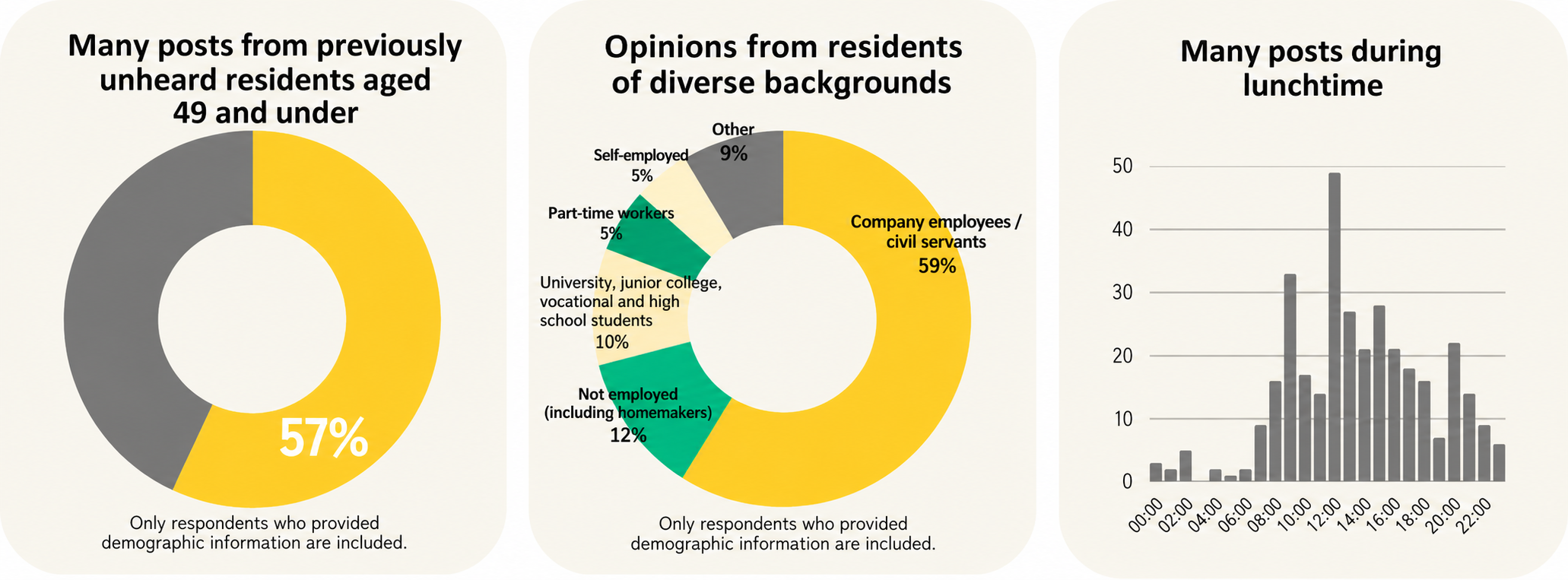
As of March 2026, Sakata City’s collaboration with Liquitous is continuing to expand. More than half of all contributors are in their 40s or younger, and participation includes company employees, public servants, homemakers and other non-employed residents, students, and many other groups.
Below, we introduce the outline and progress to date of the “Downtown Grand Design” project for the Nakamachi area, which uses SakaPos to shape a revitalization policy for the city center. We also share concrete feedback from the Urban Design Division, which has been leading the project.
Overview of the “Sakata City Downtown Grand Design”
SakaPos was used in the process of formulating the “Sakata City Downtown Grand Design,” which sets out the future vision and concrete measures for turning the Nakamachi city-center area back into a lively place where people gather and move through the city.
▶︎ The actual “Sakata City Downtown Grand Design” project on SakaPos
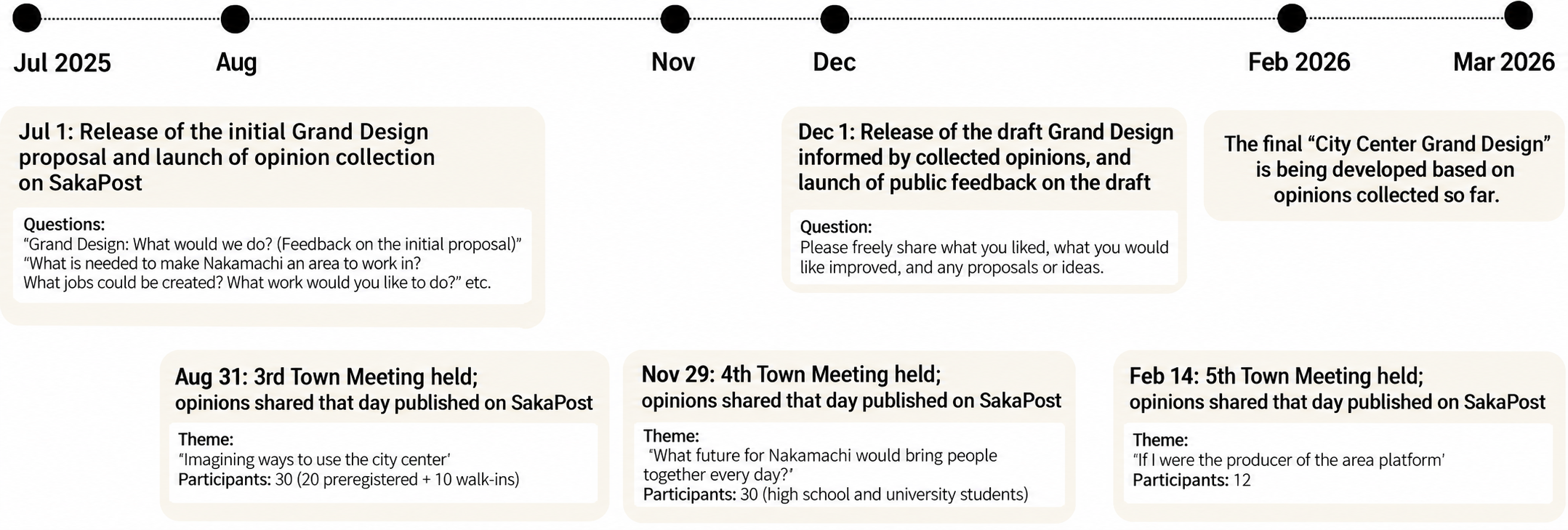
Project timeline
Concrete Outcomes So Far (as of March 2026)
⚫︎ Two-way communication and visualization of public opinion
In this planning process, the city first presented an initial draft and broadly gathered ideas from residents about “working,” “living,” and “comfort” in the Nakamachi area. Those views, collected both at town meetings and online, were organized into a draft plan, and residents were then asked to provide feedback on that draft as well. This created a genuinely two-way communication process. According to staff from the Urban Design Division, the process reinforced their belief that “a catch-ball of dialogue with residents is essential after all.” Unlike conventional paper surveys, SakaPos also makes other people’s views visible. That means the platform appears to have functioned not only as a place for dialogue between government and residents, but also as a place where residents could see and refer to one another’s perspectives.
⚫︎ Less administrative burden creates the possibility for more dialogue
Traditional paper surveys required major administrative effort, time, and outsourcing costs to input and tabulate large volumes of responses. By using the AI built into SakaPos, those input and aggregation processes were streamlined significantly, making it possible to identify major issue trends almost instantly. Staff members said they felt that “there is real potential to increase both the quality and frequency of dialogue while keeping administrative and financial burdens under control.”
⚫︎ More concrete planning through the articulation of residents’ needs
Through this dialogue, city staff said they were reassured by being able to confirm that many residents genuinely want to visit and spend time in the Nakamachi area. Listening directly to residents also brought specific needs to the surface, such as parking, spaces for young people, and facilities for families raising children, all of which have been reflected in the Downtown Grand Design. In this way, residents’ real voices added substance to the original planning framework and helped update it into a stronger plan for revitalizing the Nakamachi area.
Sakata City and Liquitous plan to continue and expand this collaboration. The city will keep reflecting residents’ views into plans and project proposals across a wider range of themes.
One concrete challenge now being discussed is how to design the platform so that residents remain engaged even when the opinion-gathering period lasts a long time. Going forward, we will continue refining operations and building an environment in which even more residents feel motivated to contribute their views proactively.
(Published on April 3, 2026)