

Nagaokakyo City
In Nagaokakyo City, the participatory consensus-building platform Liqlid is being used across the administration for work such as formulating the city’s comprehensive plan and shaping the renewal of a well-loved walking path. Voices from residents who were previously hard to reach through conventional methods are now being incorporated from the planning stage onward, helping move projects and policies toward concrete implementation.
Highlights of the Collaboration
⚫︎ Building transparency and a cycle of dialogue
Starting in FY2024, Liqlid was introduced as a pilot under the name “Voice NAGAOKAKYO.” The city began carefully sharing the background behind ongoing plans and policies, as well as the administration’s thinking, creating a shared information foundation on which residents can offer opinions. The city also repeatedly publishes analysis results and interim drafts, then invites further feedback, building an environment aimed at more widely accepted and better-informed consensus building.
⚫︎ Organization-wide use, from expanding participation opportunities to comprehensive planning
The use of “Voice NAGAOKAKYO” has steadily expanded, and full cross-departmental rollout began in FY2026. The platform has broadened online access to “Taiwa no Wa,” a forum where residents can speak directly with the mayor. It is also being used to shape the renewal of the “Inugawa Walking Path,” a familiar local place for relaxation, and to formulate the 3rd phase of the basic plan under Nagaokakyo City’s 4th Comprehensive Plan.
⚫︎ More advanced analysis with AI and a shift toward the work that matters most
On “Voice NAGAOKAKYO,” AI is used to aggregate and analyze public comments, reducing staff workload. This goes beyond simple efficiency gains in clerical work: it creates room for the more essential work of deciding how diverse public voices should be connected to concrete policies and plans.
About the Municipality
Nagaokakyo City lies in the southwest of Kyoto Prefecture. It offers excellent access to both Kyoto and Osaka while also being home to historical assets such as Nagaoka Tenmangu Shrine.
Population: 81,944
Households: 38,352
(As of February 1, 2026)
For some time, Nagaokakyo City has focused on using residents’ voices in community development. One example is “Taiwa no Wa,” an ongoing initiative in which the mayor directly visits neighborhoods and community groups to listen in person. While the city values this careful face-to-face approach, it had also been searching for new methods that could reach people who were harder to engage through traditional frameworks and bring more diverse perspectives into policy design.
Overview of the Collaboration
Liquitous installed its participatory consensus-building platform Liqlid under the nickname “Voice NAGAOKAKYO.” By using the platform, the city established a process for gathering, analyzing, and reflecting residents’ opinions so that policy-making and community development can more fully respond to public voices.
Platform name: Voice NAGAOKAKYO
Responsible department: Division of Community Autonomy and Mutual Support (platform owner)
Using departments: Secretary Division, Comprehensive Planning Promotion Division, Road and River Division, and others
Collaboration period: From September 2024
Outcomes and Significance of the Collaboration
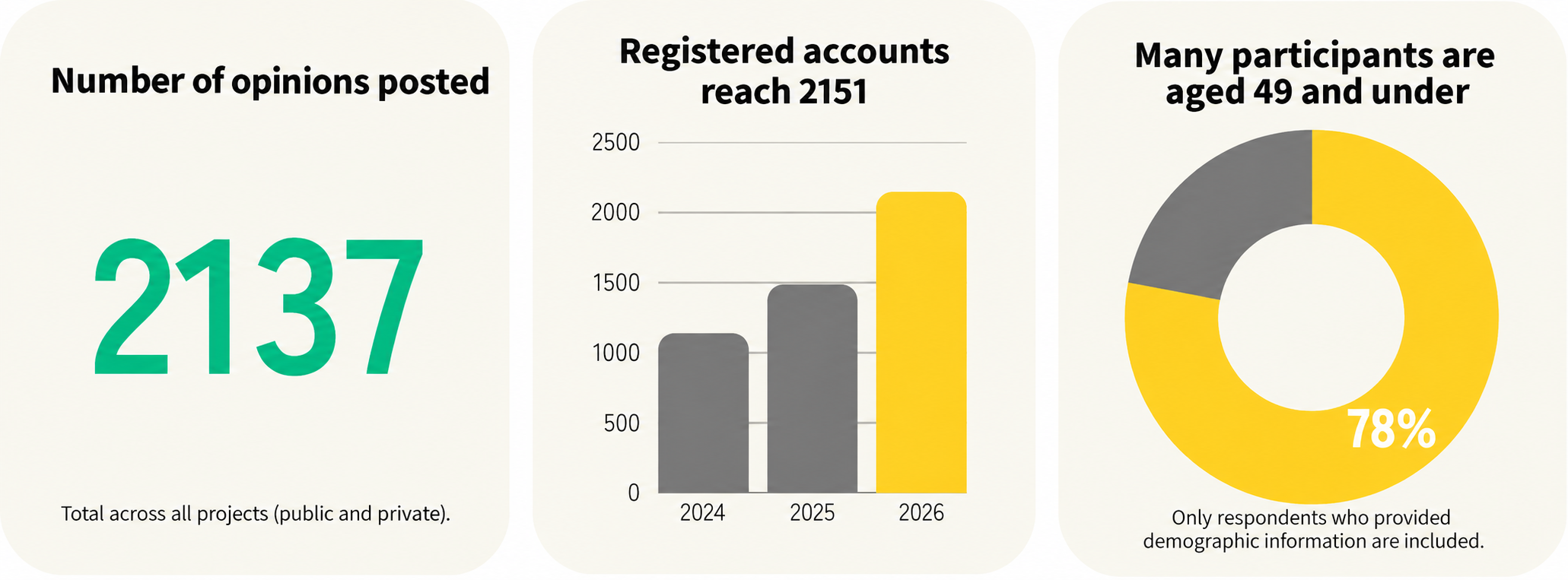
As of March 2026, the collaboration with Nagaokakyo City is ongoing and continuing to expand. The platform has received roughly 2,150 public comments and around 5,000 likes on those comments. Among participants, 78% of posts have come from residents in their 40s or younger.
Below, we introduce the concrete outcomes of the project to formulate the renewal plan for the “Inugawa Walking Path,” a familiar place of relaxation for Nagaokakyo residents, together with comments from the Road and River Division.
The “Inugawa Walking Path Renewal” Project
The “Inugawa Walking Path,” which runs from Kaiden 4-chome to Kotari 3-chome in Nagaokakyo City, has long been a cherished local place for strolling and relaxation. About 20 years had passed since the previous improvement work, and the pavement and other elements had begun to deteriorate, leading to plans for renewal. “Voice NAGAOKAKYO” was used to incorporate residents’ views into the renewal proposal.
▶︎ The actual “Inugawa Walking Path Renewal” project on Voice NAGAOKAKYO
Project timeline
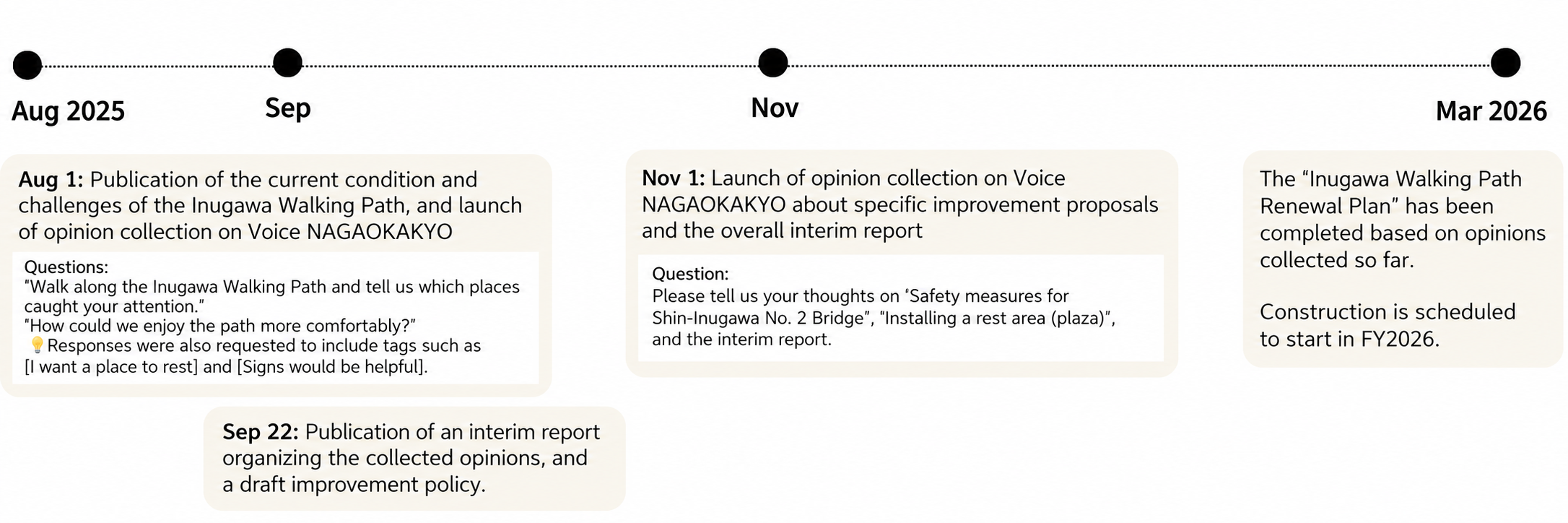
Concrete Outcomes So Far (as of March 2026)
⚫︎ Making the “silent majority” visible and boosting staff motivation
In the past, civil engineering projects mainly gathered views through briefings, conversations with nearby residents, and requests relayed by council members. By using “Voice NAGAOKAKYO” this time, the city was able to hear from people who previously had few opportunities to share their views. Staff members also reported that some residents highly appreciated the initiative, which became a major source of encouragement and helped nurture a new relationship of trust between the administration and citizens.
⚫︎ Reducing the burden of aggregation and analysis through AI
Although there is an initial operational cost in introducing a new platform, the platform has greatly reduced the time required for tabulation and analysis compared with conventional paper surveys. AI also makes it possible to structure incoming comments immediately, and staff said they could “grasp opinion trends at a glance.” As simple clerical work is reduced, the city is building capacity to spend more time on the work that matters most: deciding how to use the voices received in actual policy.
⚫︎ A new improvement direction led by residents’ voices
For this renewal project, the city asked residents for input even before drafting a plan. People were invited to share places on the walking path that stood out to them and ideas for making it more enjoyable. Based on that feedback, the city published an improvement policy as an interim report, and residents were then invited to comment on that policy as well. The process has been carefully iterative. As one staff member put it, if the work had stayed entirely within the Road and River Division, the project might have ended as a routine maintenance and repair effort. Instead, residents’ voices are helping the city discover a new direction for roadway improvement.
As the use of “Voice NAGAOKAKYO” advances, city staff have also raised more fundamental questions, such as: How can minority opinions be respected more fully? What kinds of questions best draw out residents’ views? How should teams address AI hallucinations?
We see these not as side effects after introducing a tool, but as part of the challenge of democratic consensus building itself. Rather than simply providing a system, we will continue sharing in the realities and tensions on the ground and working with Nagaokakyo City to find practical answers to each issue step by step.
(Published on April 3, 2026)